Before you start
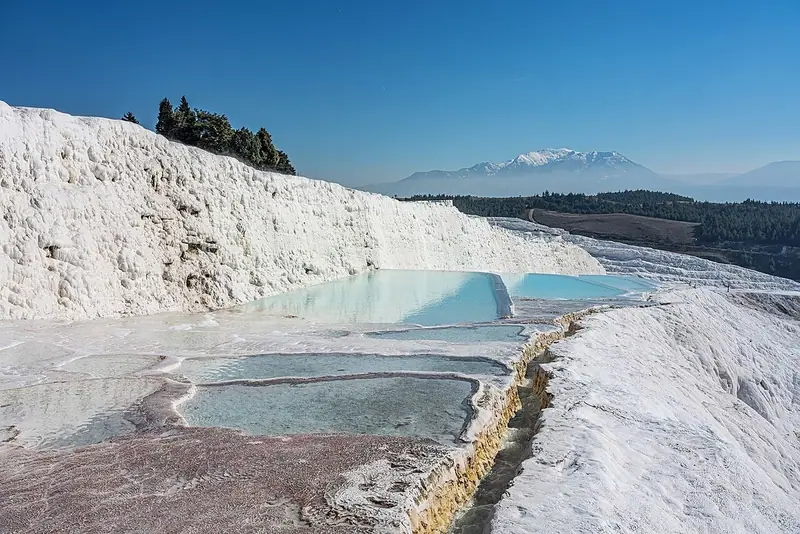
Pamukkale, the Cotton Castle, is a hillside of brilliant white travertine terraces above the village of the same name, about 20 kilometres north of Denizli in south-western Turkey. On the plateau above lie the ruins of Hierapolis, a Greek and Roman spa city built around the same hot springs. Hierapolis-Pamukkale has been a UNESCO World Heritage Site since 1988, listed for both its natural and its cultural value, and is managed by the Turkish Ministry of Culture and Tourism. This guide starts at the North Gate and follows the natural visiting order southwards: through the great Northern Necropolis, the Frontinus Gate and the main street, up to the Martyrium of St Philip, back down to the theatre, the Temple of Apollo and the Plutonium, then the Antique Pool and the museum, finishing on the travertines in the late afternoon light. If you come up from the village instead, simply follow it in reverse.
Use it as a self-guided tour of Pamukkale & Hierapolis: 9 stops in visit order, each played when you’re ready, at your own pace.
 Free preview · Stop 1
Northern Necropolis
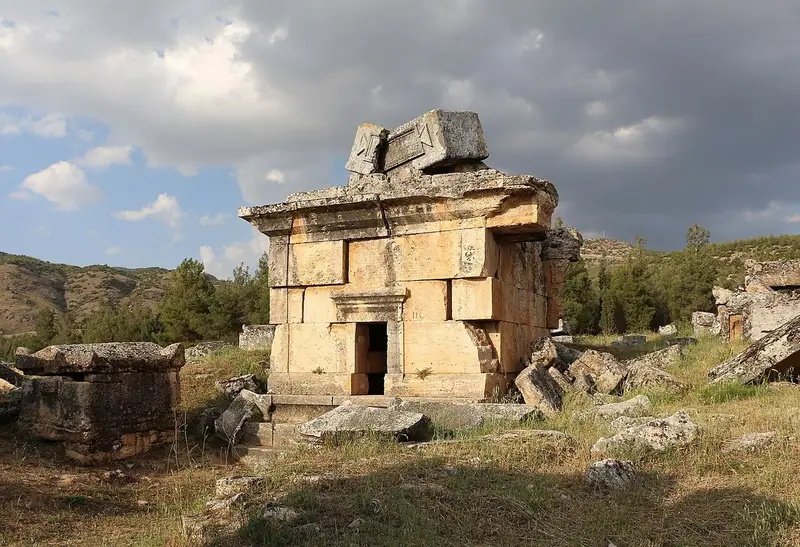
From the North Gate the road runs for well over a kilometre through the Northern Necropolis, one of the largest ancient cemeteries in Anatolia. More than twelve hundred tombs have been recorded around the city, and many of them line this road. Romans buried their dead outside the city walls, along the main approaches, so that travellers would pass the monuments of local families and remember them. Look out for the different types: simple stone sarcophagi on platforms, house-shaped tombs with gabled roofs, and round tumuli with passages leading into burial chambers. Many people came to Hierapolis hoping that the thermal waters would cure their illnesses, and some of them never left, which may explain the size of the cemetery. Read the inscriptions if you can: some record the trades of the dead, or warn against reusing the tomb.
Photo: Bernard Gagnon · CC BY-SA 3.0 · Wikimedia Commons
What to see at Pamukkale & Hierapolis: 9 stops, in visit order
- 01
 Northern NecropolisKuzey NekropolüFree preview
- 02
 Frontinus GateFrontinus KapısıIn the guide
- 03
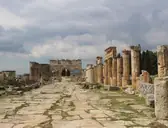 Frontinus StreetFrontinus CaddesiIn the guide
- 04
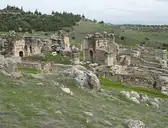 Martyrium of St PhilipAziz Philip MartyrionuIn the guide
- 05
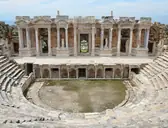 The TheatreTiyatroIn the guide
- 06
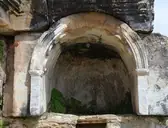 Temple of Apollo and PlutoniumApollon Tapınağı ve PlutonionIn the guide
- 07
 The Antique PoolAntik HavuzIn the guide
- 08
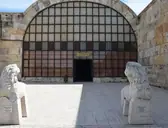 Hierapolis MuseumHierapolis Arkeoloji MüzesiIn the guide
- 09
 The TravertinesTravertenlerIn the guide
Site map of Pamukkale & Hierapolis
History of Pamukkale & Hierapolis
Nature built Pamukkale: hot, mineral-rich water rises from the springs on the plateau, and as it cools and loses carbon dioxide it deposits calcium carbonate, creating the white terraces over thousands of years. People built Hierapolis, the ‘Holy City’. It was founded in the early second century BCE by the Attalid kings of Pergamon, a Hellenistic Greek dynasty that ruled much of western Anatolia from 281 to 133 BCE, when their last king bequeathed his kingdom to Rome. Under the Roman Empire the city flourished as a spa and textile centre. After a severe earthquake in 60 CE it was rebuilt on a grand scale, and most of what you see dates from the first to the third centuries. In Byzantine times, from the fourth century, it became an important Christian centre, honouring St Philip the Apostle, who was said to have been martyred here.
The full history continues in the guide.
Pamukkale & Hierapolis guide: questions
How many stops does the Pamukkale & Hierapolis guide have?
9 stops, in visit order: 1. Northern Necropolis; 2. Frontinus Gate; 3. Frontinus Street; 4. Martyrium of St Philip; 5. The Theatre; 6. Temple of Apollo and Plutonium; 7. The Antique Pool; 8. Hierapolis Museum; 9. The Travertines.
Can I do a self-guided tour of Pamukkale & Hierapolis with this guide?
Yes. The guide is made for a self-guided tour: 9 stops in visit order, each with a photo, a story and a voice, so you can explore Pamukkale & Hierapolis at your own pace, without joining a group. Download it before you go and it works offline.
How long is each guide?
The 9 stops add up to about 8 minutes of listening in total. You play each stop when you’re ready, so you can go at your own pace.
Does the guide work offline?
Yes, once it’s downloaded. The guide is a single self-contained web page (about 9.9 MB) with the photos, text and audio built in. Download it to your phone before you go (Wi-Fi is best); after that it opens in any modern browser on iPhone or Android, with no app, account or mobile signal needed.
Does it use GPS or need my location?
No. The guide doesn’t use GPS and doesn’t know where you are: you play each stop when you reach it. It works on iPhone and Android in any modern browser, and it’s in English.
What’s included?
One self-contained HTML guide: 9 stops in visit order, each with a photo, text and a voice, plus the story of who built the site.
Who built Pamukkale & Hierapolis?
Nature built Pamukkale: hot, mineral-rich water rises from the springs on the plateau, and as it cools and loses carbon dioxide it deposits calcium carbonate, creating the white terraces over thousands of years. People built Hierapolis, the ‘Holy City’.
Where is Pamukkale & Hierapolis?
Pamukkale, the Cotton Castle, is a hillside of brilliant white travertine terraces above the village of the same name, about 20 kilometres north of Denizli in south-western Turkey.
Is there a free audio guide to Pamukkale & Hierapolis?
The first stop, Northern Necropolis, is free to read and hear on this page, so you can try the Pamukkale & Hierapolis audio tour before you buy. The full guide, with all 9 stops, is a one-off purchase: download it once and it’s yours to keep, working offline.
Is the Pamukkale & Hierapolis guide worth it?
If you’d like to know what you’re looking at, yes. For $10 you get 9 stops in visit order, each with a photo, a short history and a voice you play when you’re ready, plus a site map of the stops, and about 8 minutes of listening in all. It’s short on purpose, so you spend your time looking, not listening. It’s yours to keep, works offline and needs no app. The first stop is free on this page, so you can try it before you buy. If you’d like hours of detail, a guided tour will go deeper.
Audio guide or guided tour?
It depends how you like to visit. This guide lets you explore Pamukkale & Hierapolis at your own pace, at any time, for a one-off price. A guided tour gives you a live expert you can ask questions, but at fixed times and usually for a higher price. Many people use both: a tour for the big picture, and the guide to read beforehand or to revisit the stops in their own time.
Is this the official Pamukkale & Hierapolis guide?
No. It’s an independent guide by The Historian Guide, not affiliated with or endorsed by the operator of Pamukkale & Hierapolis. For tickets and opening hours, check the official site operator before you go.
Does the guide include entry tickets or opening hours?
No. The guide is a digital companion only. Admission to Pamukkale & Hierapolis is separate, so check the official site operator for current tickets and opening hours before you go.
- Stop 1 · Northern Necropolis: Bernard Gagnon · CC BY-SA 3.0 · Wikimedia Commons · resized
- Stop 2 · Frontinus Gate: Dosseman · CC BY-SA 4.0 · Wikimedia Commons · resized
- Stop 3 · Frontinus Street: Blcksprt · CC BY-SA 4.0 · Wikimedia Commons · resized
- Stop 4 · Martyrium of St Philip: Dosseman · CC BY-SA 4.0 · Wikimedia Commons · resized
- Stop 5 · The Theatre: Carole Raddato · CC BY-SA 2.0 · Wikimedia Commons · resized
- Stop 6 · Temple of Apollo and Plutonium: Carole Raddato from FRANKFURT, Germany · CC BY-SA 2.0 · Wikimedia Commons · resized
- Stop 7 · The Antique Pool: shankar s. from Dubai, united arab emirates · CC BY 2.0 · Wikimedia Commons · resized
- Stop 8 · Hierapolis Museum: Carole Raddato from FRANKFURT, Germany · CC BY-SA 2.0 · Wikimedia Commons · resized
- Stop 9 · The Travertines (also the cover): A.Savin · FAL · Wikimedia Commons · resized


All photographs from Wikimedia Commons under the licences shown.
More guides in Turkey
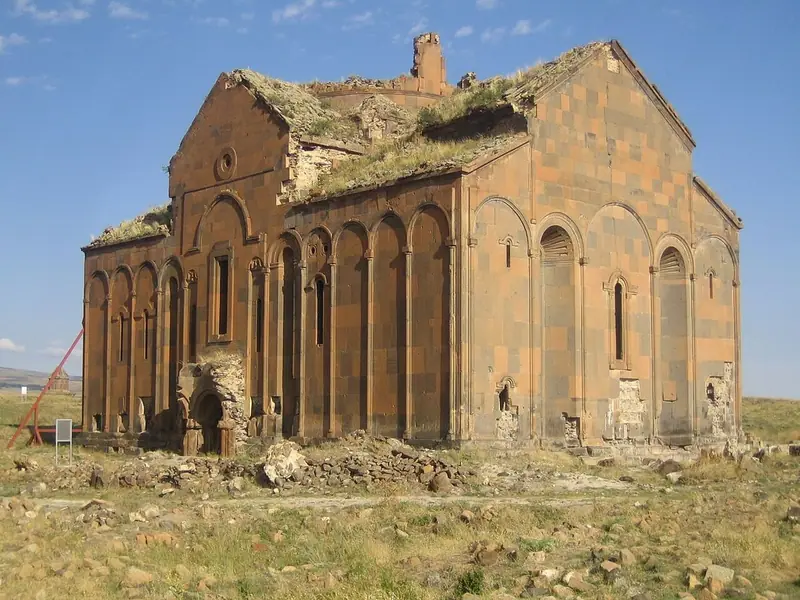 Armenian8 stops · 10th – 14th century CE
Ani audio guide
The ruined capital of medieval Armenia above a border gorge: Trdat’s cathedral, the frescoed church of Tigran Honents, the half-fallen Holy Redeemer and the minaret of Manuchihr.
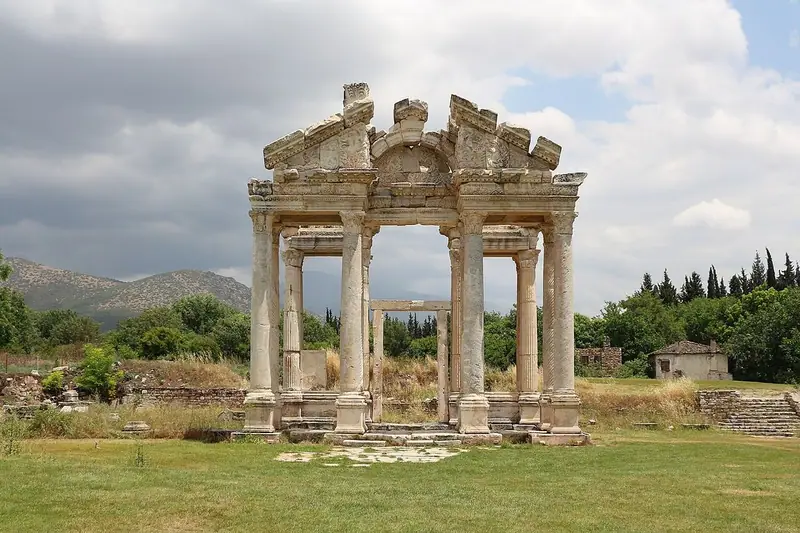 Roman8 stops · 1st century BCE – 4th century CE
Aphrodisias audio guide
The city of Aphrodite: the Tetrapylon gate, the stadium, the theatre and the sculpted reliefs of the Sebasteion.
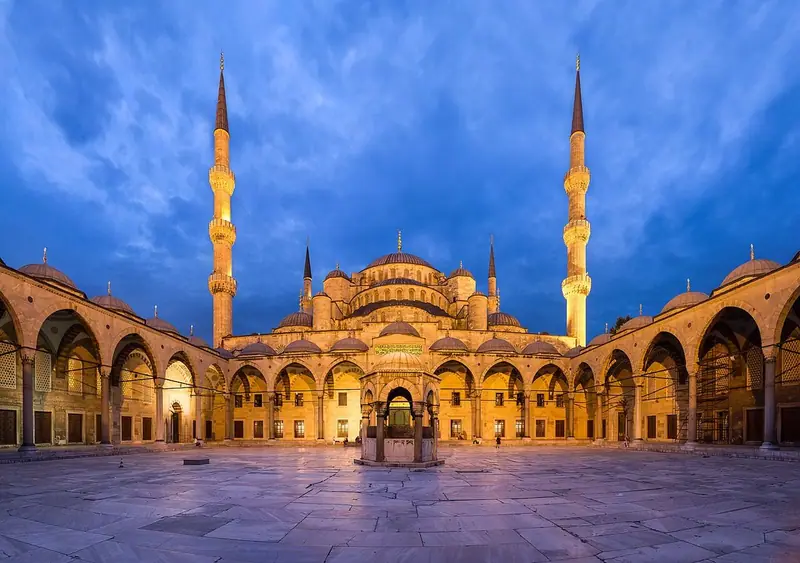 Ottoman9 stops · 1609–1616
Blue Mosque audio guide
Sultan Ahmed’s mosque facing Hagia Sophia, beside the obelisks and Serpent Column of the ancient Hippodrome.
 Byzantine8 stops · 10th–12th century
Cappadocia audio guide
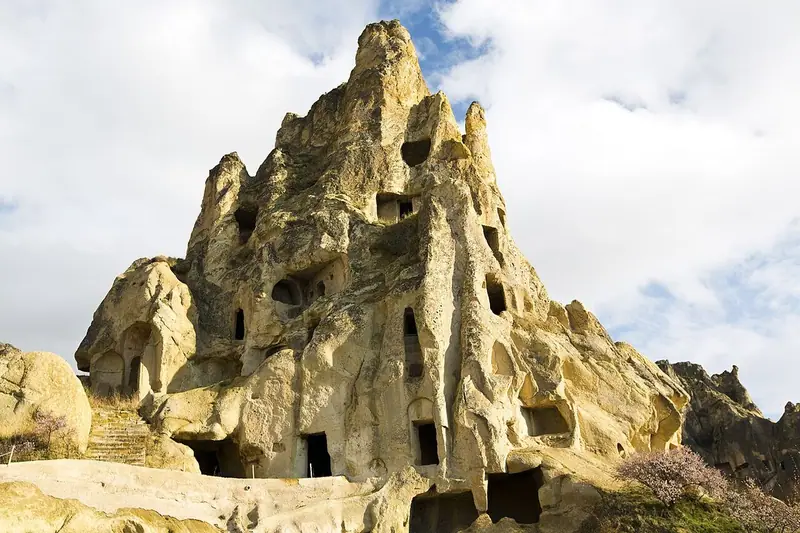
Monks' churches and chapels cut into the soft rock of Göreme, among Cappadocia’s fairy chimneys.
 Byzantine7 stops · expanded c. 780–1180 CE
Derinkuyu audio guide
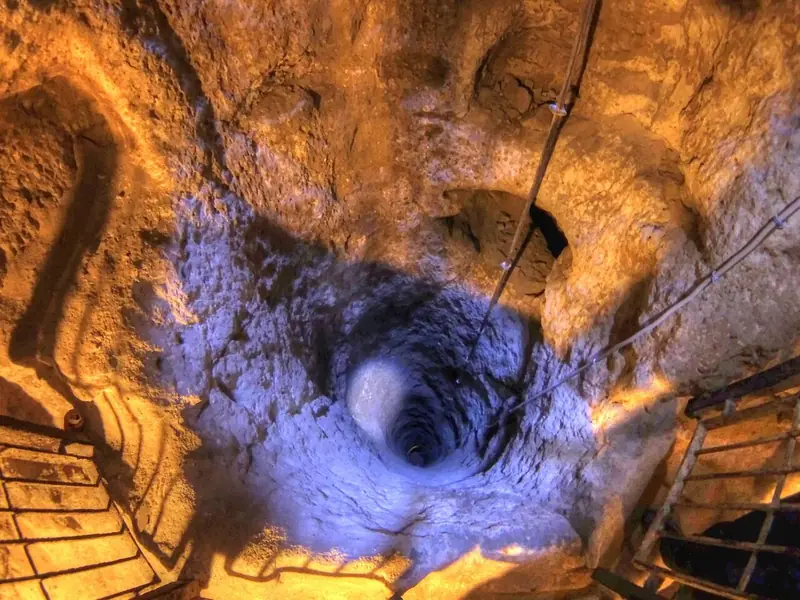
Descend through stables, kitchens and rolling stone doors into an underground city cut deep into the tuff.
 Ottoman8 stops · Late Ottoman
Dolmabahçe Palace audio guide
Climb the crystal staircase of the sultans’ palace of gold and crystal on the Bosphorus, to the vast domed Ceremonial Hall and Atatürk’s room.
Every guide, in every country
Pamukkale & Hierapolis and every other guide we publish, including future ones. One payment, no subscription.