Before you start
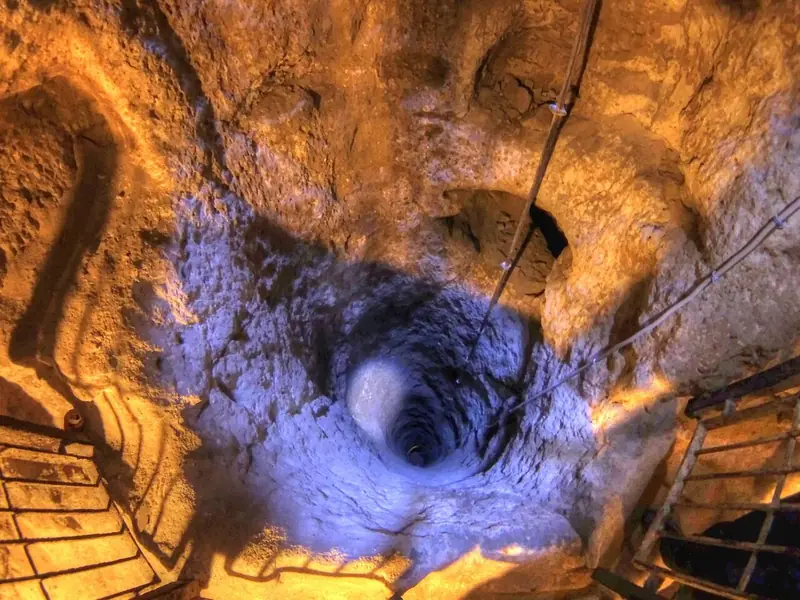
Derinkuyu Underground City, Derinkuyu Yeraltı Şehri, lies beneath the small town of the same name, about 30 kilometres south of Nevşehir on the road to Niğde, in the southern part of Cappadocia. Its name means ‘deep well’. It is one of the components of Göreme National Park and the Rock Sites of Cappadocia, a UNESCO World Heritage Site since 1985, and is run by the Turkish Ministry of Culture and Tourism. The whole city is thought to reach a depth of about 85 metres, but only around a tenth of it is open, with eight levels descending to about 50 to 55 metres. This guide follows the one-way route downwards: from the stables near the entrance to the kitchens and wine press, past a rolling stone door to the vaulted hall known as the missionary school, then beside the great ventilation shaft and down the steep stairs to the cross-shaped church on the lowest level.
Use it as a self-guided tour of Derinkuyu: 7 stops in visit order, each played when you’re ready, at your own pace.
 Free preview · Stop 1
Stables
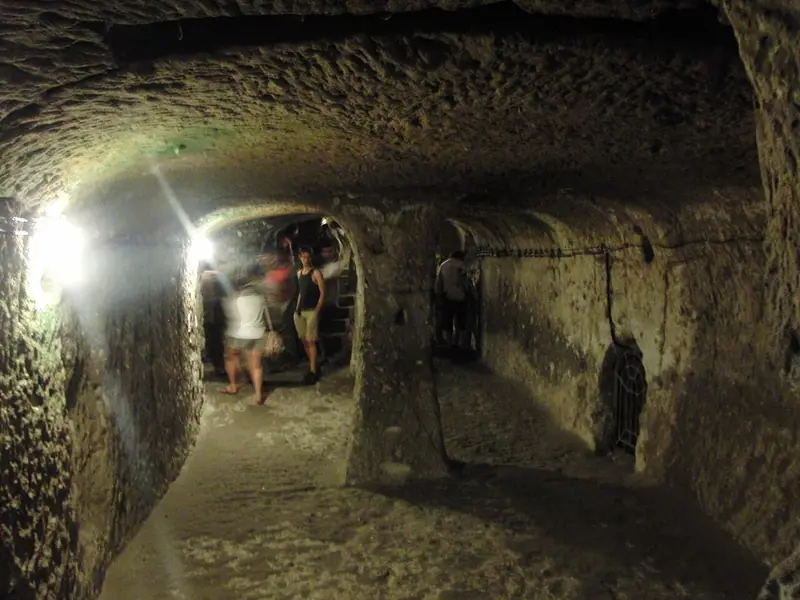
Duck through the entrance and let your eyes adjust to the dim light. The first level is cool even on the hottest day, and stays at a steady temperature all year round. The rooms closest to the surface were mostly used as stables, for the simple reason that it was hard to lead cattle, sheep and donkeys any further down. Look for the troughs and the tethering holes cut into the rock walls, where animals were tied. Notice the marks left by the tools that carved the room, and the soot that still darkens some ceilings from the oil lamps used to light them. Imagine the smell and noise when a whole village, with its livestock, crowded down here to escape raiders. Follow the arrows: the route is one-way, and passages are narrow, so let faster visitors pass in the wider rooms.
Photo: TobyJ · CC BY-SA 4.0 · Wikimedia Commons
What to see at Derinkuyu: 7 stops, in visit order
- 01
 StablesAhırlarFree preview
- 02
 Kitchens and Wine PressMutfak ve ŞırahaneIn the guide
- 03
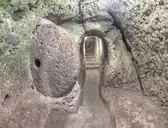 Rolling Stone DoorSürgü TaşıIn the guide
- 04
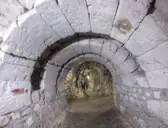 Missionary SchoolMisyoner OkuluIn the guide
- 05
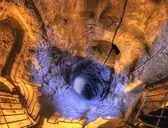 Ventilation ShaftHavalandırma BacasıIn the guide
- 06
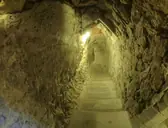 The Deep StairwayDerin MerdivenIn the guide
- 07
 Cross-Shaped ChurchHaç Planlı KiliseIn the guide
History of Derinkuyu
Nobody knows exactly who dug the first chambers at Derinkuyu. Cappadocia’s soft volcanic tuff is easy to carve, and people have cut cellars and refuges into it since antiquity; some scholars attribute the earliest underground spaces to the Phrygians, an Iron Age people of central Anatolia, in the early first millennium BCE, though this is debated. The underground city as we see it was largely the work of Christian communities of the Byzantine Empire, which flourished from 330, when Constantinople was founded, until 1453. During the Arab–Byzantine wars of the seventh to tenth centuries, raids swept across Cappadocia, and villagers greatly extended these shelters, adding chapels, wells and stone doors so that they could hide for long periods. The region passed to the Seljuk Turks after 1071 and later to the Ottomans, but local Greek-speaking Christians continued to use the tunnels as cellars and refuges, until the population exchange of 1923.
The full history continues in the guide.
Derinkuyu guide: questions
How many stops does the Derinkuyu guide have?
7 stops, in visit order: 1. Stables; 2. Kitchens and Wine Press; 3. Rolling Stone Door; 4. Missionary School; 5. Ventilation Shaft; 6. The Deep Stairway; 7. Cross-Shaped Church.
Can I do a self-guided tour of Derinkuyu with this guide?
Yes. The guide is made for a self-guided tour: 7 stops in visit order, each with a photo, a story and a voice, so you can explore Derinkuyu at your own pace, without joining a group. Download it before you go and it works offline.
How long is each guide?
The 7 stops add up to about 6 minutes of listening in total. You play each stop when you’re ready, so you can go at your own pace.
Does the guide work offline?
Yes, once it’s downloaded. The guide is a single self-contained web page (about 7.0 MB) with the photos, text and audio built in. Download it to your phone before you go (Wi-Fi is best); after that it opens in any modern browser on iPhone or Android, with no app, account or mobile signal needed.
Does it use GPS or need my location?
No. The guide doesn’t use GPS and doesn’t know where you are: you play each stop when you reach it. It works on iPhone and Android in any modern browser, and it’s in English.
What’s included?
One self-contained HTML guide: 7 stops in visit order, each with a photo, text and a voice, plus the story of who built the site.
Who built Derinkuyu?
Nobody knows exactly who dug the first chambers at Derinkuyu. Cappadocia’s soft volcanic tuff is easy to carve, and people have cut cellars and refuges into it since antiquity; some scholars attribute the earliest underground spaces to the Phrygians, an Iron Age people of central Anatolia, in the early first millennium BCE, though this is debated.
Where is Derinkuyu?
Derinkuyu Underground City, Derinkuyu Yeraltı Şehri, lies beneath the small town of the same name, about 30 kilometres south of Nevşehir on the road to Niğde, in the southern part of Cappadocia.
Is there a free audio guide to Derinkuyu?
The first stop, Stables, is free to read and hear on this page, so you can try the Derinkuyu audio tour before you buy. The full guide, with all 7 stops, is a one-off purchase: download it once and it’s yours to keep, working offline.
Is the Derinkuyu guide worth it?
If you’d like to know what you’re looking at, yes. For $10 you get 7 stops in visit order, each with a photo, a short history and a voice you play when you’re ready, about 6 minutes of listening in all. It’s short on purpose, so you spend your time looking, not listening. It’s yours to keep, works offline and needs no app. The first stop is free on this page, so you can try it before you buy. If you’d like hours of detail, a guided tour will go deeper.
Audio guide or guided tour?
It depends how you like to visit. This guide lets you explore Derinkuyu at your own pace, at any time, for a one-off price. A guided tour gives you a live expert you can ask questions, but at fixed times and usually for a higher price. Many people use both: a tour for the big picture, and the guide to read beforehand or to revisit the stops in their own time.
Is this the official Derinkuyu guide?
No. It’s an independent guide by The Historian Guide, not affiliated with or endorsed by the operator of Derinkuyu. For tickets and opening hours, check the official site operator before you go.
Does the guide include entry tickets or opening hours?
No. The guide is a digital companion only. Admission to Derinkuyu is separate, so check the official site operator for current tickets and opening hours before you go.
- Stop 1 · Stables: TobyJ · CC BY-SA 4.0 · Wikimedia Commons · resized
- Stop 2 · Kitchens and Wine Press: © Nevit Dilmen · CC BY-SA 3.0 · Wikimedia Commons · resized
- Stop 3 · Rolling Stone Door: © Nevit Dilmen · CC BY-SA 3.0 · Wikimedia Commons · resized
- Stop 4 · Missionary School: © Nevit Dilmen · CC BY-SA 3.0 · Wikimedia Commons · resized
- Stop 5 · Ventilation Shaft (also the cover): © Nevit Dilmen · CC BY-SA 3.0 · Wikimedia Commons · resized
- Stop 6 · The Deep Stairway: © Nevit Dilmen · CC BY-SA 3.0 · Wikimedia Commons · resized
- Stop 7 · Cross-Shaped Church: © Nevit Dilmen · CC BY-SA 3.0 · Wikimedia Commons · resized


All photographs from Wikimedia Commons under the licences shown.
More guides in Turkey
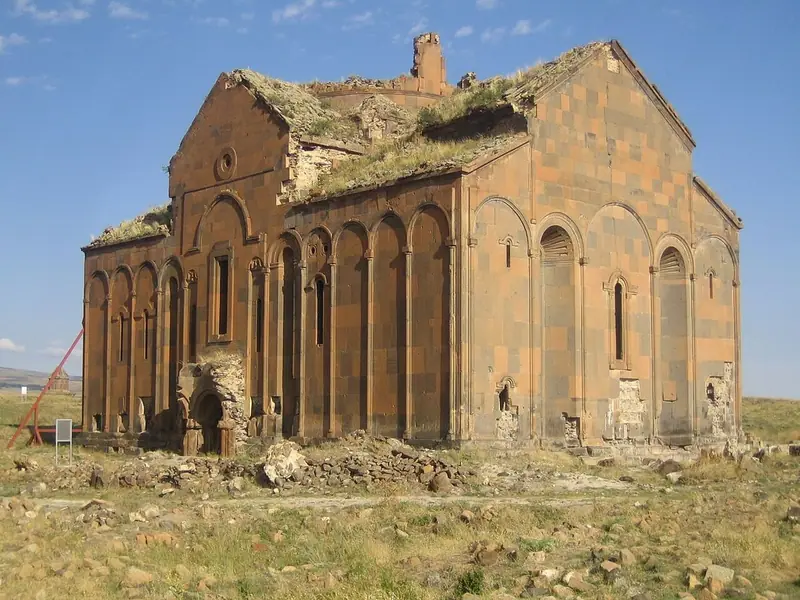 Armenian8 stops · 10th – 14th century CE
Ani audio guide
The ruined capital of medieval Armenia above a border gorge: Trdat’s cathedral, the frescoed church of Tigran Honents, the half-fallen Holy Redeemer and the minaret of Manuchihr.
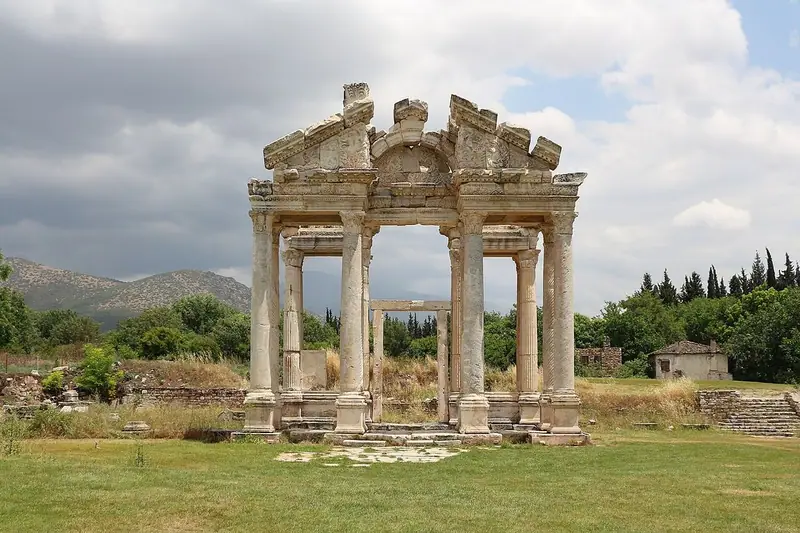 Roman8 stops · 1st century BCE – 4th century CE
Aphrodisias audio guide
The city of Aphrodite: the Tetrapylon gate, the stadium, the theatre and the sculpted reliefs of the Sebasteion.
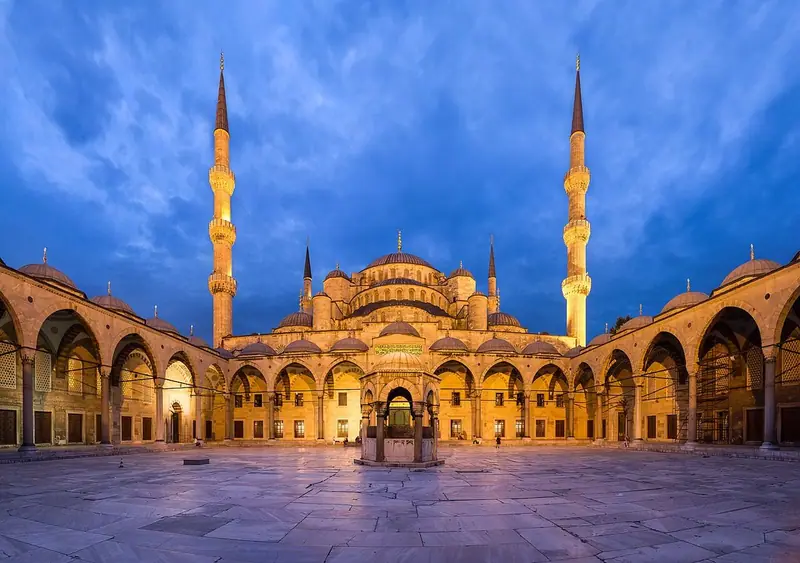 Ottoman9 stops · 1609–1616
Blue Mosque audio guide
Sultan Ahmed’s mosque facing Hagia Sophia, beside the obelisks and Serpent Column of the ancient Hippodrome.
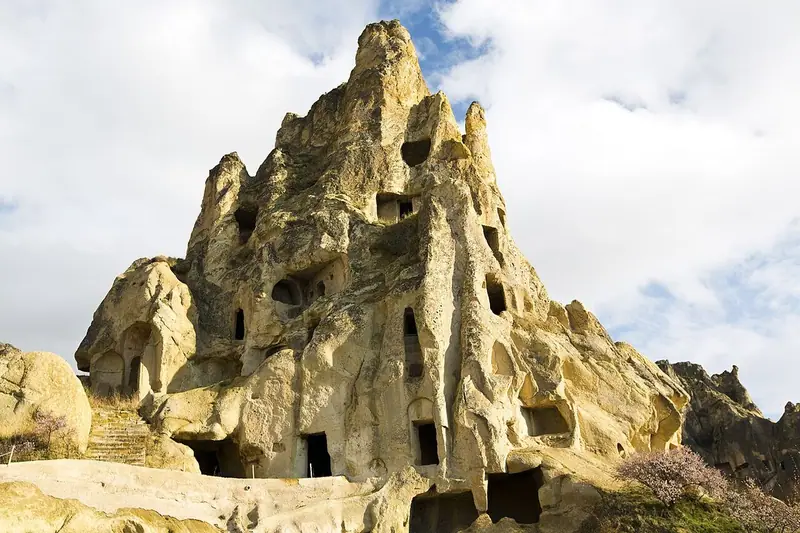 Byzantine8 stops · 10th–12th century
Cappadocia audio guide
Monks' churches and chapels cut into the soft rock of Göreme, among Cappadocia’s fairy chimneys.
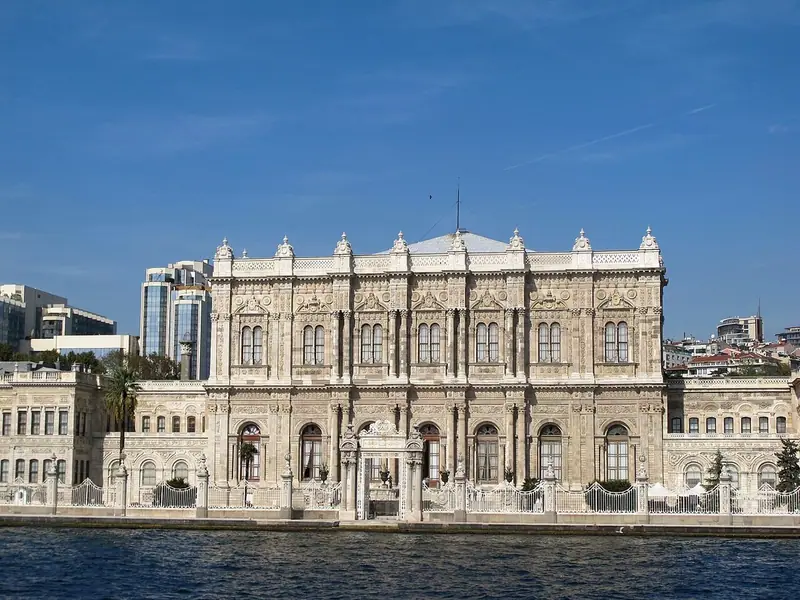 Ottoman8 stops · Late Ottoman
Dolmabahçe Palace audio guide
Climb the crystal staircase of the sultans’ palace of gold and crystal on the Bosphorus, to the vast domed Ceremonial Hall and Atatürk’s room.
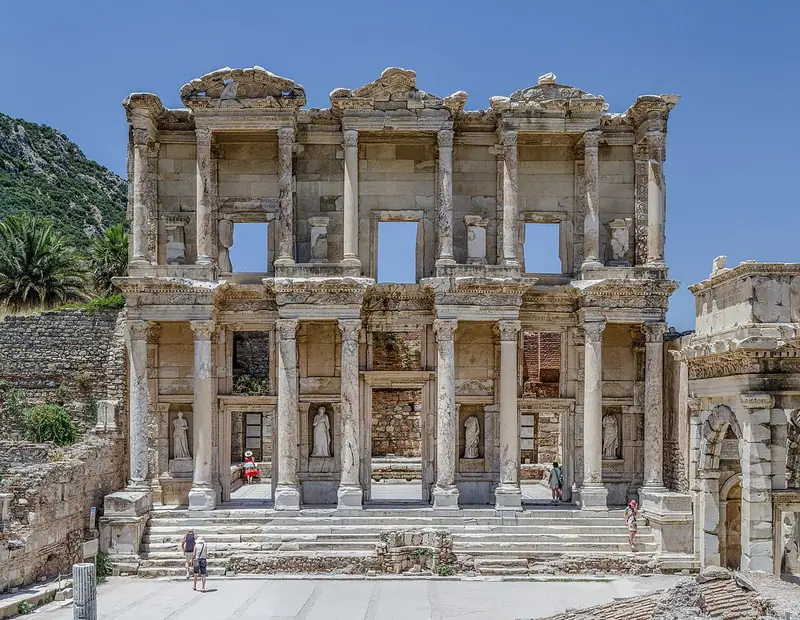 Roman9 stops · 3rd century BCE – 4th century CE
Ephesus audio guide
Down Curetes Street past the Terrace Houses to the Library of Celsus and the Great Theatre.
Every guide, in every country
Derinkuyu and every other guide we publish, including future ones. One payment, no subscription.