Before you start
Ephesus, Efes in Turkish, lies in a green valley about three kilometres from the town of Selçuk and some 80 kilometres south of İzmir, near Turkey’s Aegean coast. In antiquity it was a great port, but silt from the River Cayster has pushed the sea several kilometres away. Ephesus has been a UNESCO World Heritage Site since 2015, together with the remains of the Temple of Artemis and the Basilica of St John in Selçuk, and the site is run by the Turkish Ministry of Culture and Tourism. This guide follows the natural visiting order downhill, from the Upper Gate: through the State Agora and the Odeon, down Curetes Street past the Fountain of Trajan and the Temple of Hadrian, into the covered Terrace Houses, on to the Library of Celsus, and finally to the Great Theatre and the old Harbour Street.
Use it as a self-guided tour of Ephesus: 9 stops in visit order, each played when you’re ready, at your own pace.
 Free preview · Stop 1
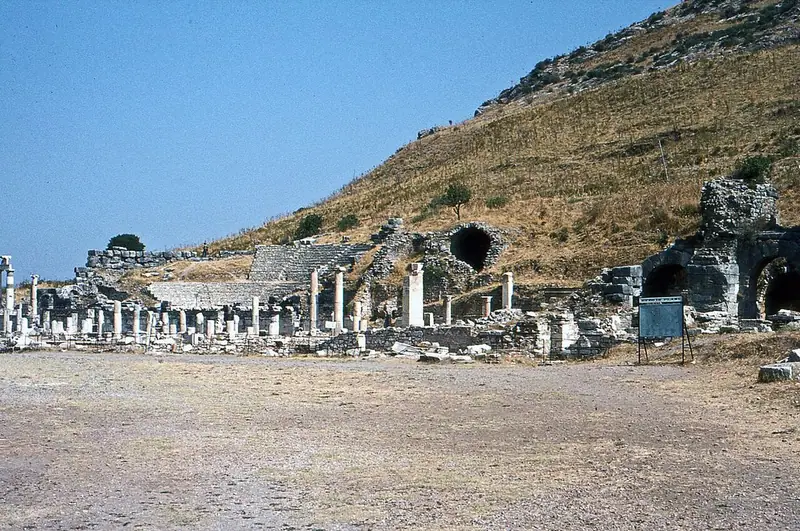
The State Agora
Begin at the Upper Gate, the higher of the two entrances, so that the whole walk runs gently downhill. The first large open space is the State Agora, the civic heart of Roman Ephesus, where official business was done rather than everyday shopping. It was laid out in the first century BCE, and along its northern side ran the Basilica Stoa, a long, three-aisled hall used for business and legal hearings. At its western end there was a small temple, probably dedicated to the emperor Augustus and the goddess Roma. Look around at the scattered column drums, inscriptions and fragments of carved decoration lying in the grass; much of the city still lies buried. Imagine officials in togas and petitioners waiting their turn. The hills on both sides, Bülbül Dağı and Panayır Dağı, framed the ancient city just as they do today.
Photo: Daniel VILLAFRUELA · CC BY-SA 3.0 · Wikimedia Commons
What to see at Ephesus: 9 stops, in visit order
- 01
 The State AgoraDevlet AgorasıFree preview
- 02
 The OdeonOdeonIn the guide
- 03
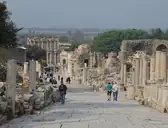 Curetes StreetKuretler CaddesiIn the guide
- 04
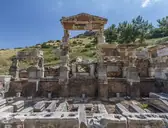 Fountain of TrajanTraianus ÇeşmesiIn the guide
- 05
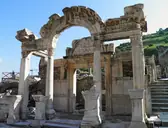 Temple of HadrianHadrian TapınağıIn the guide
- 06
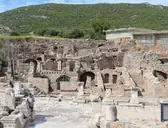 The Terrace HousesYamaç EvlerIn the guide
- 07
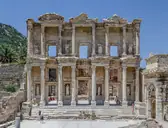 Library of CelsusCelsus KütüphanesiIn the guide
- 08
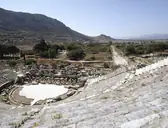 The Great TheatreBüyük TiyatroIn the guide
- 09
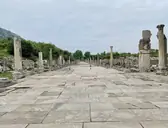 Harbour StreetLiman CaddesiIn the guide
Site map of Ephesus
History of Ephesus
Ephesus was founded by Ionian Greeks, settlers from mainland Greece who, by tradition, arrived on this coast around the eleventh and tenth centuries BCE, near an older Anatolian settlement; the region was known as Ionia. Greek city life flourished here from the Archaic period, when the vast Temple of Artemis, one of the Seven Wonders of the Ancient World, was built, through the Classical and Hellenistic ages. Around 290 BCE Lysimachus, one of Alexander the Great’s successors, moved the city to its present site. Rome took over in 133 BCE, and under the Roman Empire, which ruled here until the fourth century, Ephesus became the capital of the province of Asia and one of the largest cities of the eastern Mediterranean. Most of the buildings you see are Roman.
The full history continues in the guide.
Ephesus guide: questions
How many stops does the Ephesus guide have?
9 stops, in visit order: 1. The State Agora; 2. The Odeon; 3. Curetes Street; 4. Fountain of Trajan; 5. Temple of Hadrian; 6. The Terrace Houses; 7. Library of Celsus; 8. The Great Theatre; 9. Harbour Street.
Can I do a self-guided tour of Ephesus with this guide?
Yes. The guide is made for a self-guided tour: 9 stops in visit order, each with a photo, a story and a voice, so you can explore Ephesus at your own pace, without joining a group. Download it before you go and it works offline.
How long is each guide?
The 9 stops add up to about 8 minutes of listening in total. You play each stop when you’re ready, so you can go at your own pace.
Does the guide work offline?
Yes, once it’s downloaded. The guide is a single self-contained web page (about 10.1 MB) with the photos, text and audio built in. Download it to your phone before you go (Wi-Fi is best); after that it opens in any modern browser on iPhone or Android, with no app, account or mobile signal needed.
Does it use GPS or need my location?
No. The guide doesn’t use GPS and doesn’t know where you are: you play each stop when you reach it. It works on iPhone and Android in any modern browser, and it’s in English.
What’s included?
One self-contained HTML guide: 9 stops in visit order, each with a photo, text and a voice, plus the story of who built the site.
Who built Ephesus?
Ephesus was founded by Ionian Greeks, settlers from mainland Greece who, by tradition, arrived on this coast around the eleventh and tenth centuries BCE, near an older Anatolian settlement; the region was known as Ionia. Greek city life flourished here from the Archaic period, when the vast Temple of Artemis, one of the Seven Wonders of the Ancient World, was built, through the Classical and Hellenistic ages.
Where is Ephesus?
Ephesus, Efes in Turkish, lies in a green valley about three kilometres from the town of Selçuk and some 80 kilometres south of İzmir, near Turkey’s Aegean coast.
Is there a free audio guide to Ephesus?
The first stop, The State Agora, is free to read and hear on this page, so you can try the Ephesus audio tour before you buy. The full guide, with all 9 stops, is a one-off purchase: download it once and it’s yours to keep, working offline.
Is the Ephesus guide worth it?
If you’d like to know what you’re looking at, yes. For $10 you get 9 stops in visit order, each with a photo, a short history and a voice you play when you’re ready, plus a site map of the stops, and about 8 minutes of listening in all. It’s short on purpose, so you spend your time looking, not listening. It’s yours to keep, works offline and needs no app. The first stop is free on this page, so you can try it before you buy. If you’d like hours of detail, a guided tour will go deeper.
Audio guide or guided tour?
It depends how you like to visit. This guide lets you explore Ephesus at your own pace, at any time, for a one-off price. A guided tour gives you a live expert you can ask questions, but at fixed times and usually for a higher price. Many people use both: a tour for the big picture, and the guide to read beforehand or to revisit the stops in their own time.
Is this the official Ephesus guide?
No. It’s an independent guide by The Historian Guide, not affiliated with or endorsed by the operator of Ephesus. For tickets and opening hours, check the official site operator before you go.
Does the guide include entry tickets or opening hours?
No. The guide is a digital companion only. Admission to Ephesus is separate, so check the official site operator for current tickets and opening hours before you go.
- Stop 1 · The State Agora: Daniel VILLAFRUELA · CC BY-SA 3.0 · Wikimedia Commons · resized
- Stop 2 · The Odeon: Bernard Gagnon · CC BY-SA 3.0 · Wikimedia Commons · resized
- Stop 3 · Curetes Street: shankar s. from Dubai, united arab emirates · CC BY 2.0 · Wikimedia Commons · resized
- Stop 4 · Fountain of Trajan: Benh LIEU SONG from Torcy, France · CC BY-SA 2.0 · Wikimedia Commons · resized
- Stop 5 · Temple of Hadrian: Carole Raddato from FRANKFURT, Germany · CC BY-SA 2.0 · Wikimedia Commons · resized
- Stop 6 · The Terrace Houses: Bernard Gagnon · CC BY-SA 3.0 · Wikimedia Commons · resized
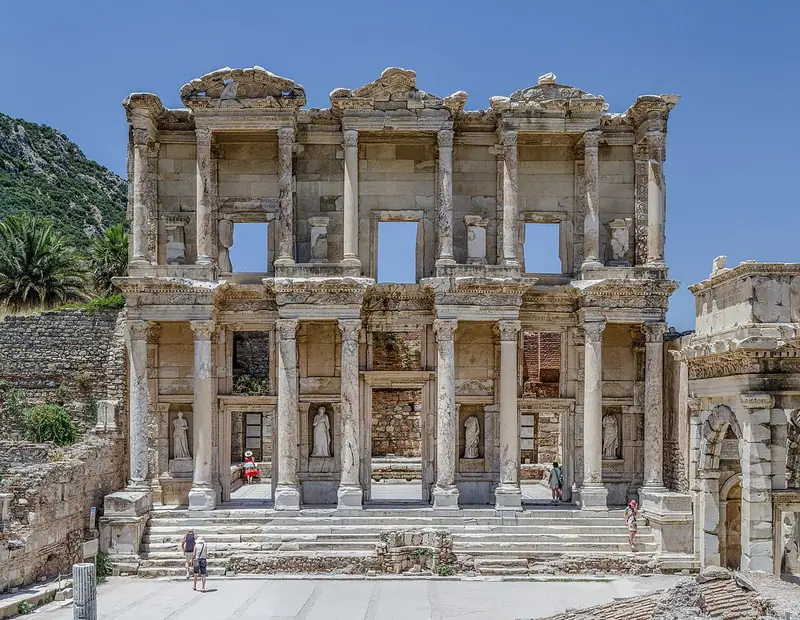
- Stop 7 · Library of Celsus (also the cover): Benh LIEU SONG · CC BY-SA 3.0 · Wikimedia Commons · resized
- Stop 8 · The Great Theatre: Dosseman · CC BY-SA 4.0 · Wikimedia Commons · resized
- Stop 9 · Harbour Street: Warren LeMay from Chicago, IL, United States · CC BY-SA 2.0 · Wikimedia Commons · resized


All photographs from Wikimedia Commons under the licences shown.
More guides in Turkey
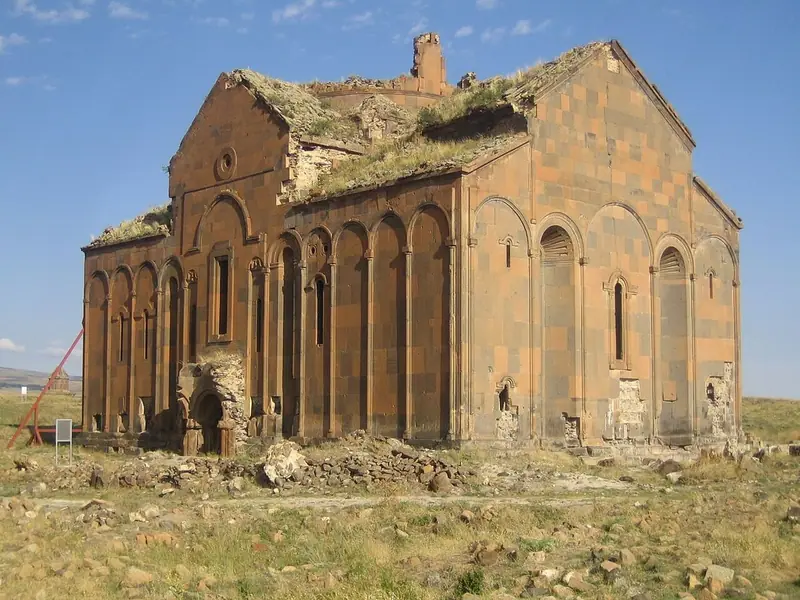 Armenian8 stops · 10th – 14th century CE
Ani audio guide
The ruined capital of medieval Armenia above a border gorge: Trdat’s cathedral, the frescoed church of Tigran Honents, the half-fallen Holy Redeemer and the minaret of Manuchihr.
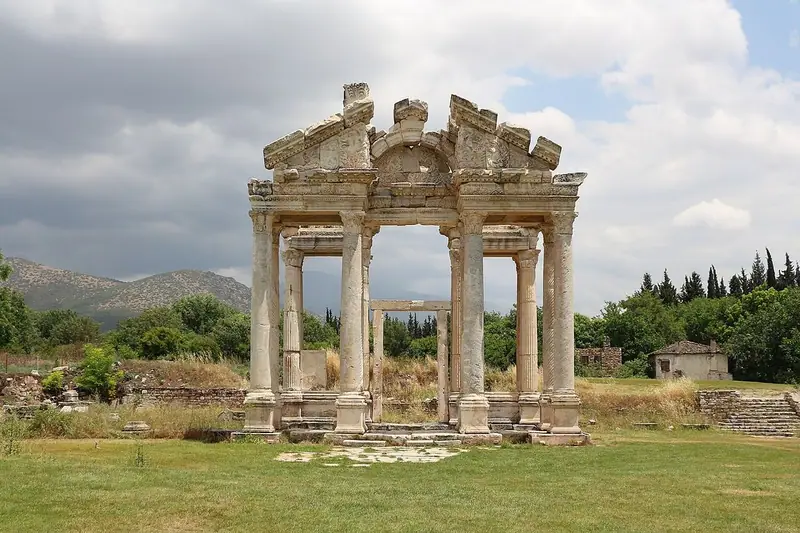 Roman8 stops · 1st century BCE – 4th century CE
Aphrodisias audio guide
The city of Aphrodite: the Tetrapylon gate, the stadium, the theatre and the sculpted reliefs of the Sebasteion.
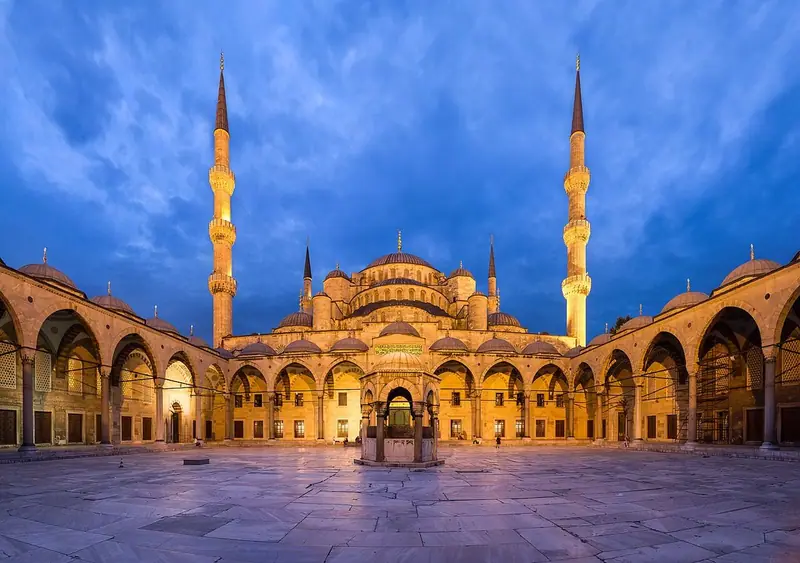 Ottoman9 stops · 1609–1616
Blue Mosque audio guide
Sultan Ahmed’s mosque facing Hagia Sophia, beside the obelisks and Serpent Column of the ancient Hippodrome.
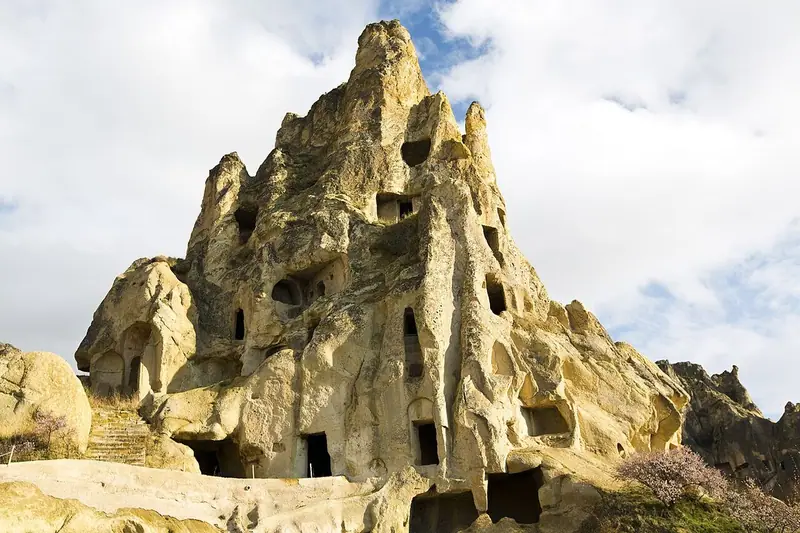 Byzantine8 stops · 10th–12th century
Cappadocia audio guide
Monks' churches and chapels cut into the soft rock of Göreme, among Cappadocia’s fairy chimneys.
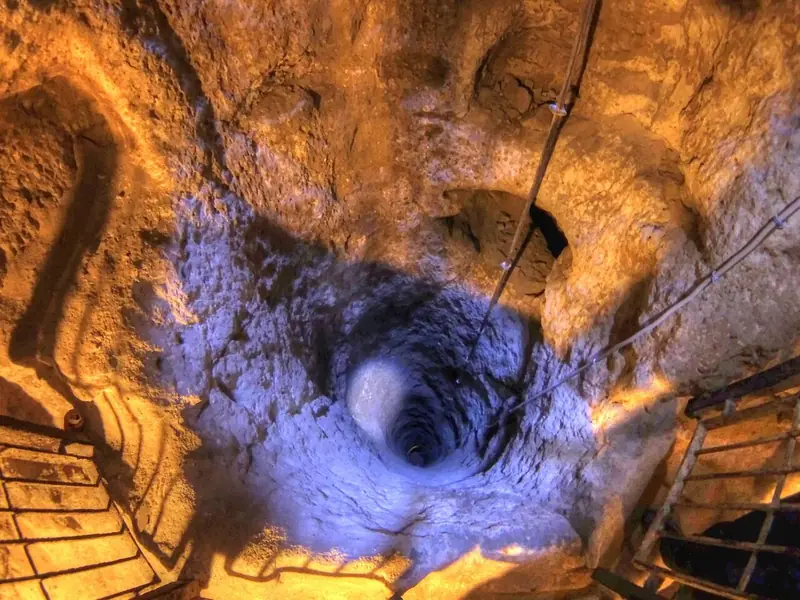 Byzantine7 stops · expanded c. 780–1180 CE
Derinkuyu audio guide
Descend through stables, kitchens and rolling stone doors into an underground city cut deep into the tuff.
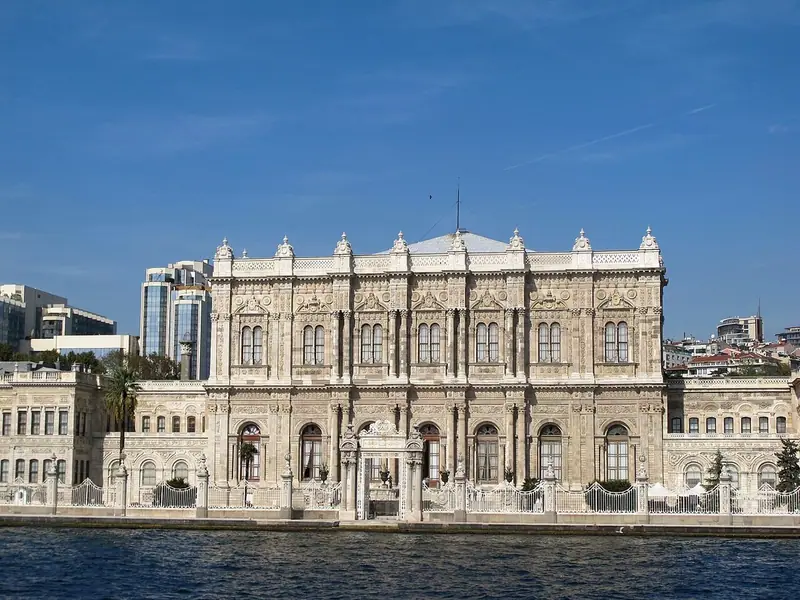 Ottoman8 stops · Late Ottoman
Dolmabahçe Palace audio guide
Climb the crystal staircase of the sultans’ palace of gold and crystal on the Bosphorus, to the vast domed Ceremonial Hall and Atatürk’s room.
Every guide, in every country
Ephesus and every other guide we publish, including future ones. One payment, no subscription.