Before you start
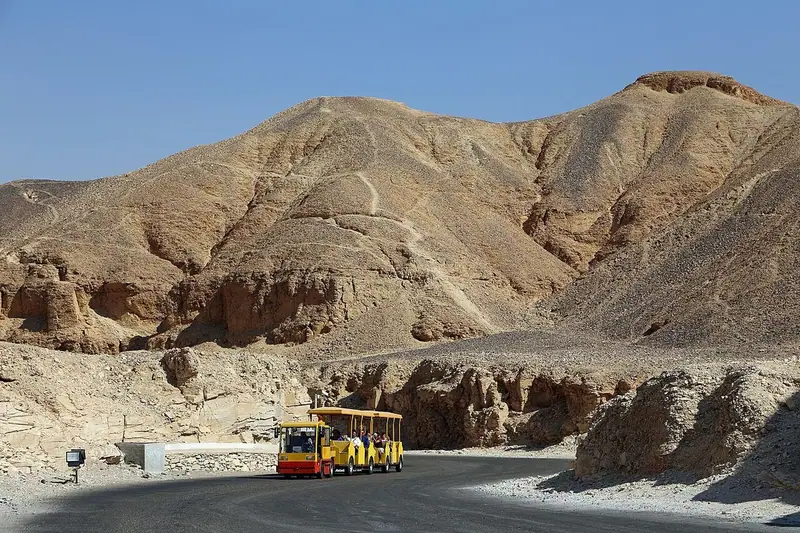
The Valley of the Kings lies in the desert hills on the west bank of the Nile opposite Luxor, a drive of around half an hour from the town, beneath a peak called el-Qurn that rises like a natural pyramid. It is part of the UNESCO World Heritage Site ‘Ancient Thebes with its Necropolis’, inscribed in 1979, and is managed by Egypt’s Ministry of Tourism and Antiquities. From the visitor centre a small electric train takes you up to the valley itself, where paths lead to the tomb entrances. The standard ticket covers a set number of tombs, usually three, chosen from those open that day; Tutankhamun, Seti I and Ramesses VI need extra tickets. Tombs open in rotation for conservation, so some stops below may be closed. This guide follows the main path up the valley, from the entrance to the tomb of Thutmose III at its far end.
Use it as a self-guided tour of the Valley of the Kings: 9 stops in visit order, each played when you’re ready, at your own pace.
 Free preview · Stop 1
Visitor Centre and the Valley
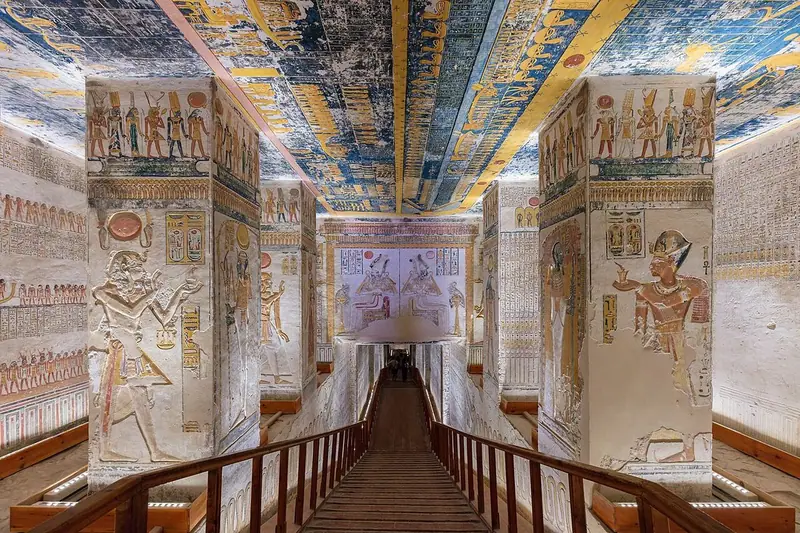
Begin at the visitor centre, where you can get your bearings before taking the train up into the valley. The valley is a dry, branching gorge in the limestone hills, and from about 1500 BCE the kings of Egypt chose it for their tombs. Above it rises el-Qurn, the Horn, a peak shaped like a pyramid, which may have been part of the attraction. The tombs are numbered in the order they were recorded, with the prefix KV, for Kings’ Valley, starting with KV1 near the entrance and running past sixty. Inside, most follow a similar plan: a long sloping corridor cut deep into the rock, leading through halls to a burial chamber, with walls covered in texts and images from the books of the underworld that guided the king on his journey with the sun god through the night.
Photo: Marc Ryckaert · CC BY-SA 4.0 · Wikimedia Commons
What to see at the Valley of the Kings: 9 stops, in visit order
- 01
 Visitor Centre and the ValleyWhere the train beginsFree preview
- 02
 Tomb of Ramesses IVKV2In the guide
- 03
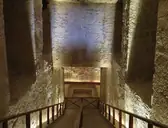 Tomb of Ramesses IXKV6In the guide
- 04
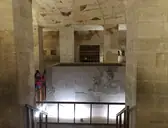 Tomb of MerenptahKV8In the guide
- 05
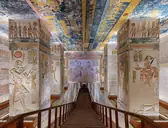 Tomb of Ramesses VIKV9In the guide
- 06
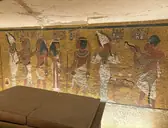 Tomb of TutankhamunKV62In the guide
- 07
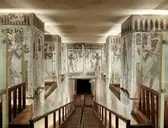 Tomb of Ramesses IIIKV11In the guide
- 08
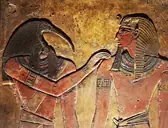 Tomb of Seti IKV17In the guide
- 09
 Tomb of Thutmose IIIKV34In the guide
Site map of the Valley of the Kings
History of the Valley of the Kings
The tombs were cut by the ancient Egyptians of the New Kingdom for their kings and a few favoured nobles, from about 1500 BCE to about 1075 BCE, through the Eighteenth, Nineteenth and Twentieth Dynasties. Kings had stopped building pyramids, which were easy targets for robbers, and chose instead hidden tombs in this remote valley, with temples for their cults built separately at the edge of the fields. The tombs were dug and decorated by skilled craftsmen who lived with their families in the village now called Deir el-Medina, over the hill. Ancient Egyptian civilisation had begun around 3100 BCE, with the union of Upper and Lower Egypt, and it lasted as an independent kingdom until Rome annexed Egypt in 30 BCE, after the death of Cleopatra VII. Greek and Roman tourists were already visiting some of these tombs and leaving graffiti. More than sixty tombs are now known in the valley.
Valley of the Kings guide: questions
How many stops does the Valley of the Kings guide have?
9 stops, in visit order: 1. Visitor Centre and the Valley; 2. Tomb of Ramesses IV; 3. Tomb of Ramesses IX; 4. Tomb of Merenptah; 5. Tomb of Ramesses VI; 6. Tomb of Tutankhamun; 7. Tomb of Ramesses III; 8. Tomb of Seti I; 9. Tomb of Thutmose III.
Can I do a self-guided tour of the Valley of the Kings with this guide?
Yes. The guide is made for a self-guided tour: 9 stops in visit order, each with a photo, a story and a voice, so you can explore the Valley of the Kings at your own pace, without joining a group. Download it before you go and it works offline.
How long is each guide?
The 9 stops add up to about 6 minutes of listening in total. You play each stop when you’re ready, so you can go at your own pace.
Does the guide work offline?
Yes, once it’s downloaded. The guide is a single self-contained web page (about 8.7 MB) with the photos, text and audio built in. Download it to your phone before you go (Wi-Fi is best); after that it opens in any modern browser on iPhone or Android, with no app, account or mobile signal needed.
Does it use GPS or need my location?
No. The guide doesn’t use GPS and doesn’t know where you are: you play each stop when you reach it. It works on iPhone and Android in any modern browser, and it’s in English.
What’s included?
One self-contained HTML guide: 9 stops in visit order, each with a photo, text and a voice, plus the story of who built the site.
Who built the Valley of the Kings?
The tombs were cut by the ancient Egyptians of the New Kingdom for their kings and a few favoured nobles, from about 1500 BCE to about 1075 BCE, through the Eighteenth, Nineteenth and Twentieth Dynasties. Kings had stopped building pyramids, which were easy targets for robbers, and chose instead hidden tombs in this remote valley, with temples for their cults built separately at the edge of the fields.
Is there a free audio guide to the Valley of the Kings?
The first stop, Visitor Centre and the Valley, is free to read and hear on this page, so you can try the Valley of the Kings audio tour before you buy. The full guide, with all 9 stops, is a one-off purchase: download it once and it’s yours to keep, working offline.
Is the Valley of the Kings guide worth it?
If you’d like to know what you’re looking at, yes. For $10 you get 9 stops in visit order, each with a photo, a short history and a voice you play when you’re ready, plus a site map of the stops, and about 6 minutes of listening in all. It’s short on purpose, so you spend your time looking, not listening. It’s yours to keep, works offline and needs no app. The first stop is free on this page, so you can try it before you buy. If you’d like hours of detail, a guided tour will go deeper.
Audio guide or guided tour?
It depends how you like to visit. This guide lets you explore the Valley of the Kings at your own pace, at any time, for a one-off price. A guided tour gives you a live expert you can ask questions, but at fixed times and usually for a higher price. Many people use both: a tour for the big picture, and the guide to read beforehand or to revisit the stops in their own time.
Is this the official Valley of the Kings guide?
No. It’s an independent guide by The Historian Guide, not affiliated with or endorsed by the operator of the Valley of the Kings. For tickets and opening hours, check the official site operator before you go.
Does the guide include entry tickets or opening hours?
No. The guide is a digital companion only. Admission to the Valley of the Kings is separate, so check the official site operator for current tickets and opening hours before you go.
- Stop 1 · Visitor Centre and the Valley: Marc Ryckaert · CC BY-SA 4.0 · Wikimedia Commons · resized
- Stop 2 · Tomb of Ramesses IV: Gary Todd from Xinzheng, China · CC0 · Wikimedia Commons · resized
- Stop 3 · Tomb of Ramesses IX: Luigi Rosa · CC BY-SA 2.0 · Wikimedia Commons · resized
- Stop 4 · Tomb of Merenptah: Marie Thérèse Hébert & Jean Robert Thibault from Québec, Canada · CC BY-SA 2.0 · Wikimedia Commons · resized
- Stop 5 · Tomb of Ramesses VI (also the cover): Diego Delso · CC BY-SA 4.0 · Wikimedia Commons · resized
- Stop 6 · Tomb of Tutankhamun: ولاء · Public domain · Wikimedia Commons · resized
- Stop 7 · Tomb of Ramesses III: R Prazeres · CC BY-SA 4.0 · Wikimedia Commons · resized
- Stop 8 · Tomb of Seti I: Carole Raddato from Frankfurt, Germany · CC BY-SA 2.0 · Wikimedia Commons · resized
- Stop 9 · Tomb of Thutmose III: Tripidays Egypt tours · Public domain · Wikimedia Commons · resized


All photographs from Wikimedia Commons under the licences shown.
More guides in Egypt
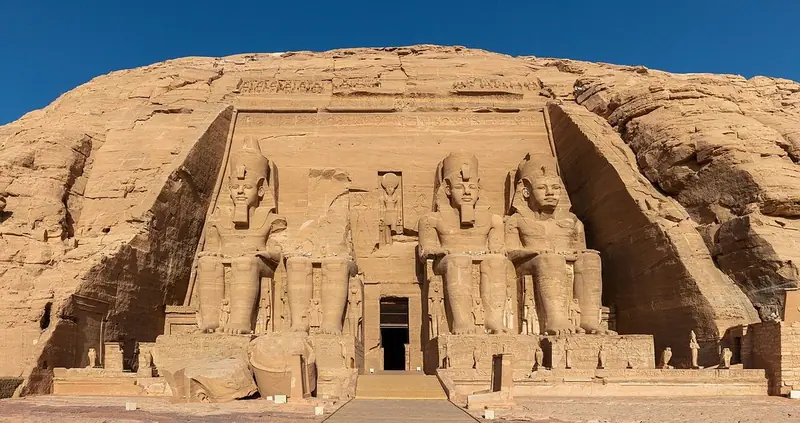 Ancient Egyptian8 stops · 13th century BCE
Abu Simbel audio guide
Ramesses II’s colossal temple façade, the Temple of Nefertari, and how both were rescued from the waters of Lake Nasser.
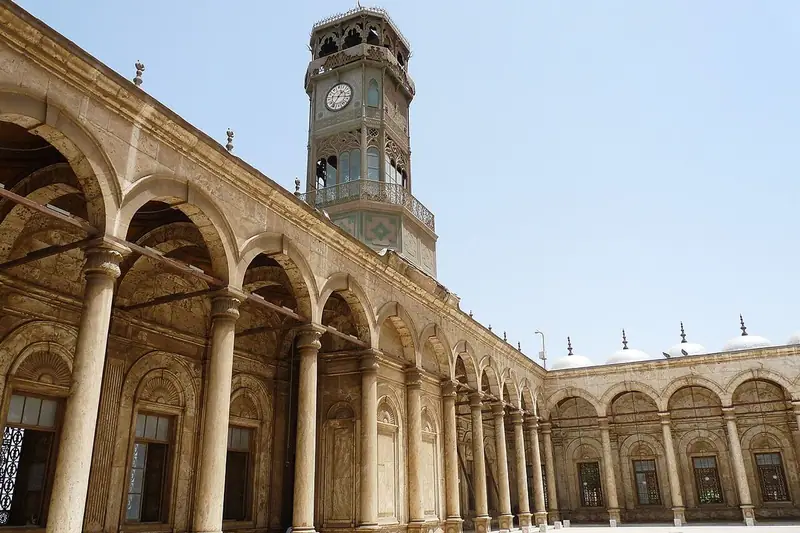 Ayyubid7 stops · from 1176 CE
Cairo Citadel audio guide
Saladin’s walls on the Muqattam Hills and the domes of Muhammad Ali’s mosque, high above the minarets of Islamic Cairo.
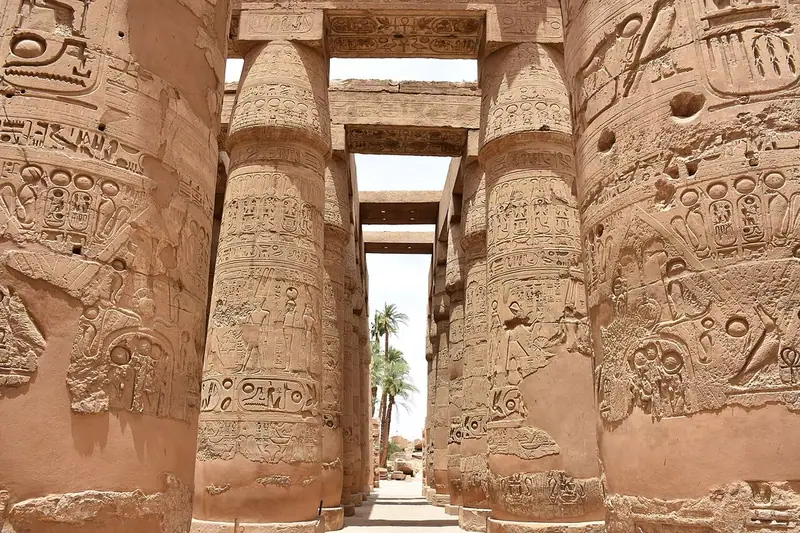 Ancient Egyptian7 stops · Middle Kingdom to Ptolemaic period
Karnak Temple audio guide
Along the Avenue of Rams into the Great Hypostyle Hall, a forest of giant columns built for Amun-Re.
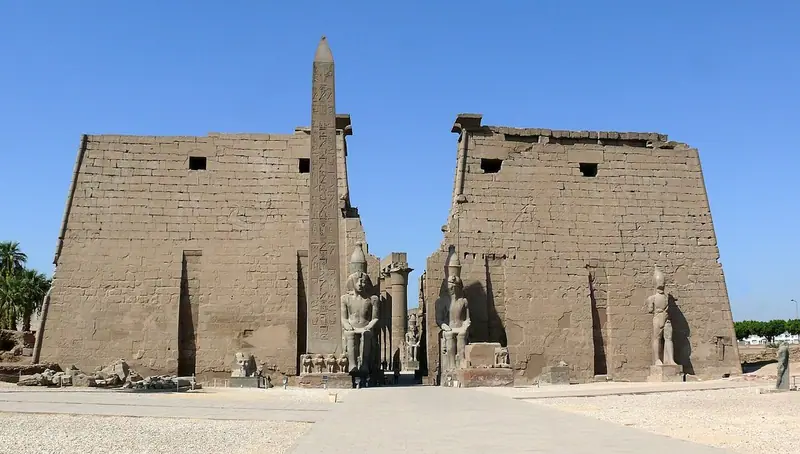 Ancient Egyptian7 stops · from c. 1390 BCE
Luxor Temple audio guide
Past Ramesses II’s pylon to Amenhotep III’s colonnade, with a Roman chapel and a shrine of Alexander within.
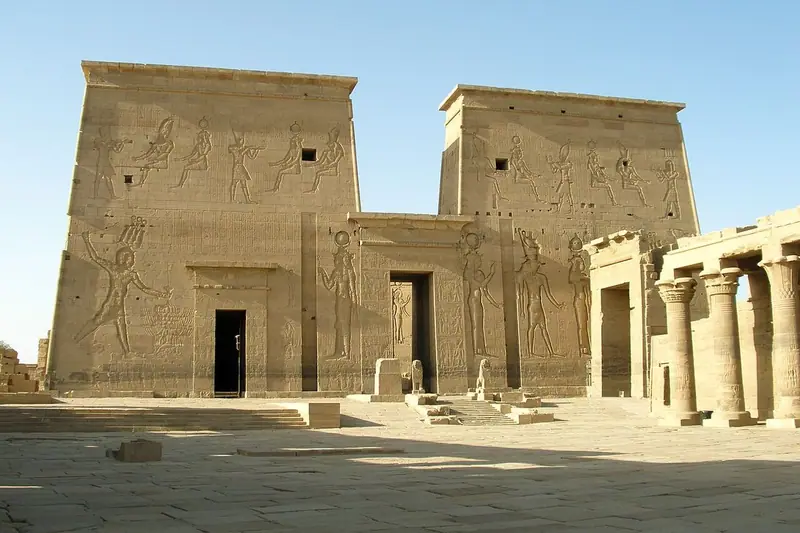 Ancient Egyptian8 stops · 3rd century BCE onwards
Philae Temple audio guide
A short boat ride to the island temple of Isis, with the Kiosk of Trajan standing at the water’s edge.
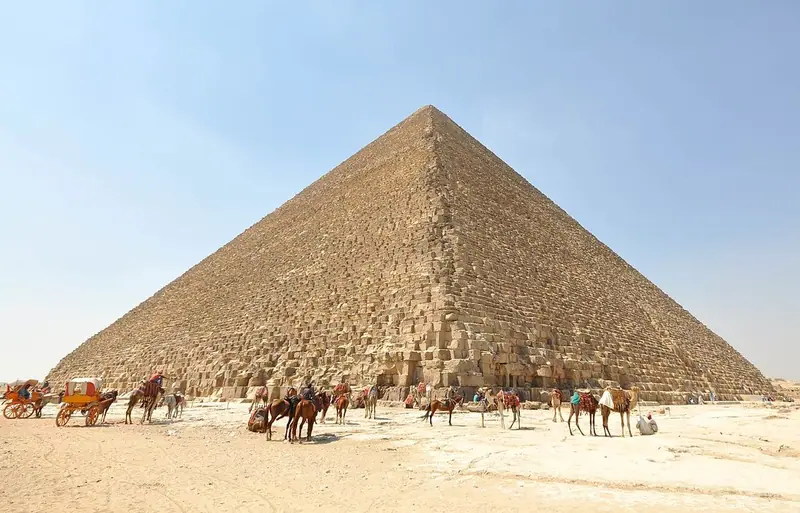 Ancient Egyptian7 stops · c. 26th century BCE
Pyramids of Giza audio guide
The Great Pyramid of Khufu, the pyramids of Khafre and Menkaure, and the Great Sphinx keeping watch.
Every guide, in every country
Valley of the Kings and every other guide we publish, including future ones. One payment, no subscription.