Before you start
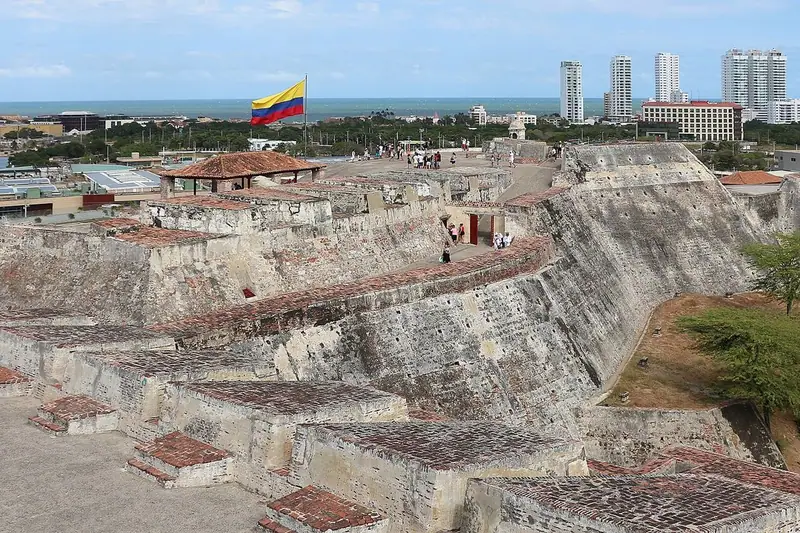
The Castillo San Felipe de Barajas rises on the hill of San Lázaro, just outside the walled city of Cartagena, commanding the approaches to the city by land and sea. It is often described as the most formidable fortress built by the Spanish in the Americas, and it is part of the World Heritage Site of Cartagena’s port and fortifications. This guide begins at the statue of Blas de Lezo, climbs the ramps and batteries to the summit, and descends into the tunnels. There is little shade, so visit early in the morning or late in the afternoon, bring water, and wear a hat and comfortable shoes. The tunnels are narrow and dark, so take care, and avoid them if you dislike enclosed spaces.
Use it as a self-guided tour of Castillo San Felipe de Barajas: 7 stops in visit order, each played when you’re ready, at your own pace.
 Free preview · Stop 1
Blas de Lezo
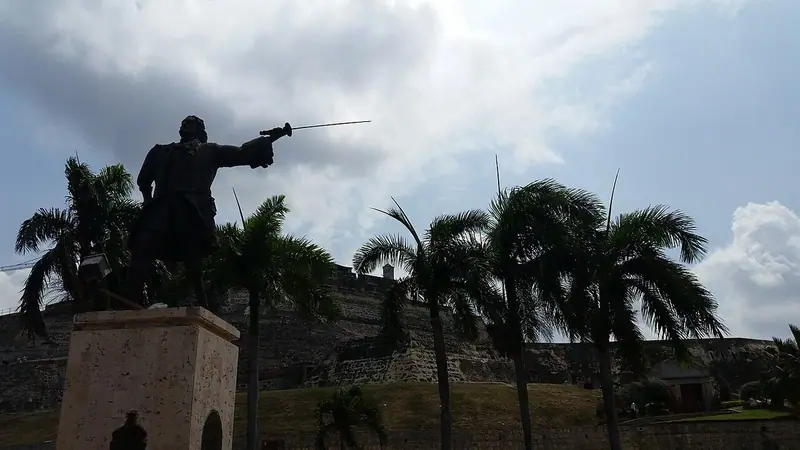
Begin at the foot of the hill, by the statue of Admiral Blas de Lezo, sword in hand, who led the defence of Cartagena in 1741. He was born in the Basque Country in 1689, and during his long naval career he lost his left leg, the sight of his left eye and the use of his right arm. In 1741, a huge British fleet under Admiral Edward Vernon, with a hundred and twenty-four ships, including twenty-nine ships of the line, and more than twenty-seven thousand men, attacked Cartagena, during the War of Jenkins’ Ear. The defenders, commanded by the viceroy Sebastián de Eslava and Blas de Lezo, were greatly outnumbered. Look at the statue’s raised sword. Lezo survived the siege, but he fell ill and died in Cartagena a few months later, in September 1741. Look up at the fortress above you.
Photo: Pi3.124 · CC BY-SA 4.0 · Wikimedia Commons
What to see at Castillo San Felipe de Barajas: 7 stops, in visit order
- 01
 Blas de LezoThe Defender of CartagenaFree preview
- 02
 The Hill of San LázaroA Fortress on a HillIn the guide
- 03
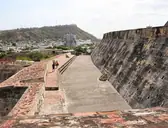 The Ramps and WallsThe ClimbIn the guide
- 04
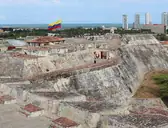 The BatteriesGuns Facing OutwardsIn the guide
- 05
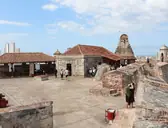 The SummitThe Heart of the FortressIn the guide
- 06
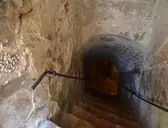 The TunnelsBeneath the HillIn the guide
- 07
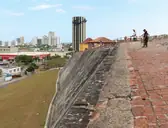 Decline and RevivalThe Fortress TodayIn the guide
Site map of Castillo San Felipe de Barajas
History of Castillo San Felipe de Barajas
The first fort on the hill was begun in 1639, and it was originally known as the Castillo de San Lázaro. It was later named in honour of King Philip IV of Spain. It was built by the labour of enslaved Africans, under Spanish supervision. In 1697, it fell to a French force under the Baron de Pointis, who sacked Cartagena. It was repaired and enlarged in the eighteenth century, in the 1730s and again by the engineer Antonio de Arévalo in 1763, into the great complex of walls, batteries and tunnels that you see today.
Castillo San Felipe de Barajas guide: questions
How many stops does the Castillo San Felipe de Barajas guide have?
7 stops, in visit order: 1. Blas de Lezo; 2. The Hill of San Lázaro; 3. The Ramps and Walls; 4. The Batteries; 5. The Summit; 6. The Tunnels; 7. Decline and Revival.
Can I do a self-guided tour of Castillo San Felipe de Barajas with this guide?
Yes. The guide is made for a self-guided tour: 7 stops in visit order, each with a photo, a story and a voice, so you can explore Castillo San Felipe de Barajas at your own pace, without joining a group. Download it before you go and it works offline.
How long is each guide?
The 7 stops add up to about 5 minutes of listening in total. You play each stop when you’re ready, so you can go at your own pace.
Does the guide work offline?
Yes, once it’s downloaded. The guide is a single self-contained web page (about 6.7 MB) with the photos, text and audio built in. Download it to your phone before you go (Wi-Fi is best); after that it opens in any modern browser on iPhone or Android, with no app, account or mobile signal needed.
Does it use GPS or need my location?
No. The guide doesn’t use GPS and doesn’t know where you are: you play each stop when you reach it. It works on iPhone and Android in any modern browser, and it’s in English.
What’s included?
One self-contained HTML guide: 7 stops in visit order, each with a photo, text and a voice, plus the story of who built the site.
Who built Castillo San Felipe de Barajas?
The first fort on the hill was begun in 1639, and it was originally known as the Castillo de San Lázaro. It was later named in honour of King Philip IV of Spain.
Where is Castillo San Felipe de Barajas?
The Castillo San Felipe de Barajas rises on the hill of San Lázaro, just outside the walled city of Cartagena, commanding the approaches to the city by land and sea.
Is there a free audio guide to Castillo San Felipe de Barajas?
The first stop, Blas de Lezo, is free to read and hear on this page, so you can try the Castillo San Felipe de Barajas audio tour before you buy. The full guide, with all 7 stops, is a one-off purchase: download it once and it’s yours to keep, working offline.
Is the Castillo San Felipe de Barajas guide worth it?
If you’d like to know what you’re looking at, yes. For $10 you get 7 stops in visit order, each with a photo, a short history and a voice you play when you’re ready, plus a site map of the stops, and about 5 minutes of listening in all. It’s short on purpose, so you spend your time looking, not listening. It’s yours to keep, works offline and needs no app. The first stop is free on this page, so you can try it before you buy. If you’d like hours of detail, a guided tour will go deeper.
Audio guide or guided tour?
It depends how you like to visit. This guide lets you explore Castillo San Felipe de Barajas at your own pace, at any time, for a one-off price. A guided tour gives you a live expert you can ask questions, but at fixed times and usually for a higher price. Many people use both: a tour for the big picture, and the guide to read beforehand or to revisit the stops in their own time.
Is this the official Castillo San Felipe de Barajas guide?
No. It’s an independent guide by The Historian Guide, not affiliated with or endorsed by the operator of Castillo San Felipe de Barajas. For tickets and opening hours, check the official site operator before you go.
Does the guide include entry tickets or opening hours?
No. The guide is a digital companion only. Admission to Castillo San Felipe de Barajas is separate, so check the official site operator for current tickets and opening hours before you go.
- Stop 1 · Blas de Lezo: Pi3.124 · CC BY-SA 4.0 · Wikimedia Commons · resized
- Stop 2 · The Hill of San Lázaro: Joe Ross from Lansing, Michigan · CC BY-SA 2.0 · Wikimedia Commons · resized
- Stop 3 · The Ramps and Walls: Bernard Gagnon · CC BY-SA 4.0 · Wikimedia Commons · resized
- Stop 4 · The Batteries (also the cover): Bernard Gagnon · CC BY-SA 4.0 · Wikimedia Commons · resized
- Stop 5 · The Summit: Bernard Gagnon · CC BY-SA 4.0 · Wikimedia Commons · resized
- Stop 6 · The Tunnels: Joe Ross from Lansing, Michigan · CC BY-SA 2.0 · Wikimedia Commons · resized
- Stop 7 · Decline and Revival: Bernard Gagnon · CC BY-SA 4.0 · Wikimedia Commons · resized


All photographs from Wikimedia Commons under the licences shown.
More guides in Colombia
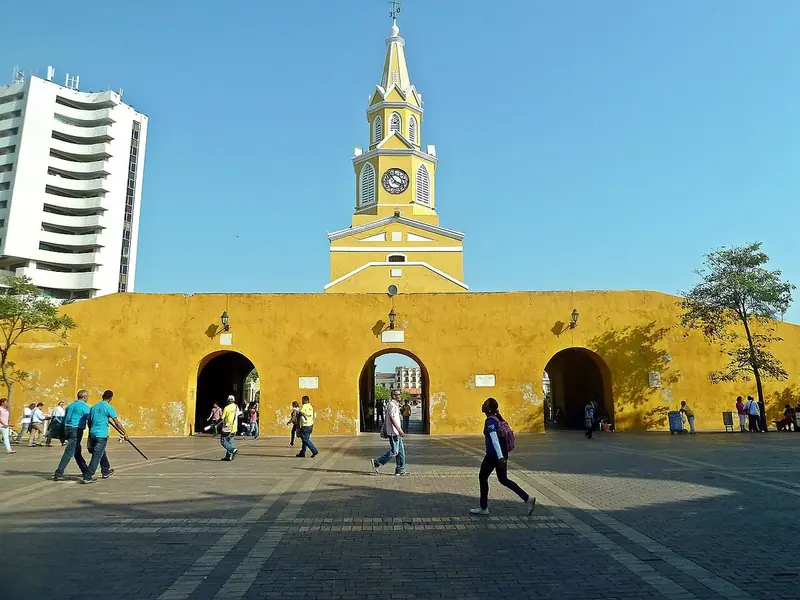 Spanish Colonial8 stops · 1533–1811 CE
Cartagena Old Town audio guide
Pass through the Clock Gate into one of the great ports of the Spanish Empire, with its squares, painted balconies and massive walls.
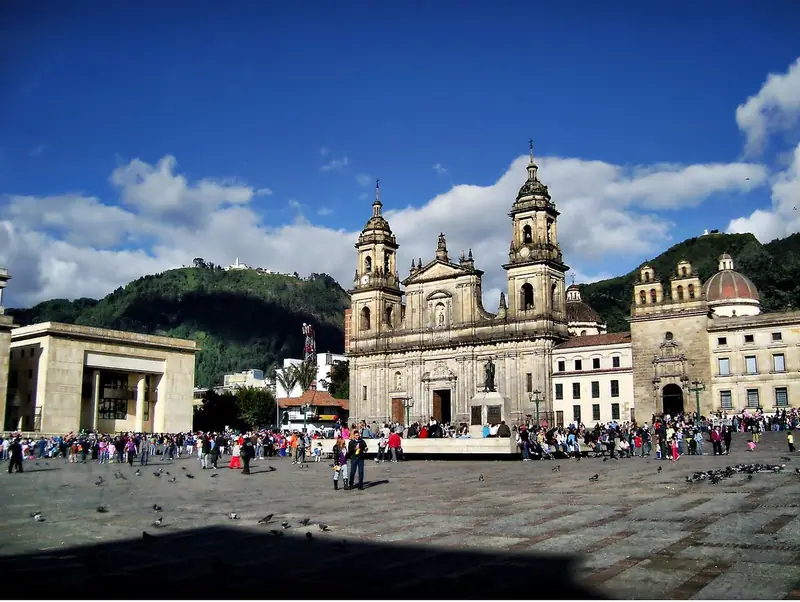 Spanish Colonial8 stops · 1538–1810 CE
La Candelaria, Bogotá audio guide
The steep colonial streets where Bogotá was founded in 1538, from the Plaza de Bolívar to the Gold Museum and the Chorro de Quevedo.
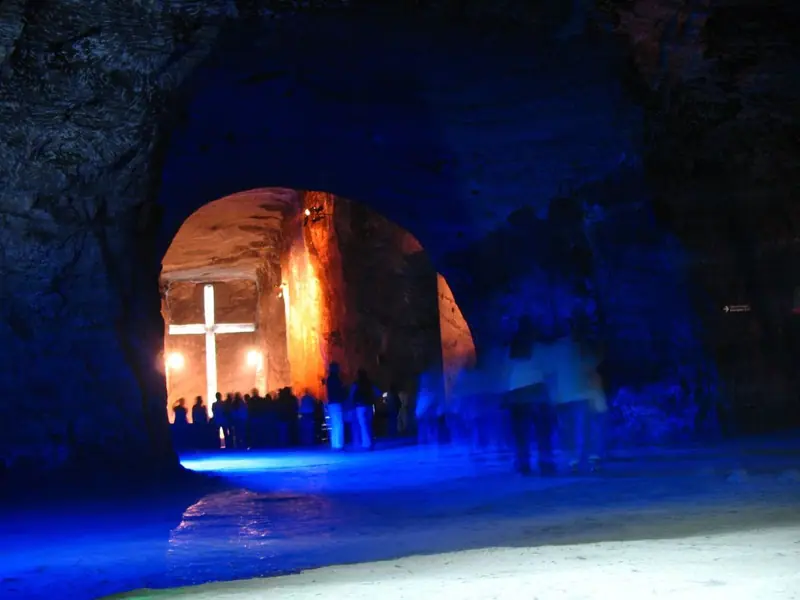 Modern8 stops · 1954–1995 CE
Salt Cathedral of Zipaquirá audio guide
Descend into the tunnels of a salt mine, past the Stations of the Cross carved in rock salt, to the nave and main altar of an underground cathedral.
Every guide, in every country
Castillo San Felipe de Barajas and every other guide we publish, including future ones. One payment, no subscription.