Before you start
Cartagena de Indias, on the Caribbean coast of Colombia, was one of the great ports of the Spanish Empire, and its walled old town is one of the best-preserved colonial cities in the Americas. The walled city and its fortifications have been a World Heritage Site since 1984. Behind the walls are squares, churches and narrow streets of brightly painted houses with wooden balconies covered in flowers. This guide enters by the Clock Gate, continues through the squares and churches of the old town, and ends on the city walls at Las Bóvedas. The midday heat can be intense, so walk in the morning or late afternoon, drink plenty of water, and wear a hat.
Use it as a self-guided tour of Cartagena Old Town: 8 stops in visit order, each played when you’re ready, at your own pace.
 Free preview · Stop 1
The Clock Gate
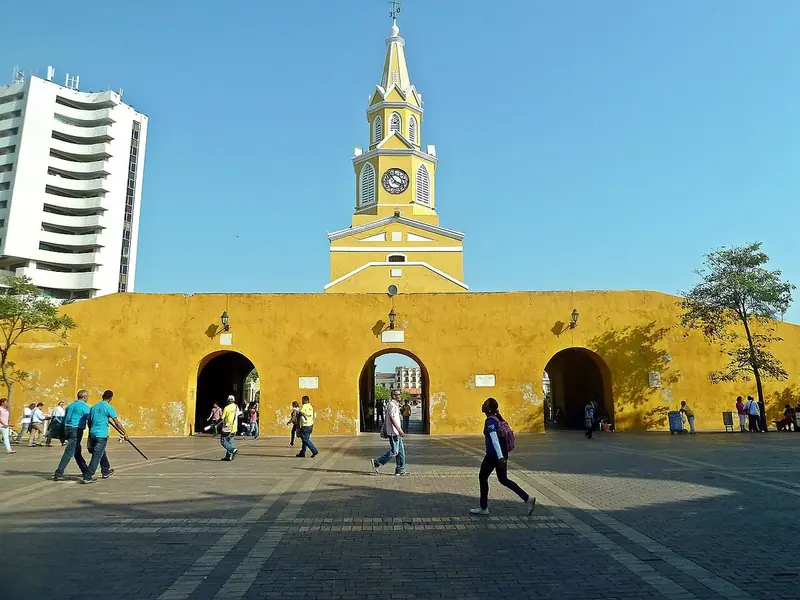
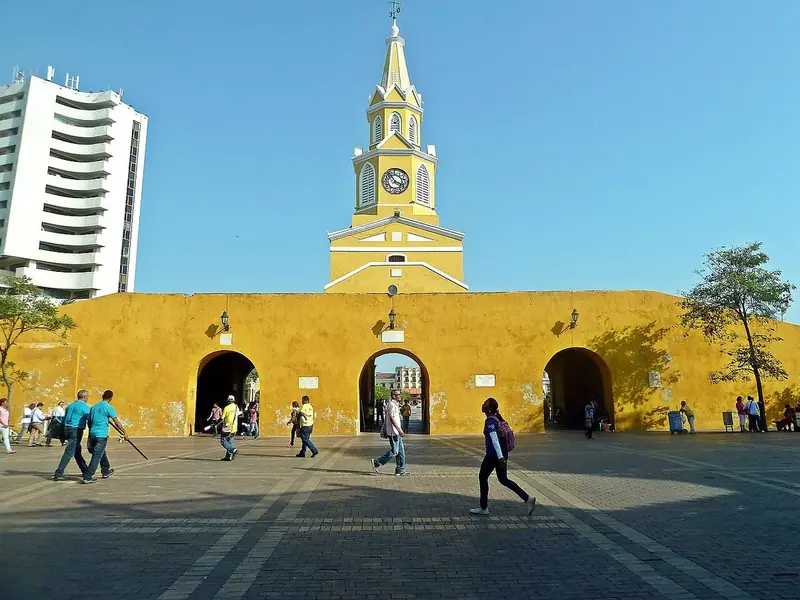
Begin in front of the Puerta del Reloj, the Clock Gate, the main entrance to the walled city, with its yellow tower rising above three arches. Local people often call it the Boca del Puente, the mouth of the bridge, because in colonial times a drawbridge crossed a channel of seawater here, linking the walled city with the district of Getsemaní. In case of attack, the bridge could be raised. Look at the central arch, flanked by pairs of columns, in the classical style. The gate was rebuilt between 1704 and 1738 by the Spanish military engineer Juan de Herrera y Sotomayor, replacing an older gate of 1631, and it was crowned with its clock. Experts consider it one of the finest examples of Spanish colonial military architecture in the Americas. Walk through the central arch into the old town.
Photo: David Shankbone · CC BY-SA 3.0 · Wikimedia Commons
What to see at Cartagena Old Town: 8 stops, in visit order
- 01
 The Clock GateThe Main EntranceFree preview
- 02
 Plaza de los CochesThe Square of the CarriagesIn the guide
- 03
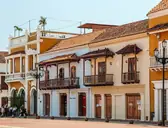 Plaza de la AduanaHouses and BalconiesIn the guide
- 04
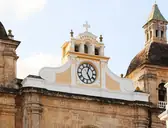 The Church of San Pedro ClaverThe Slave of the SlavesIn the guide
- 05
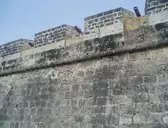 The City WallsDefending the PortIn the guide
- 06
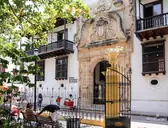 The Palace of the InquisitionA Tribunal of FaithIn the guide
- 07
 The CathedralSaint Catherine of AlexandriaIn the guide
- 08
 Las BóvedasThe VaultsIn the guide
Site map of Cartagena Old Town
History of Cartagena Old Town
Cartagena was founded on 1 June 1533 by the Spanish commander Pedro de Heredia, on the site of the indigenous village of Calamarí, and named after Cartagena in Spain. It became a key port for shipping the silver of Potosí to Spain, and one of the main ports in the Americas for the trade in enslaved Africans. Its wealth attracted pirates and enemies, among them Francis Drake, who sacked the city in 1586. Spain then fortified it, and in 1741 the city withstood a great siege by a British fleet under Admiral Edward Vernon. Cartagena declared its independence from Spain in 1811.
Cartagena Old Town guide: questions
How many stops does the Cartagena Old Town guide have?
8 stops, in visit order: 1. The Clock Gate; 2. Plaza de los Coches; 3. Plaza de la Aduana; 4. The Church of San Pedro Claver; 5. The City Walls; 6. The Palace of the Inquisition; 7. The Cathedral; 8. Las Bóvedas.
Can I do a self-guided tour of Cartagena Old Town with this guide?
Yes. The guide is made for a self-guided tour: 8 stops in visit order, each with a photo, a story and a voice, so you can explore Cartagena Old Town at your own pace, without joining a group. Download it before you go and it works offline.
How long is each guide?
The 8 stops add up to about 6 minutes of listening in total. You play each stop when you’re ready, so you can go at your own pace.
Does the guide work offline?
Yes, once it’s downloaded. The guide is a single self-contained web page (about 7.4 MB) with the photos, text and audio built in. Download it to your phone before you go (Wi-Fi is best); after that it opens in any modern browser on iPhone or Android, with no app, account or mobile signal needed.
Does it use GPS or need my location?
No. The guide doesn’t use GPS and doesn’t know where you are: you play each stop when you reach it. It works on iPhone and Android in any modern browser, and it’s in English.
What’s included?
One self-contained HTML guide: 8 stops in visit order, each with a photo, text and a voice, plus the story of who built the site.
Who built Cartagena Old Town?
Cartagena was founded on 1 June 1533 by the Spanish commander Pedro de Heredia, on the site of the indigenous village of Calamarí, and named after Cartagena in Spain. It became a key port for shipping the silver of Potosí to Spain, and one of the main ports in the Americas for the trade in enslaved Africans.
Where is Cartagena Old Town?
Cartagena de Indias, on the Caribbean coast of Colombia, was one of the great ports of the Spanish Empire, and its walled old town is one of the best-preserved colonial cities in the Americas.
Is there a free audio guide to Cartagena Old Town?
The first stop, The Clock Gate, is free to read and hear on this page, so you can try the Cartagena Old Town audio tour before you buy. The full guide, with all 8 stops, is a one-off purchase: download it once and it’s yours to keep, working offline.
Is the Cartagena Old Town guide worth it?
If you’d like to know what you’re looking at, yes. For $10 you get 8 stops in visit order, each with a photo, a short history and a voice you play when you’re ready, plus a site map of the stops, and about 6 minutes of listening in all. It’s short on purpose, so you spend your time looking, not listening. It’s yours to keep, works offline and needs no app. The first stop is free on this page, so you can try it before you buy. If you’d like hours of detail, a guided tour will go deeper.
Audio guide or guided tour?
It depends how you like to visit. This guide lets you explore Cartagena Old Town at your own pace, at any time, for a one-off price. A guided tour gives you a live expert you can ask questions, but at fixed times and usually for a higher price. Many people use both: a tour for the big picture, and the guide to read beforehand or to revisit the stops in their own time.
Is this the official Cartagena Old Town guide?
No. It’s an independent guide by The Historian Guide, not affiliated with or endorsed by the operator of Cartagena Old Town. For tickets and opening hours, check the official site operator before you go.
Does the guide include entry tickets or opening hours?
No. The guide is a digital companion only. Admission to Cartagena Old Town is separate, so check the official site operator for current tickets and opening hours before you go.
- Stop 1 · The Clock Gate (also the cover): David Shankbone · CC BY-SA 3.0 · Wikimedia Commons · resized
- Stop 2 · Plaza de los Coches: Bernard Gagnon · CC BY-SA 4.0 · Wikimedia Commons · resized
- Stop 3 · Plaza de la Aduana: Dr. Thomas Liptak · CC BY-SA 4.0 · Wikimedia Commons · resized
- Stop 4 · The Church of San Pedro Claver: Bernard Gagnon · CC BY-SA 4.0 · Wikimedia Commons · resized
- Stop 5 · The City Walls: Nickeyra · CC BY-SA 4.0 · Wikimedia Commons · resized
- Stop 6 · The Palace of the Inquisition: © Dr. Thomas Liptak · CC BY-SA 4.0 · Wikimedia Commons · resized
- Stop 7 · The Cathedral: KennethCartagena · CC BY-SA 3.0 · Wikimedia Commons · resized
- Stop 8 · Las Bóvedas: O--o · CC BY 3.0 · Wikimedia Commons · resized


All photographs from Wikimedia Commons under the licences shown.
More guides in Colombia
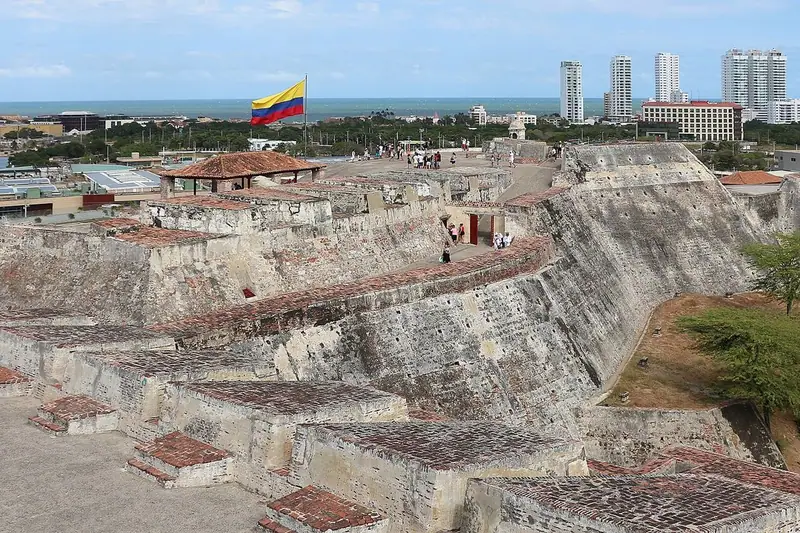 Spanish Colonial7 stops · 1639–1763 CE
Castillo San Felipe de Barajas audio guide
Climb the hill of San Lázaro to Cartagena’s great fortress of ramps, batteries and tunnels, guarding the city by land and sea.
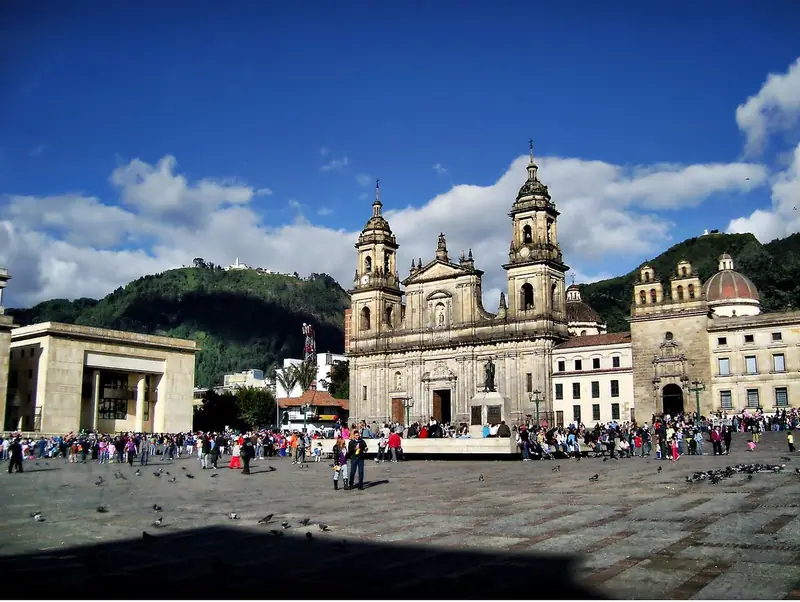 Spanish Colonial8 stops · 1538–1810 CE
La Candelaria, Bogotá audio guide
The steep colonial streets where Bogotá was founded in 1538, from the Plaza de Bolívar to the Gold Museum and the Chorro de Quevedo.
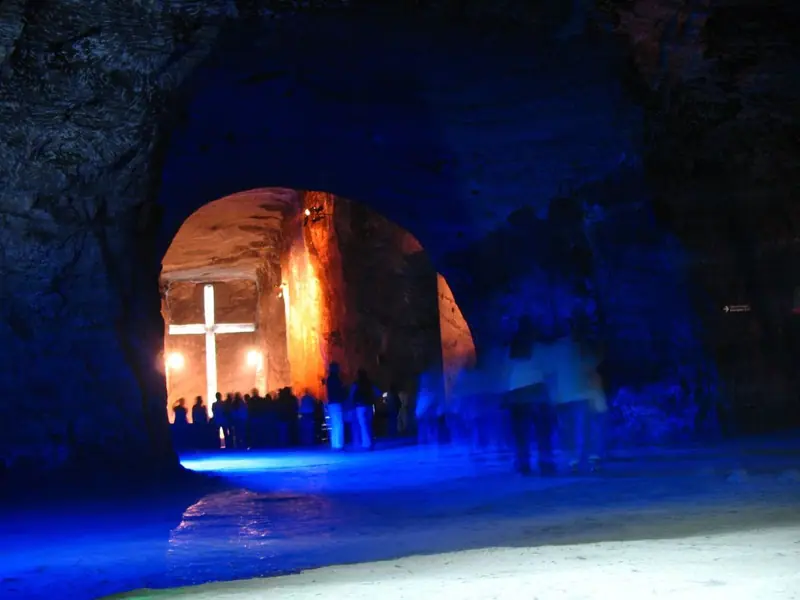 Modern8 stops · 1954–1995 CE
Salt Cathedral of Zipaquirá audio guide
Descend into the tunnels of a salt mine, past the Stations of the Cross carved in rock salt, to the nave and main altar of an underground cathedral.
Every guide, in every country
Cartagena Old Town and every other guide we publish, including future ones. One payment, no subscription.