Before you start
St Augustine, on the Atlantic coast of north-east Florida, is the oldest city in the United States founded by Europeans that has been lived in without a break. The Spanish founded it in 1565, more than forty years before the English settled at Jamestown, and for most of the next two and a half centuries it was the capital of Spanish Florida. Its narrow streets, coquina-stone walls, balconies and courtyards still recall that Spanish past, alongside the grand hotels built in the late nineteenth century, when the railway brought winter visitors from the north. This guide starts at the great stone fort on the bay, passes through the old city gate and along the colonial streets, visits two of the old hotels and the main square, and ends at the oldest house in the city.
Use it as a self-guided tour of St Augustine: 10 stops in visit order, each played when you’re ready, at your own pace.
 Free preview · Stop 1
The Castillo de San Marcos
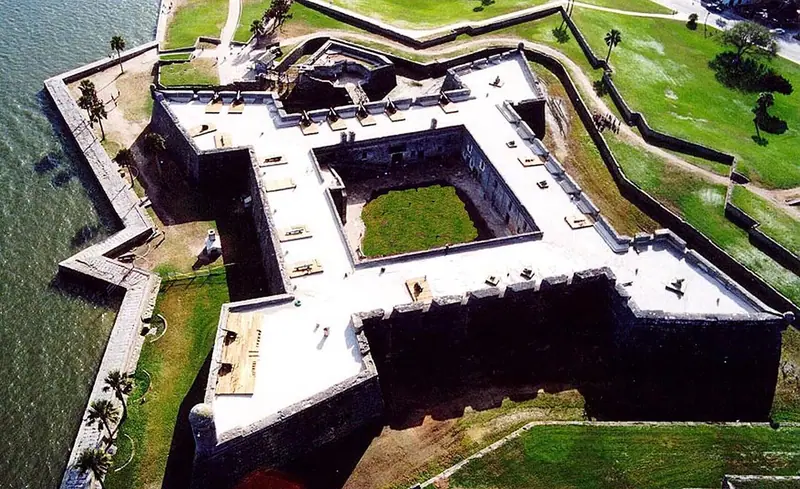
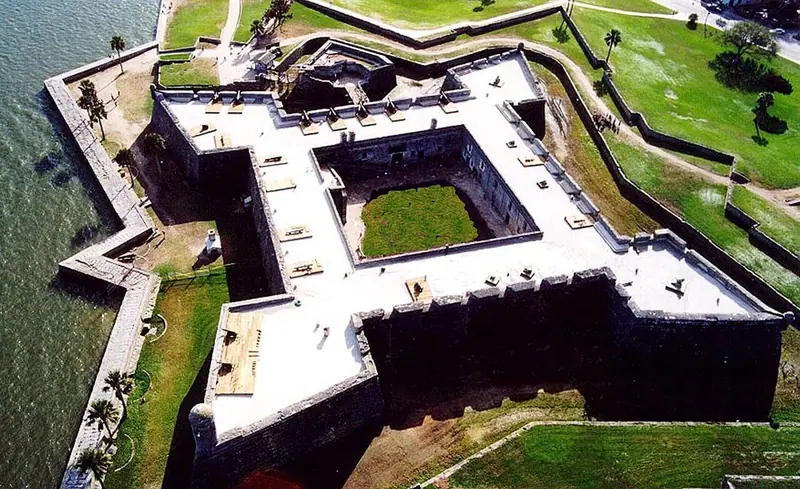
Begin at the Castillo de San Marcos, the great star-shaped fort on the edge of Matanzas Bay. In 1668 the English privateer Robert Searles raided the town, and the Spanish decided to replace their wooden forts with one of stone. Work began on 2 October 1672 and it was declared finished in 1695. It is built of coquina, a soft limestone made of tiny shells cemented together, which the Spanish quarried on Anastasia Island across the bay. When cannon balls struck it, the stone absorbed the blow instead of shattering, and the fort was never taken by force. It passed to Britain in 1763, back to Spain in 1783 and to the United States in 1821. It is the oldest masonry fort in the continental United States and is cared for by the National Park Service. Walk around the moat, and go inside to see the rooms around the courtyard and the gun deck above, with its views over the bay.
Photo: National Park Service · Public domain · Wikimedia Commons
What to see at St Augustine: 10 stops, in visit order
- 01
 The Castillo de San MarcosThe fort of shell stoneFree preview
- 02
 The City GateThe northern entranceIn the guide
- 03
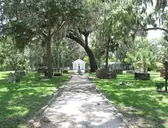 Tolomato CemeteryA mission village and a burial groundIn the guide
- 04
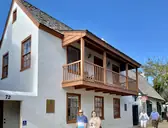 St George StreetThe spine of the colonial townIn the guide
- 05
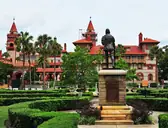 Flagler College (the former Hotel Ponce de León)Flagler's grand hotelIn the guide
- 06
 The Lightner MuseumFlagler's second hotelIn the guide
- 07
 The Cathedral BasilicaThe oldest parishIn the guide
- 08
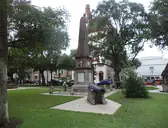 The Plaza de la ConstituciónThe town squareIn the guide
- 09
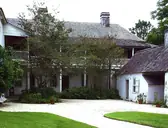 The Ximenez-Fatio HouseA house on Aviles StreetIn the guide
- 10
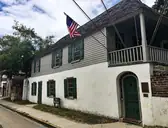 The González-Álvarez HouseThe Oldest HouseIn the guide
History of St Augustine
The Timucua people lived along this coast for thousands of years before Europeans came. On 8 September 1565 the Spanish commander Pedro Menéndez de Avilés came ashore here with soldiers and settlers, to guard the route of the Spanish treasure fleets and to drive out a French colony to the north. The town was attacked by pirates and by the English, and burned more than once, and the Spanish built a great stone fort to protect it. In 1763 Florida passed to Britain, but in 1783 it was returned to Spain, and in 1821 it became part of the United States. In the 1880s the oil magnate Henry Flagler, enchanted by the old town, built grand hotels and a railway, and St Augustine became a winter resort. In 1964 it was the scene of protests against racial segregation that helped to bring about the Civil Rights Act.
St Augustine guide: questions
How many stops does the St Augustine guide have?
10 stops, in visit order: 1. The Castillo de San Marcos; 2. The City Gate; 3. Tolomato Cemetery; 4. St George Street; 5. Flagler College (the former Hotel Ponce de León); 6. The Lightner Museum; 7. The Cathedral Basilica; 8. The Plaza de la Constitución; 9. The Ximenez-Fatio House; 10. The González-Álvarez House.
Can I do a self-guided tour of St Augustine with this guide?
Yes. The guide is made for a self-guided tour: 10 stops in visit order, each with a photo, a story and a voice, so you can explore St Augustine at your own pace, without joining a group. Download it before you go and it works offline.
How long is each guide?
The 10 stops add up to about 8 minutes of listening in total. You play each stop when you’re ready, so you can go at your own pace.
Does the guide work offline?
Yes, once it’s downloaded. The guide is a single self-contained web page (about 9.6 MB) with the photos, text and audio built in. Download it to your phone before you go (Wi-Fi is best); after that it opens in any modern browser on iPhone or Android, with no app, account or mobile signal needed.
Does it use GPS or need my location?
No. The guide doesn’t use GPS and doesn’t know where you are: you play each stop when you reach it. It works on iPhone and Android in any modern browser, and it’s in English.
What’s included?
One self-contained HTML guide: 10 stops in visit order, each with a photo, text and a voice, plus the story of who built the site.
Who built St Augustine?
The Timucua people lived along this coast for thousands of years before Europeans came. On 8 September 1565 the Spanish commander Pedro Menéndez de Avilés came ashore here with soldiers and settlers, to guard the route of the Spanish treasure fleets and to drive out a French colony to the north.
Where is St Augustine?
St Augustine, on the Atlantic coast of north-east Florida, is the oldest city in the United States founded by Europeans that has been lived in without a break.
Is there a free audio guide to St Augustine?
The first stop, The Castillo de San Marcos, is free to read and hear on this page, so you can try the St Augustine audio tour before you buy. The full guide, with all 10 stops, is a one-off purchase: download it once and it’s yours to keep, working offline.
Is the St Augustine guide worth it?
If you’d like to know what you’re looking at, yes. For $10 you get 10 stops in visit order, each with a photo, a short history and a voice you play when you’re ready, about 8 minutes of listening in all. It’s short on purpose, so you spend your time looking, not listening. It’s yours to keep, works offline and needs no app. The first stop is free on this page, so you can try it before you buy. If you’d like hours of detail, a guided tour will go deeper.
Audio guide or guided tour?
It depends how you like to visit. This guide lets you explore St Augustine at your own pace, at any time, for a one-off price. A guided tour gives you a live expert you can ask questions, but at fixed times and usually for a higher price. Many people use both: a tour for the big picture, and the guide to read beforehand or to revisit the stops in their own time.
Is this the official St Augustine guide?
No. It’s an independent guide by The Historian Guide, not affiliated with or endorsed by the operator of St Augustine. For tickets and opening hours, check the official site operator before you go.
Does the guide include entry tickets or opening hours?
No. The guide is a digital companion only. Admission to St Augustine is separate, so check the official site operator for current tickets and opening hours before you go.
- Stop 1 · The Castillo de San Marcos (also the cover): National Park Service · Public domain · Wikimedia Commons · resized
- Stop 2 · The City Gate: Diego Delso · CC BY-SA 3.0 · Wikimedia Commons · resized
- Stop 3 · Tolomato Cemetery: Mdnghtshdw · CC BY-SA 3.0 · Wikimedia Commons · resized
- Stop 4 · St George Street: w_lemay · CC BY-SA 2.0 · Wikimedia Commons · resized
- Stop 5 · Flagler College (the former Hotel Ponce de León): Steve @ the alligator farm · CC BY-SA 2.0 · Wikimedia Commons · resized
- Stop 6 · The Lightner Museum: w_lemay · CC BY-SA 2.0 · Wikimedia Commons · resized
- Stop 7 · The Cathedral Basilica: Farragutful · CC BY-SA 4.0 · Wikimedia Commons · resized
- Stop 8 · The Plaza de la Constitución: Michael Rivera · CC BY-SA 3.0 · Wikimedia Commons · resized
- Stop 9 · The Ximenez-Fatio House: XFHouse · CC BY-SA 3.0 · Wikimedia Commons · resized
- Stop 10 · The González-Álvarez House: Bwickliffe · CC BY-SA 4.0 · Wikimedia Commons · resized


All photographs from Wikimedia Commons under the licences shown.
More guides in United States
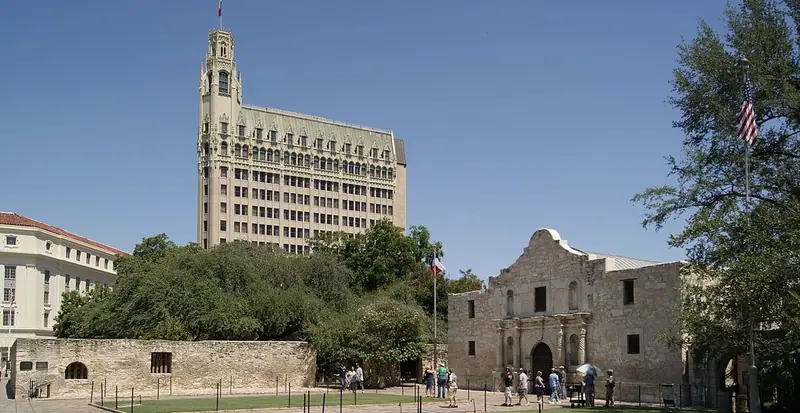 Spanish Colonial7 stops · 1718–1782
Alamo and San Antonio Missions audio guide
From the battle-scarred Alamo to Mission San José and the Espada Aqueduct, the five missions that made San Antonio.
 Modern8 stops · 1853–1963
Alcatraz audio guide
Step off the boat into the cellhouse, walk D Block and the yard, and hear the story of the 1962 escape.
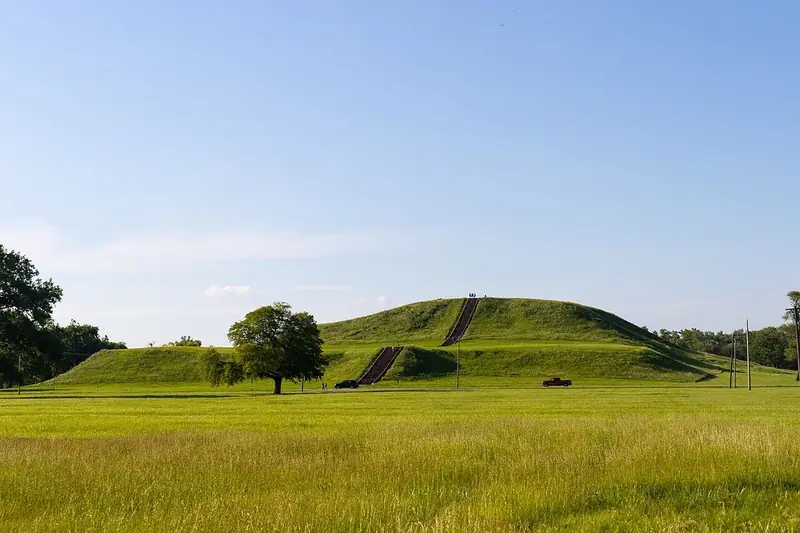 Mississippian8 stops · c. 1050 – 1350 CE
Cahokia Mounds audio guide
The largest pre-Columbian city north of Mexico, with Monks Mound, the Grand Plaza and the remains of its solar calendar posts.
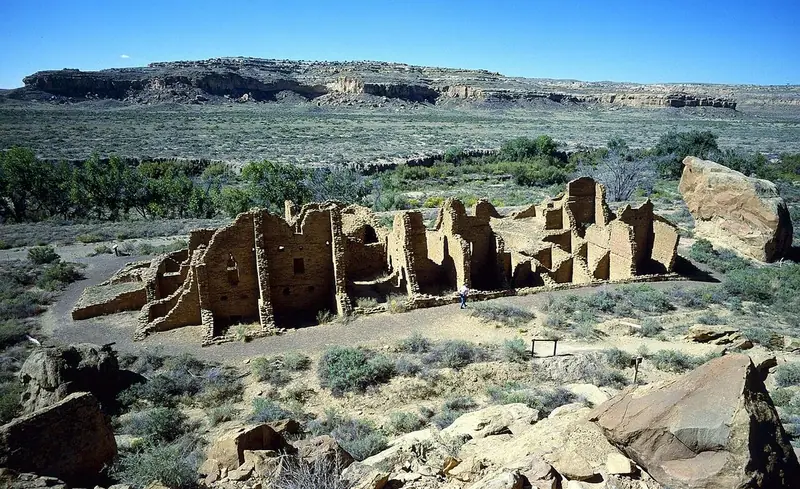 Ancestral Puebloan8 stops · c. 850–1150 CE
Chaco Canyon audio guide
The great houses of Pueblo Bonito and Chetro Ketl, planned buildings of stone that rose several storeys high.
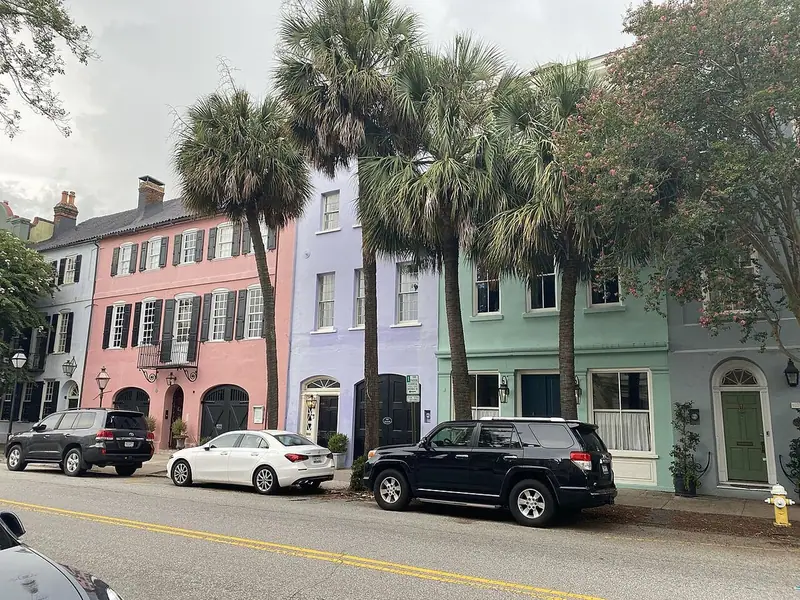 Colonial American12 stops · 17th–20th century CE
Charleston audio guide
Mother Emanuel and Beth Elohim, St Philip’s and the Huguenot Church, the Old Slave Mart, the Four Corners of Law, Rainbow Row and the Battery.
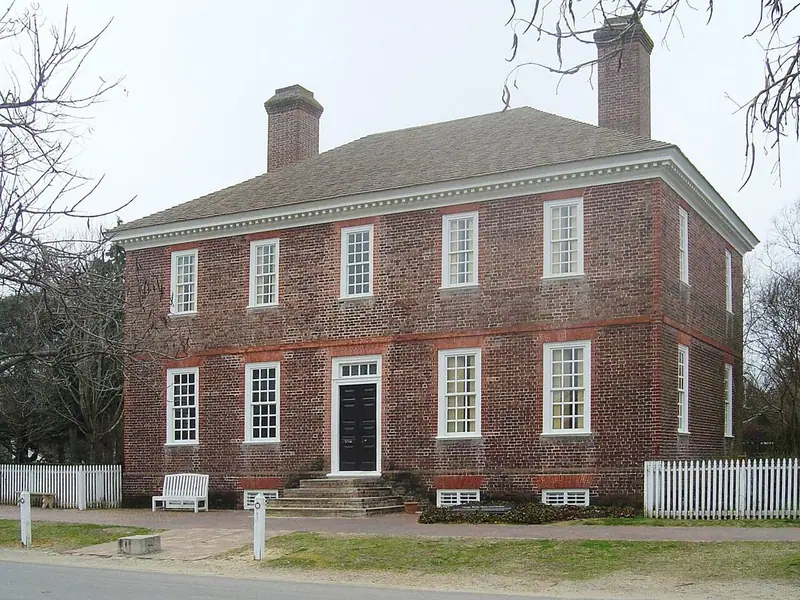 Colonial American8 stops · 1699–1780
Colonial Williamsburg audio guide
Duke of Gloucester Street, from the Capitol to the Governor’s Palace, in the restored capital of colonial Virginia.
Every guide, in every country
St Augustine and every other guide we publish, including future ones. One payment, no subscription.