Before you start
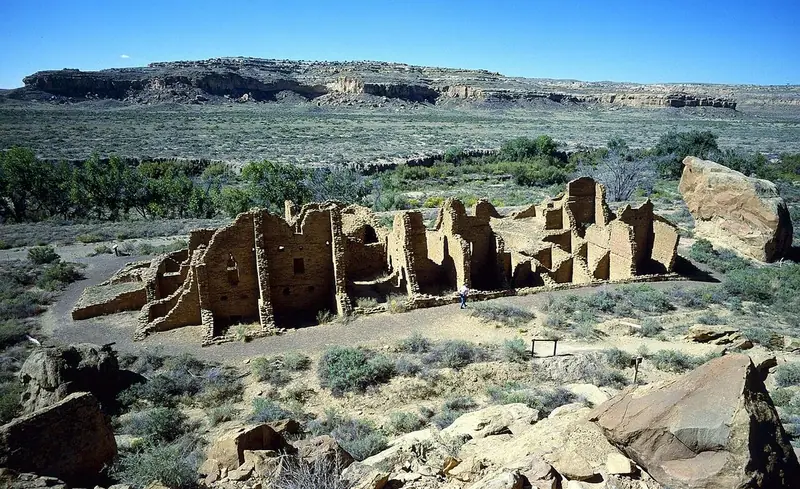
Chaco Canyon, in the high desert of north-western New Mexico, holds the greatest concentration of monumental ancient buildings in the American Southwest. It is protected as Chaco Culture National Historical Park, cared for by the US National Park Service, and it was inscribed as a UNESCO World Heritage Site in 1987. The canyon is remote: the last stretch of the approach roads is rough, unpaved track that can become impassable after rain or snow, and there are no shops, fuel or food in the park. A one-way paved loop road of about fourteen kilometres links the main sites, each reached by a short walk from its car park. This guide starts at the visitor centre and Una Vida beside it, then follows the Canyon Loop Drive past Hungo Pavi, Chetro Ketl, Pueblo Bonito, Kin Kletso and Pueblo del Arroyo, finishing at the great kiva of Casa Rinconada.
Use it as a self-guided tour of Chaco Canyon: 8 stops in visit order, each played when you’re ready, at your own pace.
 Free preview · Stop 1
Visitor Center
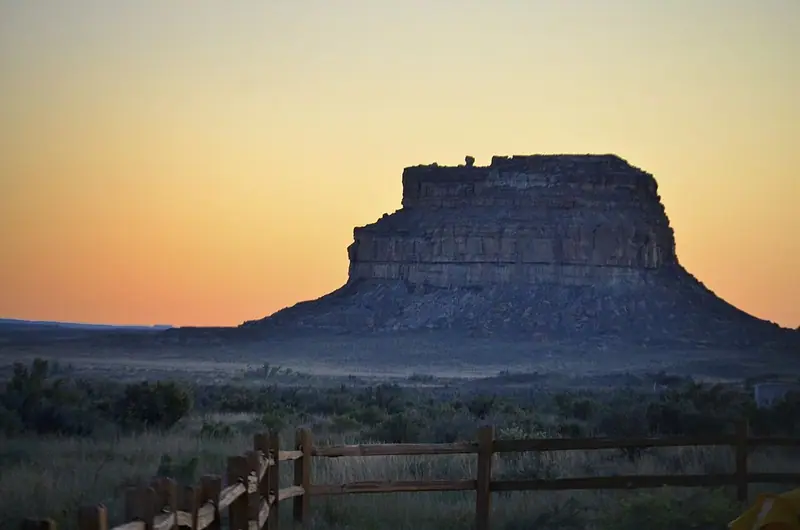
Begin at the visitor centre near the eastern entrance of the canyon, where exhibits and a short film introduce the Chacoan world, with pottery, turquoise, tools and objects traded from far away. Check the day’s ranger programmes and trail conditions here. Outside, look south-east to Fajada Butte, the tall, solitary mesa that rises from the canyon floor. Near its summit, a spiral carved on the rock is lit by daggers of sunlight passing between slabs of stone at the solstices and equinoxes; the butte is closed to visitors to protect it, but it reminds you how closely the Chacoans watched the sky. Chaco is also an International Dark Sky Park, and on clear nights the stars here are extraordinary. Fill your water bottles before you set off, as there is no water at the sites.
Photo: Joeykujawski · CC BY-SA 3.0 · Wikimedia Commons
What to see at Chaco Canyon: 8 stops, in visit order
- 01
 Visitor CenterFajada ButteFree preview
- 02
 Una VidaAn early great houseIn the guide
- 03
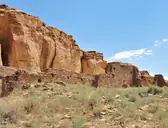 Hungo PaviA great house left as foundIn the guide
- 04
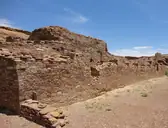 Chetro KetlGreat kiva and colonnadeIn the guide
- 05
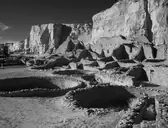 Pueblo BonitoHeart of the Chacoan worldIn the guide
- 06
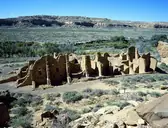 Kin KletsoA later great houseIn the guide
- 07
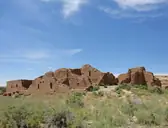 Pueblo del ArroyoBy the washIn the guide
- 08
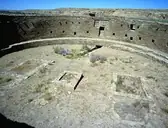 Casa RinconadaThe great kivaIn the guide
Site map of Chaco Canyon
History of Chaco Canyon
Chaco Canyon was built by the Ancestral Pueblo people, the ancestors of today’s Pueblo peoples of New Mexico and Arizona, such as the Hopi and Zuni. Farmers had lived in the canyon for centuries, but from about 850 CE they began to build great houses, huge planned buildings of stone and timber, several storeys high. Chaco became the centre of a world that stretched across the Four Corners region, linked by long, straight roads, and it flourished until about 1150 CE, when building stopped and people gradually moved away, probably in part because of drought. The builders had no metal tools, draught animals or wheels, yet they carried hundreds of thousands of timbers from distant mountains. Pueblo peoples and the Navajo still regard Chaco as a sacred place.
Chaco Canyon guide: questions
How many stops does the Chaco Canyon guide have?
8 stops, in visit order: 1. Visitor Center; 2. Una Vida; 3. Hungo Pavi; 4. Chetro Ketl; 5. Pueblo Bonito; 6. Kin Kletso; 7. Pueblo del Arroyo; 8. Casa Rinconada.
Can I do a self-guided tour of Chaco Canyon with this guide?
Yes. The guide is made for a self-guided tour: 8 stops in visit order, each with a photo, a story and a voice, so you can explore Chaco Canyon at your own pace, without joining a group. Download it before you go and it works offline.
How long is each guide?
The 8 stops add up to about 6 minutes of listening in total. You play each stop when you’re ready, so you can go at your own pace.
Does the guide work offline?
Yes, once it’s downloaded. The guide is a single self-contained web page (about 7.7 MB) with the photos, text and audio built in. Download it to your phone before you go (Wi-Fi is best); after that it opens in any modern browser on iPhone or Android, with no app, account or mobile signal needed.
Does it use GPS or need my location?
No. The guide doesn’t use GPS and doesn’t know where you are: you play each stop when you reach it. It works on iPhone and Android in any modern browser, and it’s in English.
What’s included?
One self-contained HTML guide: 8 stops in visit order, each with a photo, text and a voice, plus the story of who built the site.
Who built Chaco Canyon?
Chaco Canyon was built by the Ancestral Pueblo people, the ancestors of today’s Pueblo peoples of New Mexico and Arizona, such as the Hopi and Zuni. Farmers had lived in the canyon for centuries, but from about 850 CE they began to build great houses, huge planned buildings of stone and timber, several storeys high.
Where is Chaco Canyon?
Chaco Canyon, in the high desert of north-western New Mexico, holds the greatest concentration of monumental ancient buildings in the American Southwest.
Is there a free audio guide to Chaco Canyon?
The first stop, Visitor Center, is free to read and hear on this page, so you can try the Chaco Canyon audio tour before you buy. The full guide, with all 8 stops, is a one-off purchase: download it once and it’s yours to keep, working offline.
Is the Chaco Canyon guide worth it?
If you’d like to know what you’re looking at, yes. For $10 you get 8 stops in visit order, each with a photo, a short history and a voice you play when you’re ready, plus a site map of the stops, and about 6 minutes of listening in all. It’s short on purpose, so you spend your time looking, not listening. It’s yours to keep, works offline and needs no app. The first stop is free on this page, so you can try it before you buy. If you’d like hours of detail, a guided tour will go deeper.
Audio guide or guided tour?
It depends how you like to visit. This guide lets you explore Chaco Canyon at your own pace, at any time, for a one-off price. A guided tour gives you a live expert you can ask questions, but at fixed times and usually for a higher price. Many people use both: a tour for the big picture, and the guide to read beforehand or to revisit the stops in their own time.
Is this the official Chaco Canyon guide?
No. It’s an independent guide by The Historian Guide, not affiliated with or endorsed by the operator of Chaco Canyon. For tickets and opening hours, check the official site operator before you go.
Does the guide include entry tickets or opening hours?
No. The guide is a digital companion only. Admission to Chaco Canyon is separate, so check the official site operator for current tickets and opening hours before you go.
- Stop 1 · Visitor Center: Joeykujawski · CC BY-SA 3.0 · Wikimedia Commons · resized
- Stop 2 · Una Vida: runt35 · CC BY 3.0 · Wikimedia Commons · resized
- Stop 3 · Hungo Pavi: Rationalobserver · CC BY-SA 4.0 · Wikimedia Commons · resized
- Stop 4 · Chetro Ketl: Rationalobserver · CC BY-SA 4.0 · Wikimedia Commons · resized
- Stop 5 · Pueblo Bonito: Greg Willis from Denver, CO, usa · CC BY-SA 2.0 · Wikimedia Commons · resized
- Stop 6 · Kin Kletso (also the cover): HJPD · CC BY 3.0 · Wikimedia Commons · resized
- Stop 7 · Pueblo del Arroyo: Rationalobserver · CC BY-SA 4.0 · Wikimedia Commons · resized
- Stop 8 · Casa Rinconada: HJPD · CC BY 3.0 · Wikimedia Commons · resized


All photographs from Wikimedia Commons under the licences shown.
More guides in United States
 Spanish Colonial7 stops · 1718–1782
Alamo and San Antonio Missions audio guide
From the battle-scarred Alamo to Mission San José and the Espada Aqueduct, the five missions that made San Antonio.
 Modern8 stops · 1853–1963
Alcatraz audio guide
Step off the boat into the cellhouse, walk D Block and the yard, and hear the story of the 1962 escape.
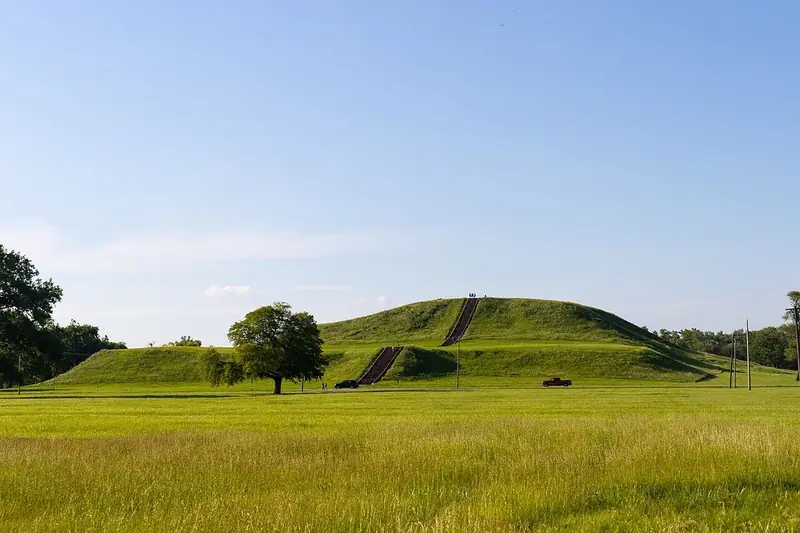 Mississippian8 stops · c. 1050 – 1350 CE
Cahokia Mounds audio guide
The largest pre-Columbian city north of Mexico, with Monks Mound, the Grand Plaza and the remains of its solar calendar posts.
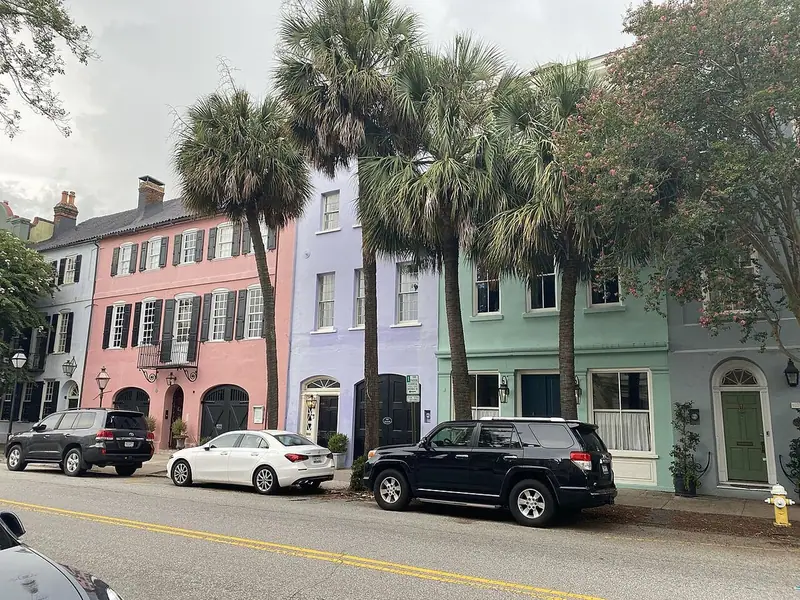 Colonial American12 stops · 17th–20th century CE
Charleston audio guide
Mother Emanuel and Beth Elohim, St Philip’s and the Huguenot Church, the Old Slave Mart, the Four Corners of Law, Rainbow Row and the Battery.
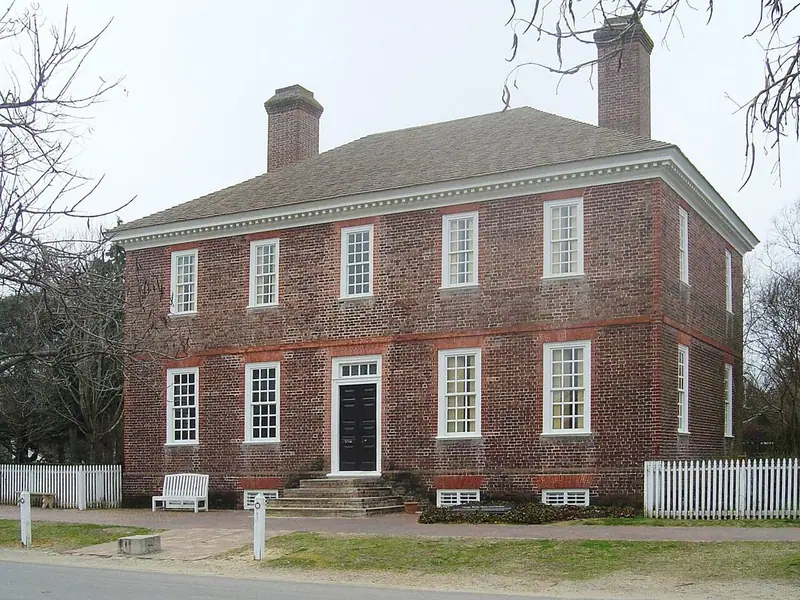 Colonial American8 stops · 1699–1780
Colonial Williamsburg audio guide
Duke of Gloucester Street, from the Capitol to the Governor’s Palace, in the restored capital of colonial Virginia.
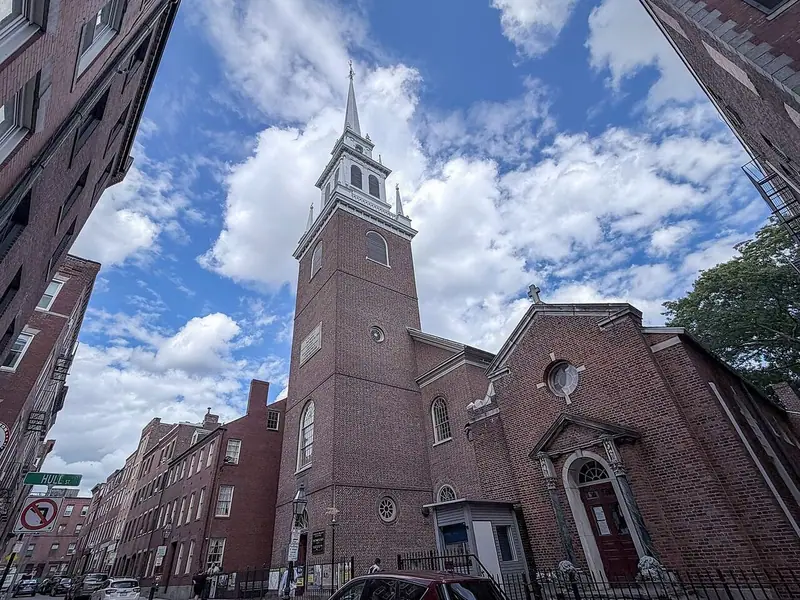 Colonial American9 stops · 1660s–1790s
Freedom Trail audio guide
Follow the red line from Boston Common past Faneuil Hall and Paul Revere’s house to the USS Constitution.
Every guide, in every country
Chaco Canyon and every other guide we publish, including future ones. One payment, no subscription.