Before you start
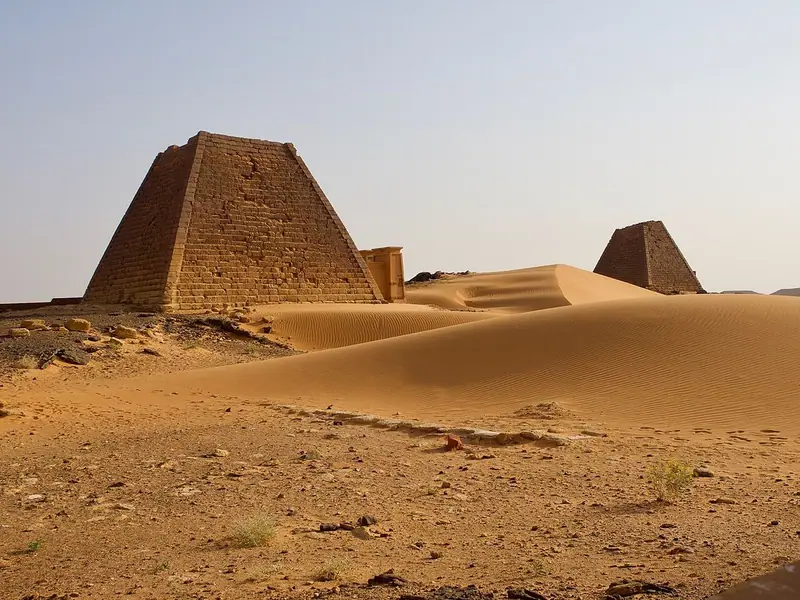
The Island of Meroe is the old name for the semi-desert plain between the Nile, the Atbara and the Blue Nile, north-east of Khartoum, the heartland of the Kingdom of Kush. UNESCO inscribed three of its sites as a World Heritage Site in 2011: Meroe, the royal capital with its town and pyramid cemeteries beside the Nile, and the inland temple sites of Musawwarat es-Sufra and Naqa. Many pyramids were torn open by treasure hunters in the nineteenth century. Since April 2023 Sudan has been at war, and most conservation work and research at the sites has stopped; in 2025 and 2026 UNESCO warned that the property was highly vulnerable and might be placed on the List of World Heritage in Danger. This guide says plainly what has been damaged, and what stands today. Check your government’s current travel advice before you plan a visit.
Use it as a self-guided tour of Meroe: 12 stops in visit order, each played when you’re ready, at your own pace.
 Free preview · Stop 1
The Royal City
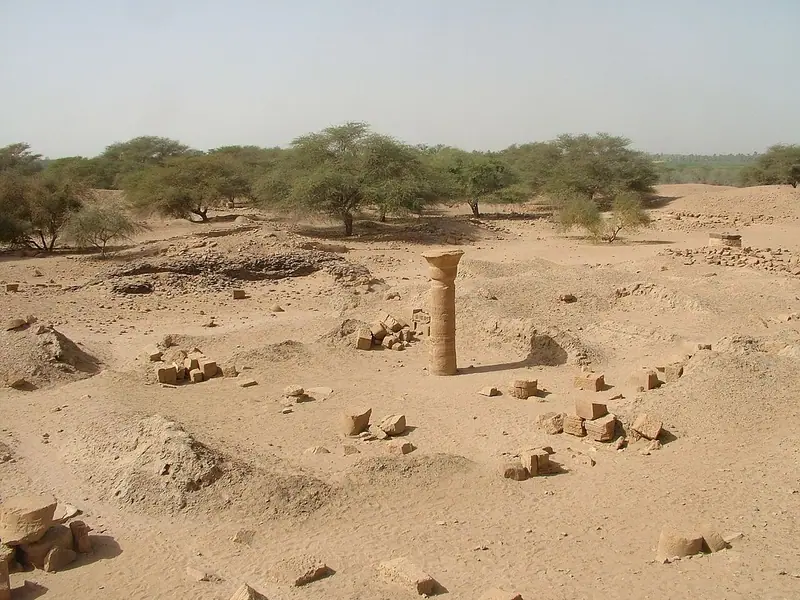
Begin at the royal city, near the river, where low mounds, scattered stones and broken columns mark the capital of Kush. Herodotus heard of it in the fifth century BCE as a great city, the mother city of the Ethiopians, as the Greeks called the people of Kush. Excavations by John Garstang between 1909 and 1914, uncovered walled palaces, a great temple of Amun, and the so-called Royal Baths, a pool decorated with statues and painted plaster. Under the steps of one temple Garstang found a bronze head of the Roman emperor Augustus, carried off from Egypt during a war with Rome; it is now in a museum in London. Around the town lie great heaps of iron slag, which led one Victorian scholar to call Meroe the Birmingham of Africa, though the scale of its iron industry is now debated. The town lies partly under fields and acacia scrub.
Photo: LassiHU · CC BY-SA 4.0 · Wikimedia Commons. Taken in 2005
What to see at Meroe: 12 stops, in visit order
- 01
 The Royal CityA capital beside the NileFree preview
- 02
 The North CemeteryA city of pyramidsIn the guide
- 03
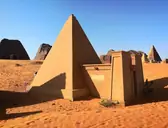 The Shape of a Kushite PyramidSteep sides and a chapelIn the guide
- 04
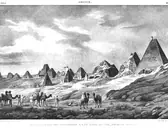 The Pyramids in 1821Before the treasure huntersIn the guide
- 05
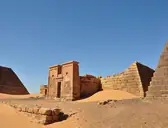 The Pyramid of AmanishakhetoPulled down in 1834In the guide
- 06
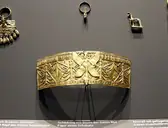 The Treasure of the QueenGold from KushIn the guide
- 07
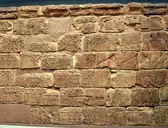 The KandakesThe ruling queens of KushIn the guide
- 08
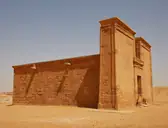 The Lion Temple of MusawwaratThe temple of ApedemakIn the guide
- 09
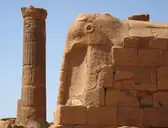 The Great EnclosureA maze of walls and elephantsIn the guide
- 10
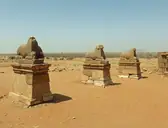 The Temple of Amun at NaqaAn avenue of ramsIn the guide
- 11
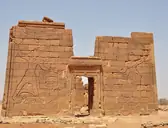 The Lion Temple of NaqaA king and a queen in triumphIn the guide
- 12
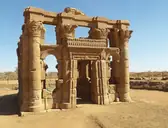 The Roman KioskWhere Egypt met RomeIn the guide
History of Meroe
Kush was a Nubian kingdom on the middle Nile, and one of Africa’s earliest great states. In the eighth century BCE its kings, ruling from Napata far to the north, conquered Egypt and reigned there as the Twenty-fifth Dynasty. Driven back south, they made Meroe their main residence, and from about 300 BCE most kings and queens were buried here, beneath steep pyramids. Meroe traded with Egypt, the Greek and Roman worlds and the lands to the south, worked iron on a large scale, and developed its own script, Meroitic, which can be read but is still only partly understood. Several of its rulers were queens, known by the title kandake. The kingdom declined from the second century CE and broke up in the fourth century, when an Aksumite army campaigned in the region.
The full history continues in the guide.
Meroe guide: questions
How many stops does the Meroe guide have?
12 stops, in visit order: 1. The Royal City; 2. The North Cemetery; 3. The Shape of a Kushite Pyramid; 4. The Pyramids in 1821; 5. The Pyramid of Amanishakheto; 6. The Treasure of the Queen; 7. The Kandakes; 8. The Lion Temple of Musawwarat; 9. The Great Enclosure; 10. The Temple of Amun at Naqa; 11. The Lion Temple of Naqa; 12. The Roman Kiosk.
Can I do a self-guided tour of Meroe with this guide?
Yes. The guide is made for a self-guided tour: 12 stops in visit order, each with a photo, a story and a voice, so you can explore Meroe at your own pace, without joining a group. Download it before you go and it works offline.
How long do you need at Meroe?
We suggest allowing two days. The 12 stops add up to about 9 minutes of listening, and you play each one when you’re ready, so you can linger wherever you like.
How long is each guide?
The 12 stops add up to about 9 minutes of listening in total. You play each stop when you’re ready, so you can go at your own pace.
Does the guide work offline?
Yes, once it’s downloaded. The guide is a single self-contained web page (about 10.2 MB) with the photos, text and audio built in. Download it to your phone before you go (Wi-Fi is best); after that it opens in any modern browser on iPhone or Android, with no app, account or mobile signal needed.
Does it use GPS or need my location?
No. The guide doesn’t use GPS and doesn’t know where you are: you play each stop when you reach it. It works on iPhone and Android in any modern browser, and it’s in English.
What’s included?
One self-contained HTML guide: 12 stops in visit order, each with a photo, text and a voice, plus the story of who built the site.
Who built Meroe?
Kush was a Nubian kingdom on the middle Nile, and one of Africa’s earliest great states. In the eighth century BCE its kings, ruling from Napata far to the north, conquered Egypt and reigned there as the Twenty-fifth Dynasty.
Where is Meroe?
The Island of Meroe is the old name for the semi-desert plain between the Nile, the Atbara and the Blue Nile, north-east of Khartoum, the heartland of the Kingdom of Kush.
Is there a free audio guide to Meroe?
The first stop, The Royal City, is free to read and hear on this page, so you can try the Meroe audio tour before you buy. The full guide, with all 12 stops, is a one-off purchase: download it once and it’s yours to keep, working offline.
Is the Meroe guide worth it?
If you’d like to know what you’re looking at, yes. For $10 you get 12 stops in visit order, each with a photo, a short history and a voice you play when you’re ready, about 9 minutes of listening in all. It’s short on purpose, so you spend your time looking, not listening. It’s yours to keep, works offline and needs no app. The first stop is free on this page, so you can try it before you buy. If you’d like hours of detail, a guided tour will go deeper.
Audio guide or guided tour?
It depends how you like to visit. This guide lets you explore Meroe at your own pace, at any time, for a one-off price. A guided tour gives you a live expert you can ask questions, but at fixed times and usually for a higher price. Many people use both: a tour for the big picture, and the guide to read beforehand or to revisit the stops in their own time.
Is this the official Meroe guide?
No. It’s an independent guide by The Historian Guide, not affiliated with or endorsed by the operator of Meroe. For tickets and opening hours, check the official site operator before you go.
Does the guide include entry tickets or opening hours?
No. The guide is a digital companion only. Admission to Meroe is separate, so check the official site operator for current tickets and opening hours before you go.
- Stop 1 · The Royal City: LassiHU · CC BY-SA 4.0 · Wikimedia Commons · resized
- Stop 2 · The North Cemetery (also the cover): Laurent de Walick · CC BY 2.0 · Wikimedia Commons · resized
- Stop 3 · The Shape of a Kushite Pyramid: Ahmed Amir · CC BY-SA 4.0 · Wikimedia Commons · resized
- Stop 4 · The Pyramids in 1821: Cailliaud, Frédéric in 1826 · Public domain · Wikimedia Commons · resized
- Stop 5 · The Pyramid of Amanishakheto: TrackHD · CC BY-SA 3.0 · Wikimedia Commons · resized
- Stop 6 · The Treasure of the Queen: © José Luiz Bernardes Ribeiro · CC BY-SA 4.0 · Wikimedia Commons · resized
- Stop 7 · The Kandakes: Osama Shukir Muhammed Amin FRCP(Glasg) · CC BY-SA 4.0 · Wikimedia Commons · resized
- Stop 8 · The Lion Temple of Musawwarat: Vaido Otsar · CC BY-SA 4.0 · Wikimedia Commons · resized
- Stop 9 · The Great Enclosure: Ron Van Oers · CC BY-SA 3.0 igo · Wikimedia Commons · resized
- Stop 10 · The Temple of Amun at Naqa: Hans Birger Nilsen · CC BY-SA 2.0 · Wikimedia Commons · resized
- Stop 11 · The Lion Temple of Naqa: TrackHD · CC BY 3.0 · Wikimedia Commons · resized
- Stop 12 · The Roman Kiosk: RomanDeckert · CC BY-SA 4.0 · Wikimedia Commons · resized


All photographs from Wikimedia Commons under the licences shown.
More guides in Sudan
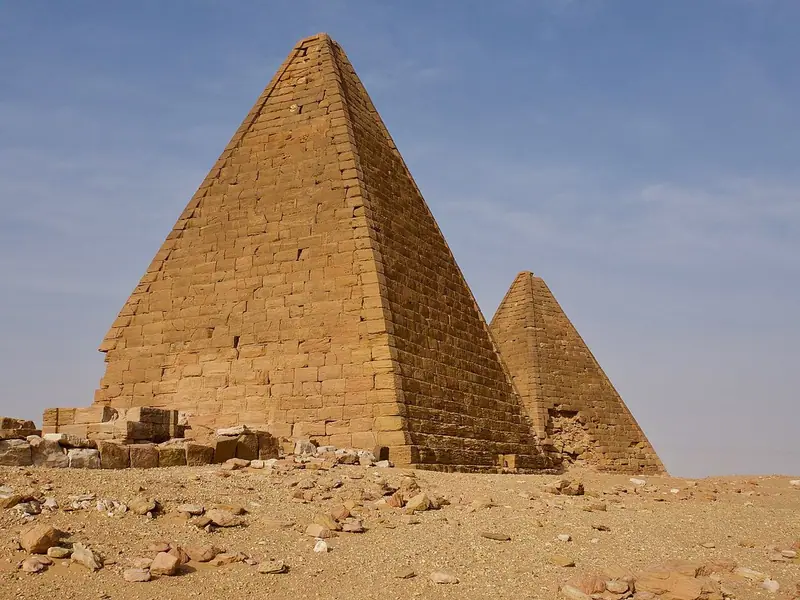 Kushite10 stops · c. 1450 BCE – 4th century CE
Gebel Barkal audio guide
The holy mountain of Amun beside the Nile, with the temples and pyramids of the Black Pharaohs and the painted royal tombs of El-Kurru and Nuri.
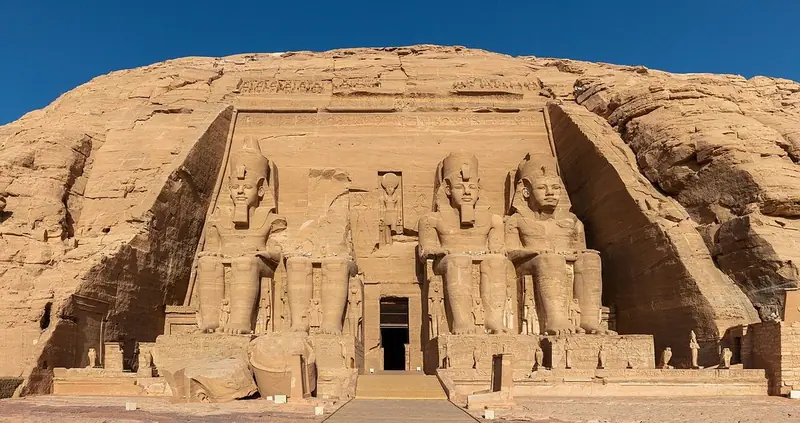 Ancient Egyptian8 stops · 13th century BCE
Abu Simbel audio guide
Ramesses II’s colossal temple façade, the Temple of Nefertari, and how both were rescued from the waters of Lake Nasser.
 Ga7 stops · 1649–1957
Old Accra audio guide
From the old forts and lighthouse of Jamestown, through the Ga fishing quarter, to the monuments of Ghana’s independence and Osu Castle.
Every guide, in every country
Meroe and every other guide we publish, including future ones. One payment, no subscription.