Before you start
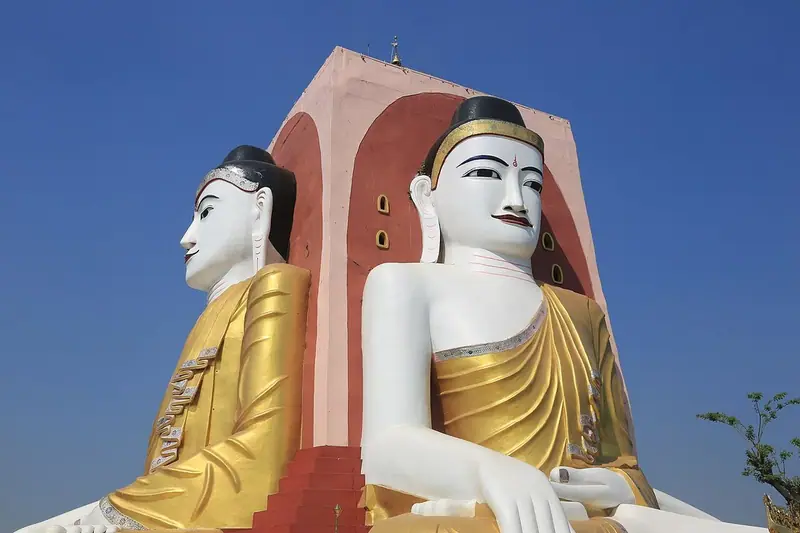
Bago, the old Pegu, lies about ninety kilometres northeast of Yangon, and was once the capital of the Mon kingdom of Hanthawaddy and later of one of the largest empires in Southeast Asian history. Today it is a busy provincial town, but its great pagodas and reclining Buddhas make it one of the most rewarding day trips from Yangon. This guide visits the giant Shwemawdaw stupa and the hill of the Hintha bird, the reconstructed palace of King Bayinnaung, then the great reclining Buddha, Bayinnaung’s pagoda close by, and the four seated Buddhas on the edge of town. The sites are spread out, so a car or taxi is needed between them. Shoes and socks are removed at every pagoda, so wear sandals and dress modestly.
Use it as a self-guided tour of Bago: 6 stops in visit order, each played when you’re ready, at your own pace.
 Free preview · Stop 1
Shwemawdaw Pagoda
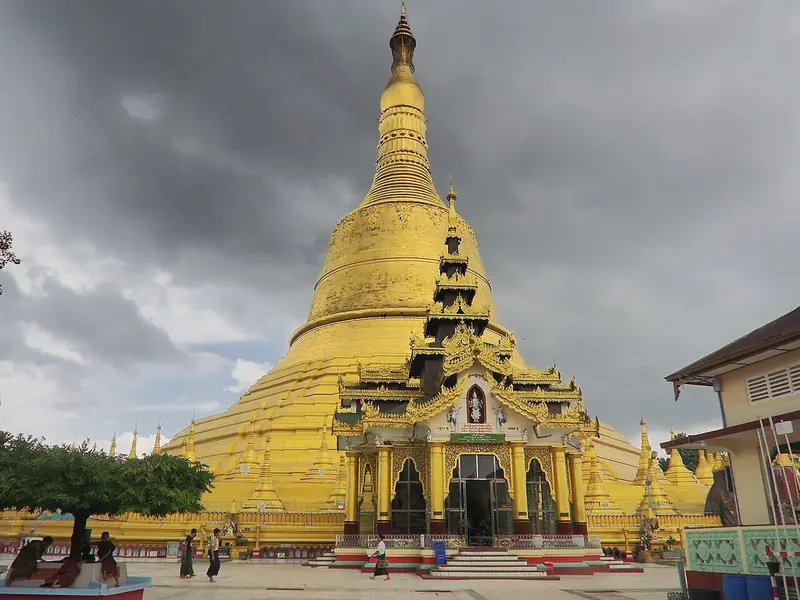
Begin at the Shwemawdaw Pagoda, the great golden stupa that towers over Bago. With its spire, it rises about 114 metres, higher even than the Shwedagon in Yangon. Tradition claims that it was built in the lifetime of the Buddha by two merchant brothers to enshrine two of his hairs, though this story may date only from the eighteenth century. In recorded history it was enlarged by many kings: Razadarit built small stupas around it in 1390, and Bayinnaung gave a crowning umbrella set with jewels from his own crown. The stupa was badly damaged by earthquakes in the early twentieth century and collapsed in 1930; it was rebuilt in the 1950s. Look for the great fallen portion of the earlier stupa, which has been kept on the platform as a reminder of the earthquake.
Photo: Clay Gilliland · CC BY-SA 2.0 · Wikimedia Commons
What to see at Bago: 6 stops, in visit order
- 01
 Shwemawdaw PagodaThe Great Golden GodFree preview
- 02
 Hintha GonThe Hill of the Sacred BirdIn the guide
- 03
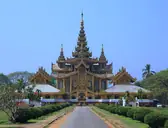 Kanbawzathadi PalaceBayinnaung’s Golden PalaceIn the guide
- 04
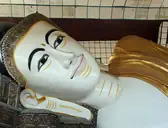 Shwethalyaung BuddhaThe Sleeping GiantIn the guide
- 05
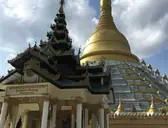 Mahazedi PagodaThe Tooth Relic StupaIn the guide
- 06
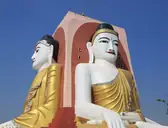 Kyaik PunFour Buddhas Back to BackIn the guide
Site map of Bago
History of Bago
Bago rose to greatness as the capital of the Hanthawaddy Kingdom, the Mon kingdom of Lower Burma, which ruled from 1287 to 1539. Its kings, among them Razadarit, Queen Shin Saw Pu and Dhammazedi, made it a rich trading port and a great centre of Theravada Buddhism. In 1539 the city fell to the Taungoo dynasty of the Burmese, and under King Bayinnaung, who reigned from 1550 to 1581, it became the capital of a vast empire that stretched into what is now Thailand and Laos. The city was sacked in 1599, briefly revived as the capital of a restored Mon kingdom in the eighteenth century, and destroyed by the Burmese king Alaungpaya in 1757.
Bago guide: questions
How many stops does the Bago guide have?
6 stops, in visit order: 1. Shwemawdaw Pagoda; 2. Hintha Gon; 3. Kanbawzathadi Palace; 4. Shwethalyaung Buddha; 5. Mahazedi Pagoda; 6. Kyaik Pun.
Can I do a self-guided tour of Bago with this guide?
Yes. The guide is made for a self-guided tour: 6 stops in visit order, each with a photo, a story and a voice, so you can explore Bago at your own pace, without joining a group. Download it before you go and it works offline.
How long is each guide?
The 6 stops add up to about 4 minutes of listening in total. You play each stop when you’re ready, so you can go at your own pace.
Does the guide work offline?
Yes, once it’s downloaded. The guide is a single self-contained web page (about 5.6 MB) with the photos, text and audio built in. Download it to your phone before you go (Wi-Fi is best); after that it opens in any modern browser on iPhone or Android, with no app, account or mobile signal needed.
Does it use GPS or need my location?
No. The guide doesn’t use GPS and doesn’t know where you are: you play each stop when you reach it. It works on iPhone and Android in any modern browser, and it’s in English.
What’s included?
One self-contained HTML guide: 6 stops in visit order, each with a photo, text and a voice, plus the story of who built the site.
Who built Bago?
Bago rose to greatness as the capital of the Hanthawaddy Kingdom, the Mon kingdom of Lower Burma, which ruled from 1287 to 1539. Its kings, among them Razadarit, Queen Shin Saw Pu and Dhammazedi, made it a rich trading port and a great centre of Theravada Buddhism.
Is there a free audio guide to Bago?
The first stop, Shwemawdaw Pagoda, is free to read and hear on this page, so you can try the Bago audio tour before you buy. The full guide, with all 6 stops, is a one-off purchase: download it once and it’s yours to keep, working offline.
Is the Bago guide worth it?
If you’d like to know what you’re looking at, yes. For $10 you get 6 stops in visit order, each with a photo, a short history and a voice you play when you’re ready, plus a site map of the stops, and about 4 minutes of listening in all. It’s short on purpose, so you spend your time looking, not listening. It’s yours to keep, works offline and needs no app. The first stop is free on this page, so you can try it before you buy. If you’d like hours of detail, a guided tour will go deeper.
Audio guide or guided tour?
It depends how you like to visit. This guide lets you explore Bago at your own pace, at any time, for a one-off price. A guided tour gives you a live expert you can ask questions, but at fixed times and usually for a higher price. Many people use both: a tour for the big picture, and the guide to read beforehand or to revisit the stops in their own time.
Is this the official Bago guide?
No. It’s an independent guide by The Historian Guide, not affiliated with or endorsed by the operator of Bago. For tickets and opening hours, check the official site operator before you go.
Does the guide include entry tickets or opening hours?
No. The guide is a digital companion only. Admission to Bago is separate, so check the official site operator for current tickets and opening hours before you go.
- Stop 1 · Shwemawdaw Pagoda: Clay Gilliland · CC BY-SA 2.0 · Wikimedia Commons · resized
- Stop 2 · Hintha Gon: ခင်မောင်မောင်လွင် · CC BY-SA 4.0 · Wikimedia Commons · resized
- Stop 3 · Kanbawzathadi Palace: Hans A. Rosbach · CC BY-SA 3.0 · Wikimedia Commons · resized
- Stop 4 · Shwethalyaung Buddha: Anagoria · CC BY 4.0 · Wikimedia Commons · resized
- Stop 5 · Mahazedi Pagoda: Christophe95 · CC BY-SA 4.0 · Wikimedia Commons · resized
- Stop 6 · Kyaik Pun (also the cover): Hans A. Rosbach · CC BY-SA 3.0 · Wikimedia Commons · resized


All photographs from Wikimedia Commons under the licences shown.
More guides in Myanmar
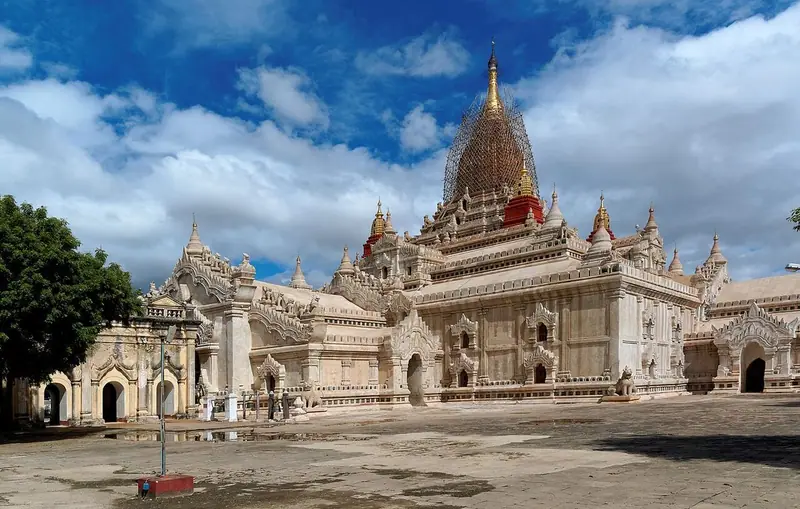 Pagan Kingdom8 stops · 11th–13th century CE
Bagan audio guide
Explore a dry plain beside the Irrawaddy scattered with more than two thousand red-brick temples and stupas, from Shwezigon Pagoda to Ananda and Sulamani.
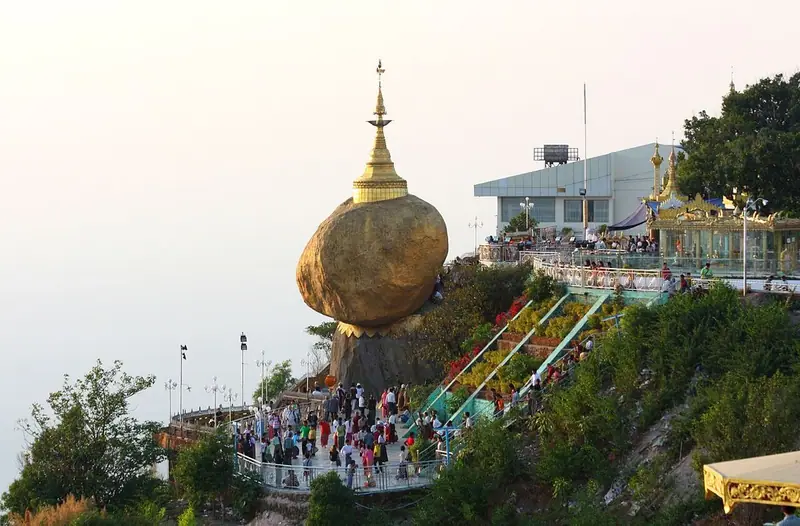 Mon7 stops · date unknown; living shrine
Golden Rock audio guide
Join the pilgrims climbing to a gilded granite boulder balanced on a cliff edge near the summit of Mount Kyaiktiyo.
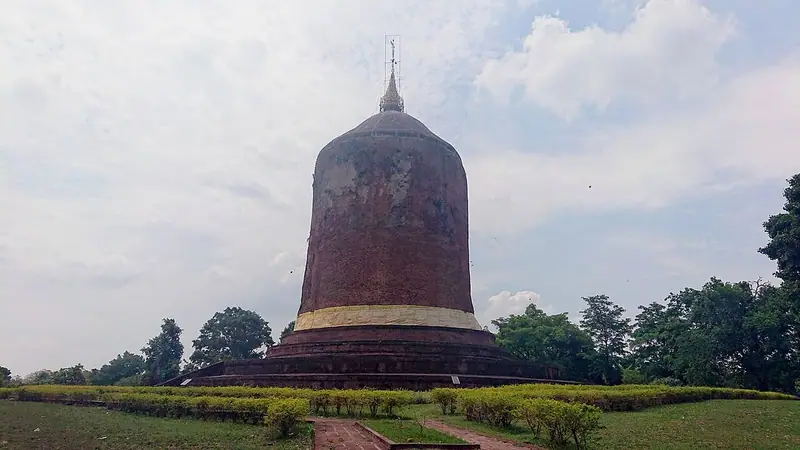 Pyu11 stops · c. 200 BCE – 900 CE
Pyu Ancient Cities audio guide
The first Buddhist cities of South-East Asia: the great brick stupas and walls of Sri Ksetra, the ruins and silver coins of Beikthano, and the burial grounds of Halin.
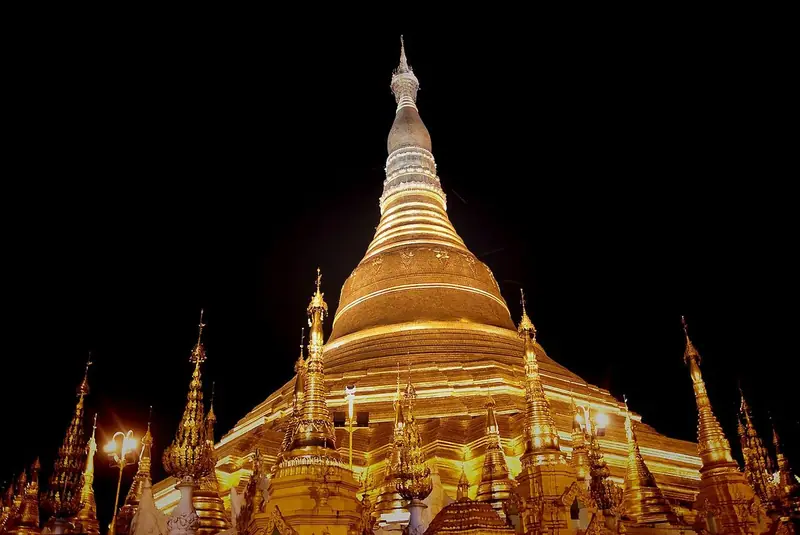 Mon7 stops · 14th century CE onwards
Shwedagon Pagoda audio guide
Climb the southern stairway to the golden stupa on Singuttara Hill, and walk round its marble platform among shrines, bells and pilgrims.
Every guide, in every country
Bago and every other guide we publish, including future ones. One payment, no subscription.