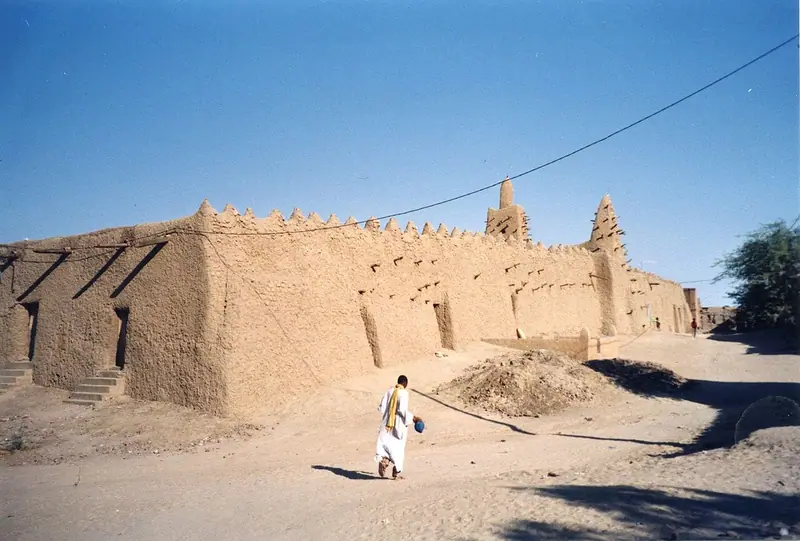
Before you start
Timbuktu lies on the southern edge of the Sahara, about fifteen kilometres north of the main channel of the River Niger, where camel caravans from the desert once met the boats of the river. UNESCO inscribed its three great earthen mosques, Djingareyber, Sankoré and Sidi Yahia, together with sixteen mausoleums and cemeteries, as a World Heritage Site in 1988, as witnesses to a golden age of trade and Islamic learning in the fifteenth and sixteenth centuries. The site has been on the List of World Heritage in Danger since 2012, the year armed groups occupying the town destroyed fourteen of the sixteen inscribed mausoleums; local masons rebuilt them, with UNESCO support, between 2014 and 2015. Since 2023 armed groups have repeatedly cut the roads and river routes to the town, and in 2026 residents faced severe shortages of fuel, water and electricity. This guide says plainly what was lost, and what stands today. Check your government’s current travel advice before you plan a visit.
Use it as a self-guided tour of Timbuktu: 9 stops in visit order, each played when you’re ready, at your own pace.
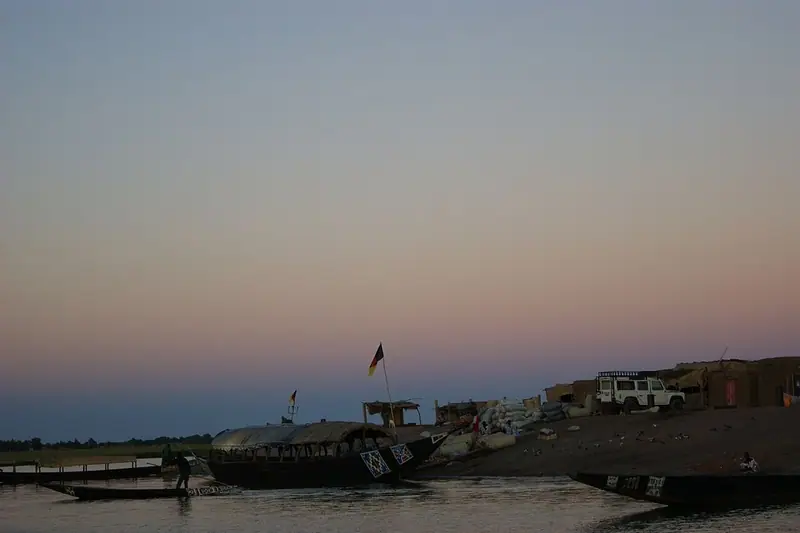 Free preview · Stop 1
The River Port of Kabara
Begin where most travellers once arrived, at Kabara, the old river port about eight kilometres south of the town. Timbuktu stood at the southern end of a great trans-Saharan route: gold, ivory and slaves from the south met salt and manuscripts from the north, and the river carried goods on to Djenné and beyond. Until the second half of the twentieth century, great salt caravans, or azalai, of thousands of camels brought slabs of rock salt from the mines of Taoudenni, far to the north; today the salt mostly comes by truck. Kabara works as a port only in the months when the Niger is in full flood. In 2007 a silted canal linking it to an arm of the river was dredged again; at other times boats dock at Korioumé, linked to the town by a paved road.
Photo: Annabel Symington · CC BY 2.0 · Wikimedia Commons
What to see at Timbuktu: 9 stops, in visit order
- 01
 The River Port of KabaraWhere the desert meets the NigerFree preview
- 02
 The Grand MarketSalt, cloth and bread ovensIn the guide
- 03
 The Mausoleums of the SaintsDestroyed in 2012, rebuilt in 2015In the guide
- 04
 The Djingareyber MosqueThe great mosque of Mansa MusaIn the guide
- 05
 The Explorers' HousesLaing, Caillié and BarthIn the guide
- 06
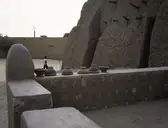 The Sidi Yahia MosqueThe gate that must not be openedIn the guide
- 07
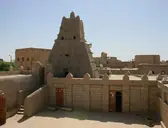 The Sankoré MosqueA focus of scholarshipIn the guide
- 08
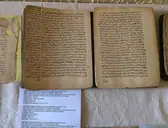 The Ahmed Baba InstituteThe manuscripts of TimbuktuIn the guide
- 09
 The Edge of the SaharaDunes at the city’s doorIn the guide
Site map of Timbuktu
History of Timbuktu
Timbuktu began as a seasonal camp of Tuareg herders and became a permanent town early in the twelfth century. Its name is often explained as the well of Buktu, after a woman said to have kept the camp, though scholars have proposed several other origins. The town joined the Mali Empire early in the fourteenth century, and the pilgrimage to Mecca of its ruler, Mansa Musa, in 1324 spread its fame across the Islamic world. Tuareg rulers held it from 1433, and in 1468 the Songhai king Sunni Ali took it into the Songhai Empire. Under the Askia dynasty Timbuktu reached its height, with scholars, judges and book traders from across North Africa, and a population often put at fifty thousand or more. A Moroccan army defeated the Songhai in 1591, and in 1594 leading scholars, among them Ahmad Baba, were deported to Morocco.
The full history continues in the guide.
Timbuktu guide: questions
How many stops does the Timbuktu guide have?
9 stops, in visit order: 1. The River Port of Kabara; 2. The Grand Market; 3. The Mausoleums of the Saints; 4. The Djingareyber Mosque; 5. The Explorers' Houses; 6. The Sidi Yahia Mosque; 7. The Sankoré Mosque; 8. The Ahmed Baba Institute; 9. The Edge of the Sahara.
Can I do a self-guided tour of Timbuktu with this guide?
Yes. The guide is made for a self-guided tour: 9 stops in visit order, each with a photo, a story and a voice, so you can explore Timbuktu at your own pace, without joining a group. Download it before you go and it works offline.
How long do you need at Timbuktu?
We suggest allowing one to two days. The 9 stops add up to about 7 minutes of listening, and you play each one when you’re ready, so you can linger wherever you like.
How long is each guide?
The 9 stops add up to about 7 minutes of listening in total. You play each stop when you’re ready, so you can go at your own pace.
Does the guide work offline?
Yes, once it’s downloaded. The guide is a single self-contained web page (about 7.8 MB) with the photos, text and audio built in. Download it to your phone before you go (Wi-Fi is best); after that it opens in any modern browser on iPhone or Android, with no app, account or mobile signal needed.
Does it use GPS or need my location?
No. The guide doesn’t use GPS and doesn’t know where you are: you play each stop when you reach it. It works on iPhone and Android in any modern browser, and it’s in English.
What’s included?
One self-contained HTML guide: 9 stops in visit order, each with a photo, text and a voice, plus the story of who built the site.
Who built Timbuktu?
Timbuktu began as a seasonal camp of Tuareg herders and became a permanent town early in the twelfth century. Its name is often explained as the well of Buktu, after a woman said to have kept the camp, though scholars have proposed several other origins.
Is there a free audio guide to Timbuktu?
The first stop, The River Port of Kabara, is free to read and hear on this page, so you can try the Timbuktu audio tour before you buy. The full guide, with all 9 stops, is a one-off purchase: download it once and it’s yours to keep, working offline.
Is the Timbuktu guide worth it?
If you’d like to know what you’re looking at, yes. For $10 you get 9 stops in visit order, each with a photo, a short history and a voice you play when you’re ready, plus a site map of the stops, and about 7 minutes of listening in all. It’s short on purpose, so you spend your time looking, not listening. It’s yours to keep, works offline and needs no app. The first stop is free on this page, so you can try it before you buy. If you’d like hours of detail, a guided tour will go deeper.
Audio guide or guided tour?
It depends how you like to visit. This guide lets you explore Timbuktu at your own pace, at any time, for a one-off price. A guided tour gives you a live expert you can ask questions, but at fixed times and usually for a higher price. Many people use both: a tour for the big picture, and the guide to read beforehand or to revisit the stops in their own time.
Is this the official Timbuktu guide?
No. It’s an independent guide by The Historian Guide, not affiliated with or endorsed by the operator of Timbuktu. For tickets and opening hours, check the official site operator before you go.
Does the guide include entry tickets or opening hours?
No. The guide is a digital companion only. Admission to Timbuktu is separate, so check the official site operator for current tickets and opening hours before you go.
- Stop 1 · The River Port of Kabara: Annabel Symington · CC BY 2.0 · Wikimedia Commons · resized
- Stop 2 · The Grand Market: Jeanne Menjoulet from Paris, France · CC BY 2.0 · Wikimedia Commons · resized
- Stop 3 · The Mausoleums of the Saints: I, Ruud Zwart · CC BY-SA 2.5 nl · Wikimedia Commons · resized
- Stop 4 · The Djingareyber Mosque (also the cover): Jeanne Menjoulet from Paris, France · CC BY 2.0 · Wikimedia Commons · resized
- Stop 5 · The Explorers' Houses: Angeline A. van Achterberg · CC BY-SA 4.0 · Wikimedia Commons · resized
- Stop 6 · The Sidi Yahia Mosque: Angeline A. van Achterberg · CC BY-SA 4.0 · Wikimedia Commons · resized
- Stop 7 · The Sankoré Mosque: Ousmane Garba Kounta · CC BY-SA 4.0 · Wikimedia Commons · resized
- Stop 8 · The Ahmed Baba Institute: Lazare Eloundou · CC BY-SA 3.0 igo · Wikimedia Commons · resized
- Stop 9 · The Edge of the Sahara: upyernoz from Haverford, USA · CC BY 2.0 · Wikimedia Commons · resized


All photographs from Wikimedia Commons under the licences shown.
More guides in Mali
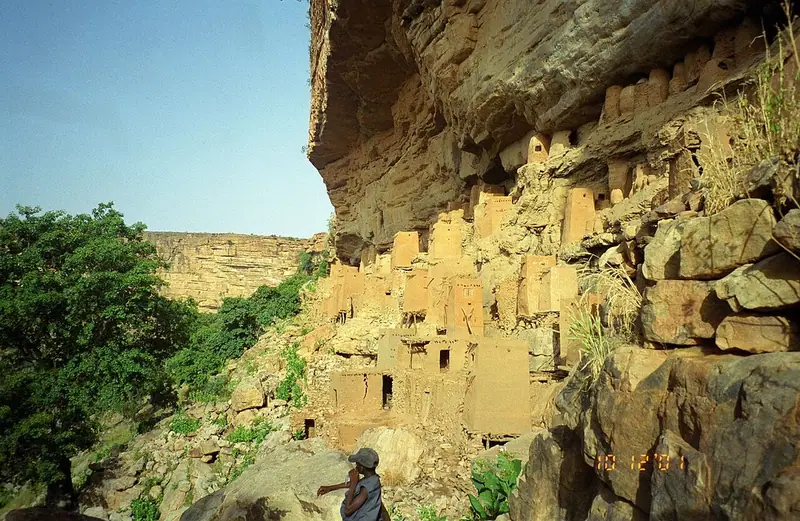 Dogon9 stops · 11th century CE – present
Cliff of Bandiagara audio guide
A long sandstone escarpment where Dogon villages, granaries and toguna shelters cling below the cliff, beneath the cave dwellings of the Tellem.
 Mali and Songhai9 stops · c. 1000 CE – present (Djenné-Djeno from c. 250 BCE)
Djenné audio guide
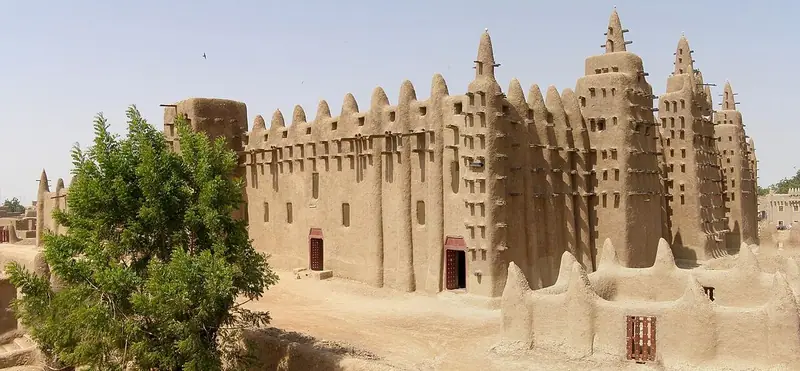
The river town of earth on the Inland Niger Delta: the Great Mosque, the yearly replastering festival, the Monday market, two-storey merchants' houses and the ancient mound of Djenné-Djeno.
 Ancient Egyptian8 stops · 13th century BCE
Abu Simbel audio guide
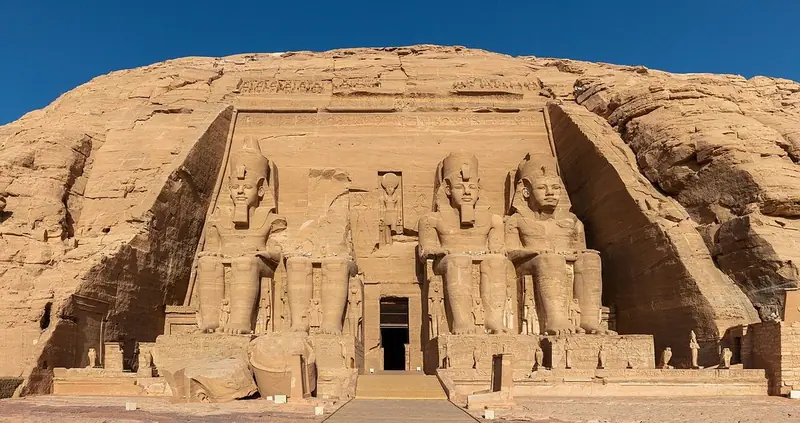
Ramesses II’s colossal temple façade, the Temple of Nefertari, and how both were rescued from the waters of Lake Nasser.
Every guide, in every country
Timbuktu and every other guide we publish, including future ones. One payment, no subscription.