Before you start
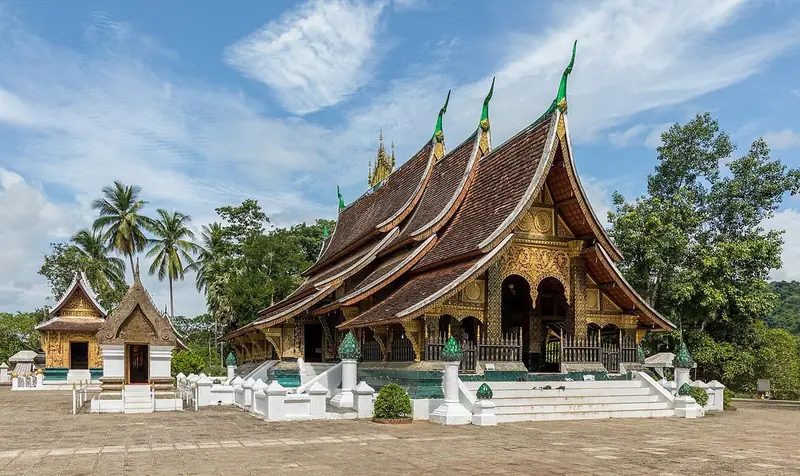
Luang Prabang lies in the mountains of northern Laos, on a narrow peninsula where the Nam Khan river flows into the Mekong. It is a town of gilded Buddhist temples, saffron-robed monks, traditional wooden houses and French colonial villas, all set among palms and frangipani trees. It was inscribed as a UNESCO World Heritage Site in 1995 for its remarkable fusion of traditional Lao architecture with that of the colonial period. This guide starts at Wat Visoun, climbs Mount Phousi, visits the former Royal Palace and the temples along the main street, and ends at Wat Xieng Thong, near the tip of the peninsula. Dress modestly, and remove your shoes before entering temple halls.
Use it as a self-guided tour of Luang Prabang: 8 stops in visit order, each played when you’re ready, at your own pace.
 Free preview · Stop 1
Wat Visoun
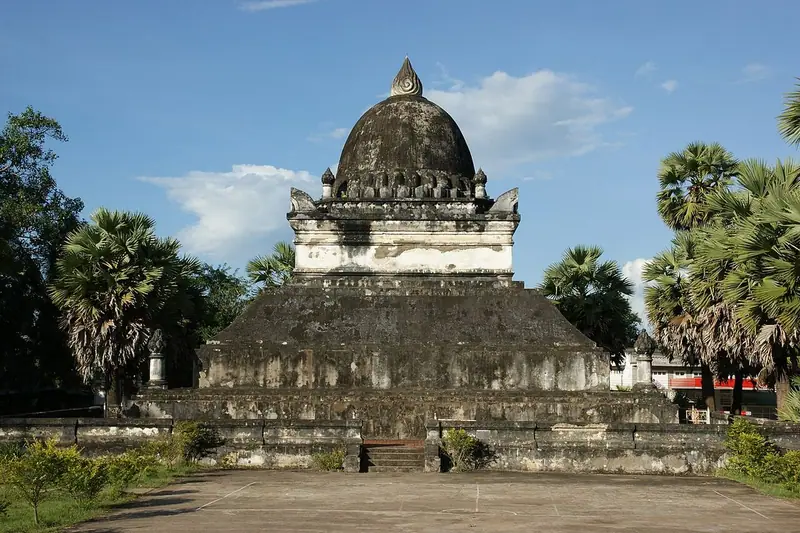
Begin at Wat Visoun, south of Mount Phousi, one of the oldest temples in Luang Prabang, founded in the early sixteenth century by King Visounnarath. The original wooden temple was destroyed in the late nineteenth century, when the town was sacked by raiders from the north, and the present hall was rebuilt soon afterwards. Inside, look at the collection of Buddha images, some of them very old. In front of the temple stands its most distinctive monument, a large, rounded stupa known as That Makmo, the watermelon stupa, because of its unusual domed shape. It contained precious Buddha images and treasures, some of which are now kept in the national museum. Wat Aham, a smaller temple, stands beside it in the same leafy compound. This is a quiet place to start, before the climb up the hill.
Photo: Allie Caulfield · CC BY 2.0 · Wikimedia Commons
What to see at Luang Prabang: 8 stops, in visit order
- 01
 Wat VisounThe watermelon stupaFree preview
- 02
 Mount PhousiThe sacred hillIn the guide
- 03
 Wat MaiA golden façadeIn the guide
- 04
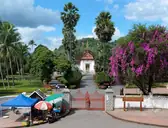 The Royal PalaceHome of the last kingsIn the guide
- 05
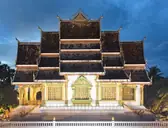 Haw Pha BangThe sacred BuddhaIn the guide
- 06
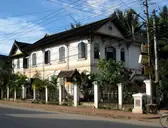 The Peninsula StreetsVillas and monasteriesIn the guide
- 07
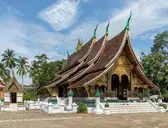 Wat Xieng ThongThe temple of the golden cityIn the guide
- 08
 The ConfluenceWhere the rivers meetIn the guide
Site map of Luang Prabang
History of Luang Prabang
Luang Prabang was the first capital of Lan Xang, the Kingdom of a Million Elephants, founded in the fourteenth century by King Fa Ngum. The town takes its name from the Phra Bang, a revered golden image of the Buddha. In 1560 King Setthathirath moved the capital to Vientiane, but Luang Prabang remained a royal city, the seat of its own kingdom after Lan Xang divided in the early eighteenth century. In the late nineteenth century it came under French protection, and the French built villas and offices beside the temples. The monarchy was abolished in 1975, when the communist Lao People’s Democratic Republic was established.
Luang Prabang guide: questions
How many stops does the Luang Prabang guide have?
8 stops, in visit order: 1. Wat Visoun; 2. Mount Phousi; 3. Wat Mai; 4. The Royal Palace; 5. Haw Pha Bang; 6. The Peninsula Streets; 7. Wat Xieng Thong; 8. The Confluence.
Can I do a self-guided tour of Luang Prabang with this guide?
Yes. The guide is made for a self-guided tour: 8 stops in visit order, each with a photo, a story and a voice, so you can explore Luang Prabang at your own pace, without joining a group. Download it before you go and it works offline.
How long is each guide?
The 8 stops add up to about 6 minutes of listening in total. You play each stop when you’re ready, so you can go at your own pace.
Does the guide work offline?
Yes, once it’s downloaded. The guide is a single self-contained web page (about 7.3 MB) with the photos, text and audio built in. Download it to your phone before you go (Wi-Fi is best); after that it opens in any modern browser on iPhone or Android, with no app, account or mobile signal needed.
Does it use GPS or need my location?
No. The guide doesn’t use GPS and doesn’t know where you are: you play each stop when you reach it. It works on iPhone and Android in any modern browser, and it’s in English.
What’s included?
One self-contained HTML guide: 8 stops in visit order, each with a photo, text and a voice, plus the story of who built the site.
Who built Luang Prabang?
Luang Prabang was the first capital of Lan Xang, the Kingdom of a Million Elephants, founded in the fourteenth century by King Fa Ngum. The town takes its name from the Phra Bang, a revered golden image of the Buddha.
Where is Luang Prabang?
Luang Prabang lies in the mountains of northern Laos, on a narrow peninsula where the Nam Khan river flows into the Mekong.
Is there a free audio guide to Luang Prabang?
The first stop, Wat Visoun, is free to read and hear on this page, so you can try the Luang Prabang audio tour before you buy. The full guide, with all 8 stops, is a one-off purchase: download it once and it’s yours to keep, working offline.
Is the Luang Prabang guide worth it?
If you’d like to know what you’re looking at, yes. For $10 you get 8 stops in visit order, each with a photo, a short history and a voice you play when you’re ready, plus a site map of the stops, and about 6 minutes of listening in all. It’s short on purpose, so you spend your time looking, not listening. It’s yours to keep, works offline and needs no app. The first stop is free on this page, so you can try it before you buy. If you’d like hours of detail, a guided tour will go deeper.
Audio guide or guided tour?
It depends how you like to visit. This guide lets you explore Luang Prabang at your own pace, at any time, for a one-off price. A guided tour gives you a live expert you can ask questions, but at fixed times and usually for a higher price. Many people use both: a tour for the big picture, and the guide to read beforehand or to revisit the stops in their own time.
Is this the official Luang Prabang guide?
No. It’s an independent guide by The Historian Guide, not affiliated with or endorsed by the operator of Luang Prabang. For tickets and opening hours, check the official site operator before you go.
Does the guide include entry tickets or opening hours?
No. The guide is a digital companion only. Admission to Luang Prabang is separate, so check the official site operator for current tickets and opening hours before you go.
- Stop 1 · Wat Visoun: Allie Caulfield · CC BY 2.0 · Wikimedia Commons · resized
- Stop 2 · Mount Phousi: Basile Morin · CC BY-SA 4.0 · Wikimedia Commons · resized
- Stop 3 · Wat Mai: Basile Morin · CC BY-SA 4.0 · Wikimedia Commons · resized
- Stop 4 · The Royal Palace: Jakub Hałun · CC BY-SA 4.0 · Wikimedia Commons · resized
- Stop 5 · Haw Pha Bang: Basile Morin · CC BY-SA 4.0 · Wikimedia Commons · resized
- Stop 6 · The Peninsula Streets: Francisco Anzola · CC BY 2.0 · Wikimedia Commons · resized
- Stop 7 · Wat Xieng Thong (also the cover): Basile Morin · CC BY-SA 4.0 · Wikimedia Commons · resized
- Stop 8 · The Confluence: Christophe95 · CC BY-SA 4.0 · Wikimedia Commons · resized


All photographs from Wikimedia Commons under the licences shown.
More guides in Laos
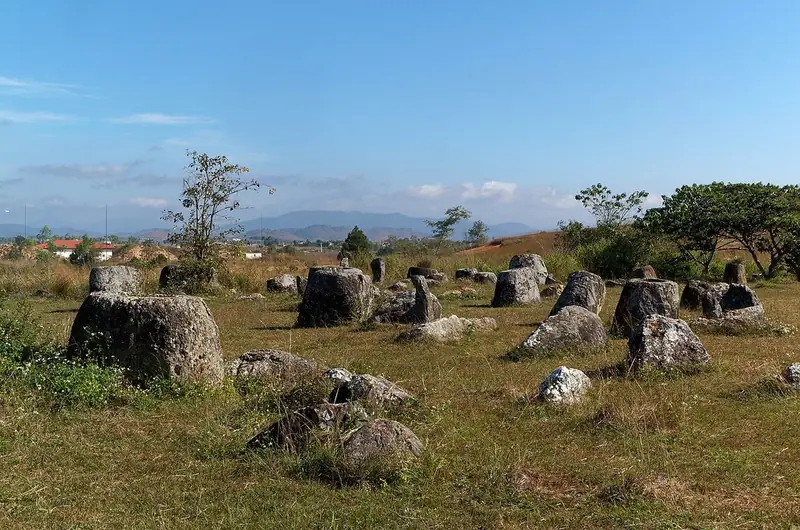 Iron Age7 stops · c. 500 BCE – 500 CE
Plain of Jars audio guide
Thousands of Iron Age stone jars on the hills of the Xiangkhouang Plateau: the great jar field of Site 1, Colani’s crematorium cave, the wooded Site 2 and Site 3 above the rice fields.
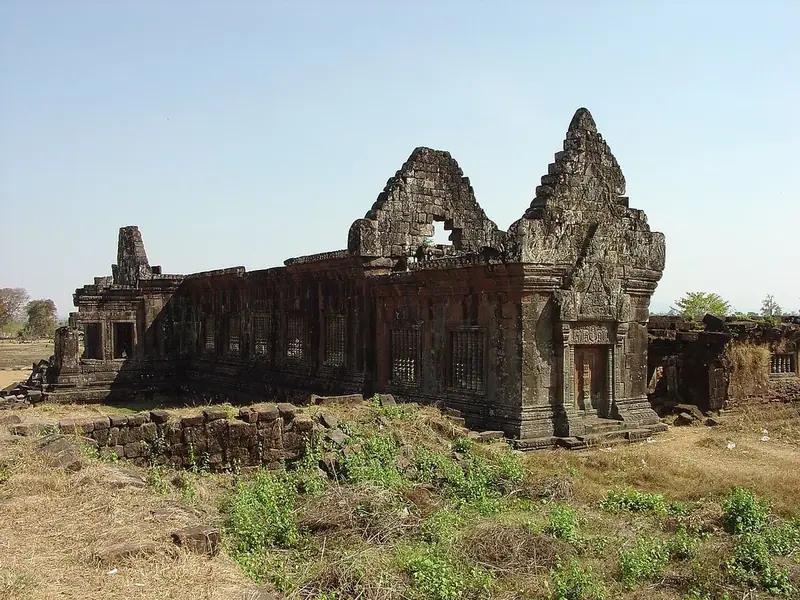 Khmer7 stops · 7th–12th century
Vat Phou audio guide
Follow the long processional way from the great reservoir up the stairway to a Khmer sanctuary and its sacred spring, older than Angkor Wat.
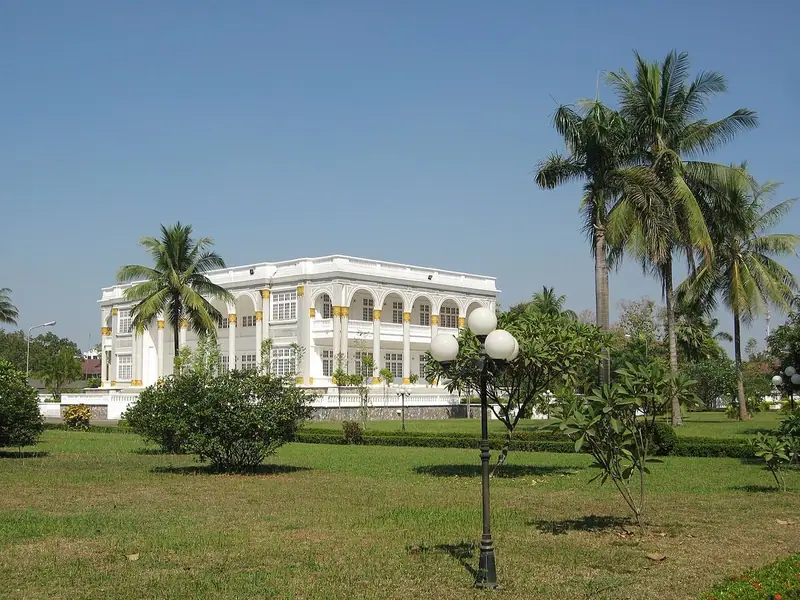 Lao7 stops · 1560–1828
Vientiane audio guide
From the Mekong riverbank to the royal temples of Lan Xang, the Black Stupa and the Victory Gate, ending at the golden That Luang.
Every guide, in every country
Luang Prabang and every other guide we publish, including future ones. One payment, no subscription.