Before you start
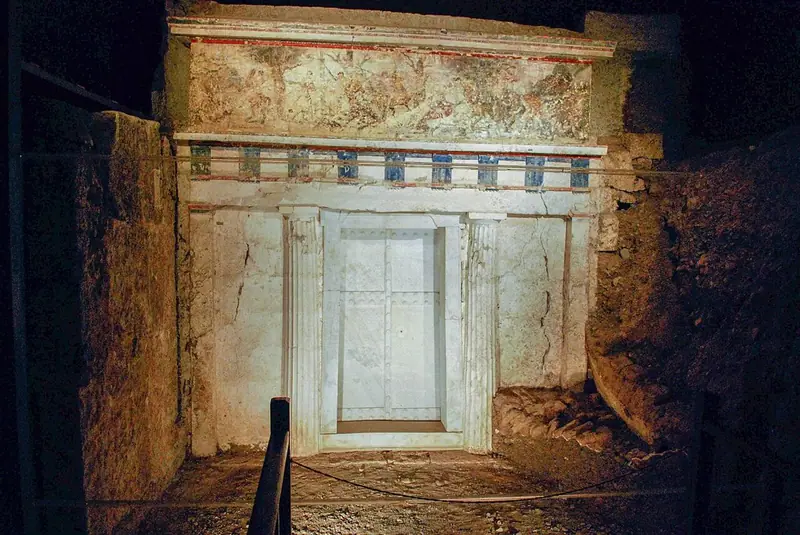
Vergina is a village in the foothills of the Pierian mountains, near the town of Veria and about 75 kilometres south-west of Thessaloniki, in Greek Macedonia. It stands on the site of Aigai, the first capital of the ancient kingdom of Macedon and the burial place of its kings, where Philip II, father of Alexander the Great, was assassinated and buried. The Archaeological Site of Aigai has been a UNESCO World Heritage Site since 1996 and is cared for by the Hellenic Ministry of Culture through the Ephorate of Antiquities of Imathia. This guide follows the natural order of a visit: into the Great Tumulus and the underground Museum of the Royal Tombs, then up the hill to the theatre and the restored Palace of Aigai, finishing at the new Polycentric Museum of Aigai.
Use it as a self-guided tour of Vergina: 8 stops in visit order, each played when you’re ready, at your own pace.
 Free preview · Stop 1
Great Tumulus
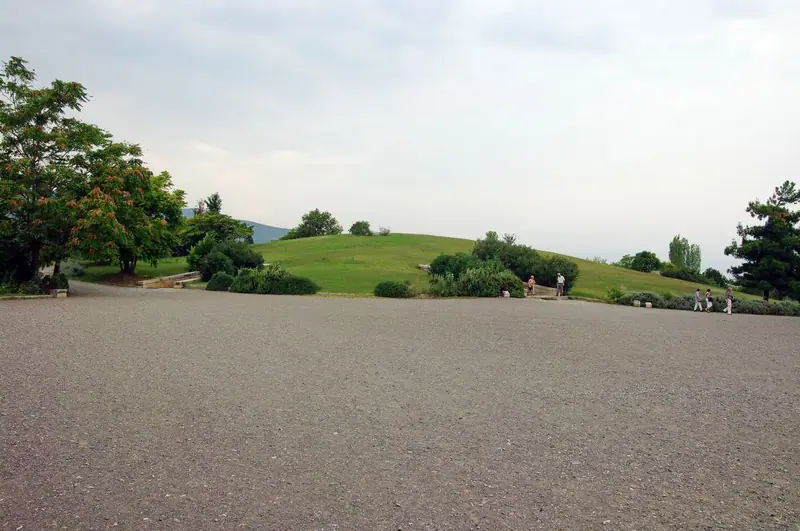
Your visit begins at the entrance to the Great Tumulus, a huge artificial mound of earth, about 110 metres across and some 12 to 13 metres high. It was raised in the early third century BCE, probably by the Macedonian king Antigonos Gonatas, to protect the royal tombs after they were looted by Celtic mercenaries in 274 or 273 BCE. For more than two thousand years it kept its secrets hidden, until 1977, when the archaeologist Manolis Andronikos, after years of searching, discovered the royal tombs beneath it. In 1993 a protective museum was created inside the mound, so the tombs remain where they were found, deep in the earth. Walk down the ramp into the cool darkness and let your eyes adjust. The atmosphere, dim and hushed, is quite extraordinary, and part of what makes this museum so unforgettable.
Photo: Bgabel · CC BY-SA 3.0 · Wikimedia Commons
What to see at Vergina: 8 stops, in visit order
- 01
 Great TumulusMegáli ToúmbaFree preview
- 02
 Tomb of PersephoneTáfos tis PersefónisIn the guide
- 03
 Tomb of Philip IITáfos tou FilíppouIn the guide
- 04
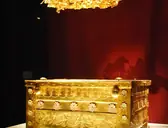 Royal TreasuresVasilikoí ThisavroíIn the guide
- 05
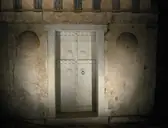 Tomb of the PrinceTáfos tou PrígkipaIn the guide
- 06
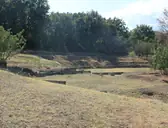 Theatre of AigaiArchaío ThéatroIn the guide
- 07
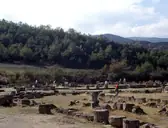 Palace of AigaiAnáktoro ton AigónIn the guide
- 08
 Polycentric Museum of AigaiPolykentrikó Mouseío AigónIn the guide
Site map of Vergina
History of Vergina
Aigai was built by the ancient Macedonians, a Greek people whose kingdom grew from the seventh century BCE under the Argead dynasty, which claimed descent from Herakles. The site was lived on far earlier, from the Early Iron Age, as a cemetery of more than five hundred burial mounds shows. Aigai was the capital until around 400 BCE, when the kings moved their main seat to Pella, but it remained their ceremonial centre and royal burial ground. Under Philip II, who ruled from 359 to 336 BCE, and his son Alexander the Great, Macedon came to dominate the Greek world and much of Asia, launching the Hellenistic age. The kingdom ended when Rome defeated it in 168 BCE, and Greece fell to Rome in 146 BCE; Aigai declined, was sacked and slowly disappeared under earth. Manolis Andronikos uncovered the royal tombs in 1977, and Greek archaeologists continue to excavate here in Macedonia today.
Vergina guide: questions
How many stops does the Vergina guide have?
8 stops, in visit order: 1. Great Tumulus; 2. Tomb of Persephone; 3. Tomb of Philip II; 4. Royal Treasures; 5. Tomb of the Prince; 6. Theatre of Aigai; 7. Palace of Aigai; 8. Polycentric Museum of Aigai.
Can I do a self-guided tour of Vergina with this guide?
Yes. The guide is made for a self-guided tour: 8 stops in visit order, each with a photo, a story and a voice, so you can explore Vergina at your own pace, without joining a group. Download it before you go and it works offline.
How long is each guide?
The 8 stops add up to about 8 minutes of listening in total. You play each stop when you’re ready, so you can go at your own pace.
Does the guide work offline?
Yes, once it’s downloaded. The guide is a single self-contained web page (about 8.7 MB) with the photos, text and audio built in. Download it to your phone before you go (Wi-Fi is best); after that it opens in any modern browser on iPhone or Android, with no app, account or mobile signal needed.
Does it use GPS or need my location?
No. The guide doesn’t use GPS and doesn’t know where you are: you play each stop when you reach it. It works on iPhone and Android in any modern browser, and it’s in English.
What’s included?
One self-contained HTML guide: 8 stops in visit order, each with a photo, text and a voice, plus the story of who built the site.
Who built Vergina?
Aigai was built by the ancient Macedonians, a Greek people whose kingdom grew from the seventh century BCE under the Argead dynasty, which claimed descent from Herakles. The site was lived on far earlier, from the Early Iron Age, as a cemetery of more than five hundred burial mounds shows.
Is there a free audio guide to Vergina?
The first stop, Great Tumulus, is free to read and hear on this page, so you can try the Vergina audio tour before you buy. The full guide, with all 8 stops, is a one-off purchase: download it once and it’s yours to keep, working offline.
Is the Vergina guide worth it?
If you’d like to know what you’re looking at, yes. For $10 you get 8 stops in visit order, each with a photo, a short history and a voice you play when you’re ready, plus a site map of the stops, and about 8 minutes of listening in all. It’s short on purpose, so you spend your time looking, not listening. It’s yours to keep, works offline and needs no app. The first stop is free on this page, so you can try it before you buy. If you’d like hours of detail, a guided tour will go deeper.
Audio guide or guided tour?
It depends how you like to visit. This guide lets you explore Vergina at your own pace, at any time, for a one-off price. A guided tour gives you a live expert you can ask questions, but at fixed times and usually for a higher price. Many people use both: a tour for the big picture, and the guide to read beforehand or to revisit the stops in their own time.
Is this the official Vergina guide?
No. It’s an independent guide by The Historian Guide, not affiliated with or endorsed by the operator of Vergina. For tickets and opening hours, check the official site operator before you go.
Does the guide include entry tickets or opening hours?
No. The guide is a digital companion only. Admission to Vergina is separate, so check the official site operator for current tickets and opening hours before you go.
- Stop 1 · Great Tumulus: User: Bgabel at wikivoyage shared · CC BY-SA 3.0 · Wikimedia Commons · resized
- Stop 2 · Tomb of Persephone: Unknown author · Public domain · Wikimedia Commons · resized
- Stop 3 · Tomb of Philip II (also the cover): Panegyrics of Granovetter (Sarah Murray) · Public domain · Wikimedia Commons · resized
- Stop 4 · Royal Treasures: Sarah Murray · CC BY-SA 2.0 · Wikimedia Commons · resized
- Stop 5 · Tomb of the Prince: Explorer1940 · CC BY-SA 4.0 · Wikimedia Commons · resized
- Stop 6 · Theatre of Aigai: Iolchos07 · CC BY-SA 4.0 · Wikimedia Commons · resized
- Stop 7 · Palace of Aigai: Mark Landon / Wikimedia Commons · CC BY 4.0 · Wikimedia Commons · resized
- Stop 8 · Polycentric Museum of Aigai: Mary Harrsch · CC BY-SA 4.0 · Wikimedia Commons · resized


All photographs from Wikimedia Commons under the licences shown.
More guides in Greece
 Greek7 stops · 5th century BCE
Acropolis of Athens audio guide
Climb through the Propylaia to the Parthenon and the Erechtheion, on the rock that has crowned Athens for three thousand years.
 Minoan7 stops · c. 2000–1600 BCE
Akrotiri audio guide
The streets of a Bronze Age town buried by Santorini’s volcano, preserved beneath a great modern roof.
 Greek7 stops · 6th century BCE – 2nd century CE
Ancient Agora of Athens audio guide
The market square where Athenians shopped, voted and argued, overlooked by the Temple of Hephaestus.
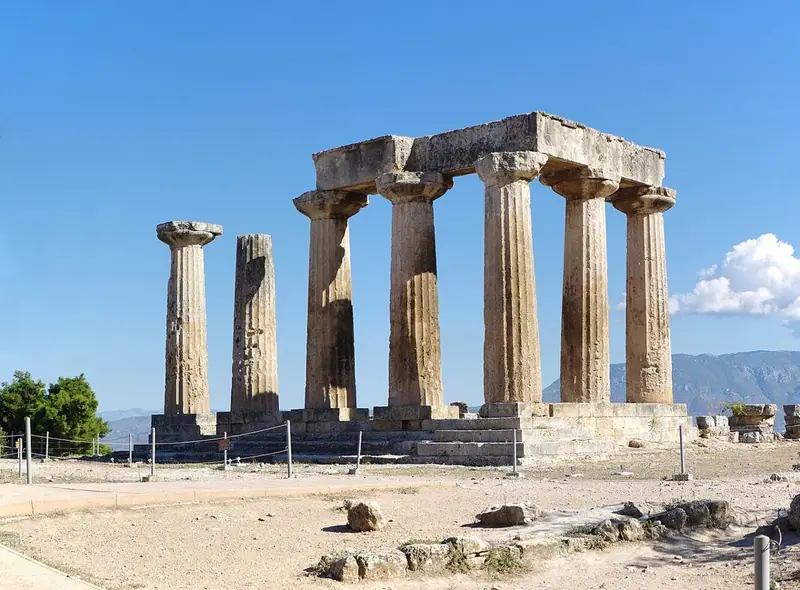 Roman7 stops · 6th century BCE – 4th century CE
Ancient Corinth audio guide
The Temple of Apollo, the Roman forum and the Bema, with the great rock of Acrocorinth above.
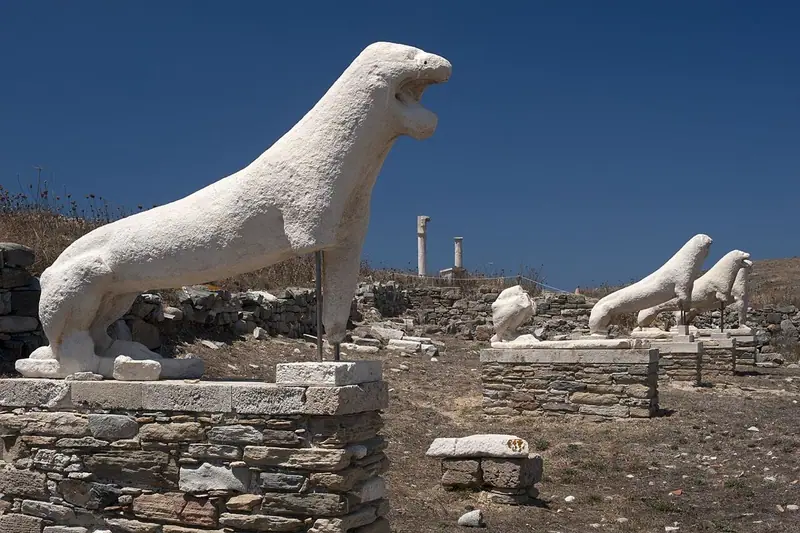 Greek7 stops · c. 800 BCE – 1st century BCE
Delos audio guide
The sacred island of Apollo: the Terrace of the Lions, mosaic-floored houses and the climb up Mount Kynthos.
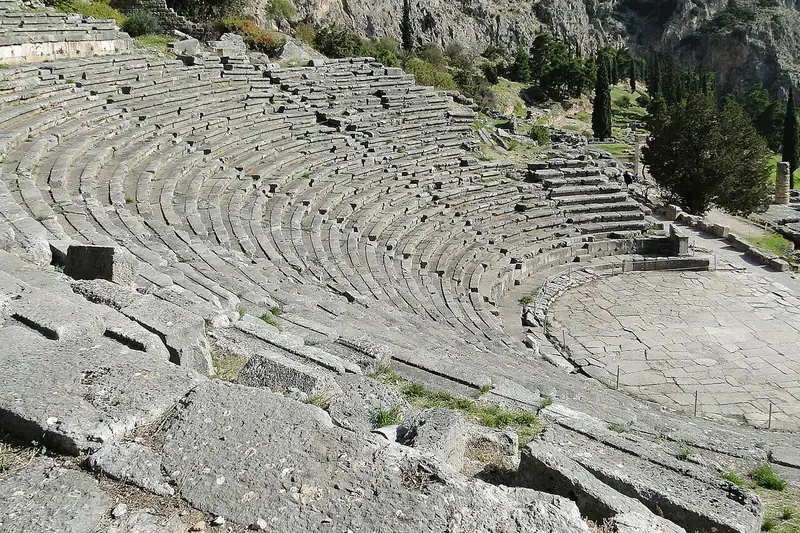 Greek8 stops · 8th century BCE – 4th century CE
Delphi audio guide
Up the Sacred Way past the treasuries to Apollo’s temple, the theatre and the stadium, high on the slopes of Parnassus.
Every guide, in every country
Vergina and every other guide we publish, including future ones. One payment, no subscription.