Before you start
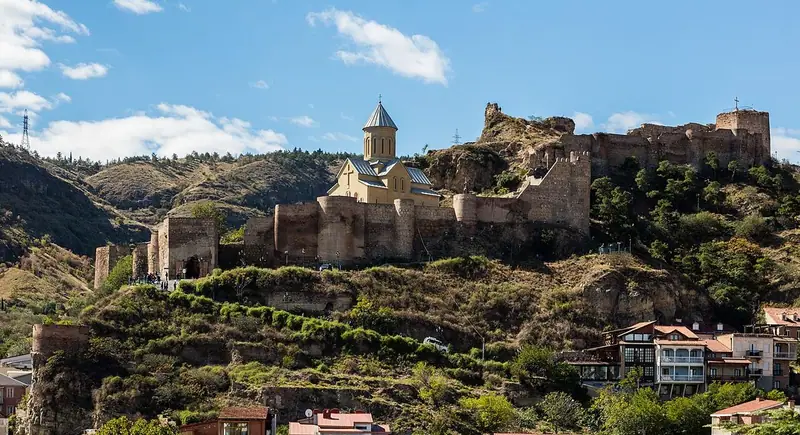
Old Tbilisi, the historic heart of the Georgian capital, is a tangle of churches, domed sulphur baths, wooden balconies and narrow lanes in the gorge of the Mtkvari River, beneath the walls of an ancient fortress. For centuries the city stood at a crossroads between Europe and Asia, and you will see churches, a mosque and a synagogue within a few minutes’ walk of each other. The old town is compact, but the streets are steep and cobbled, and the climb to the fortress is hard work in summer heat; a cable car offers an easier way up. This guide starts at Metekhi Church above the river, crosses to the sulphur baths, climbs to Narikala Fortress and the Mother of Georgia, and returns through the old town to Sioni Cathedral and Anchiskhati Basilica.
Use it as a self-guided tour of Old Tbilisi: 7 stops in visit order, each played when you’re ready, at your own pace.
 Free preview · Stop 1
Metekhi Church
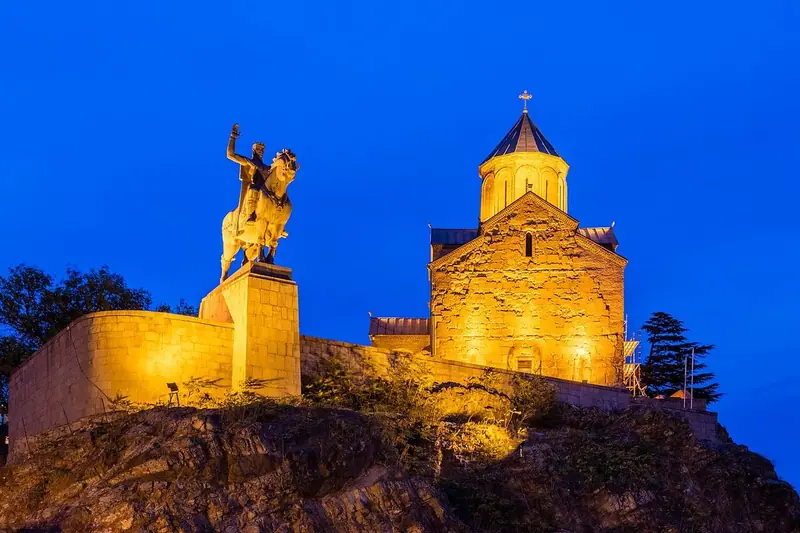
Begin at Metekhi Church, which stands on a rocky cliff above the Mtkvari River, facing the old town across the water. According to tradition, this was the site of a royal palace, and the present stone church was built in the thirteenth century, during the reign of King Demetre II. Over the centuries it was damaged and restored many times, and under Russian and Soviet rule it was used as a prison and later a theatre, before being returned to the Church. Look at its simple, solid stone walls and the carved decoration around the windows. Beside it stands a large equestrian statue of King Vakhtang Gorgasali, the legendary founder of the city, set up in the 1960s. From the terrace there are fine views across the river to the domes of the sulphur baths and the walls of Narikala Fortress above.
Photo: Diego Delso · CC BY-SA 4.0 · Wikimedia Commons
What to see at Old Tbilisi: 7 stops, in visit order
- 01
 Metekhi ChurchAbove the riverFree preview
- 02
 LeghvtakheviWaterfall in the cityIn the guide
- 03
 Sulphur BathsAbanotubaniIn the guide
- 04
 Narikala FortressWalls above the cityIn the guide
- 05
 Mother of GeorgiaKartlis DedaIn the guide
- 06
 Sioni CathedralThe cross of St NinoIn the guide
- 07
 Anchiskhati BasilicaOldest church in TbilisiIn the guide
Site map of Old Tbilisi
History of Old Tbilisi
According to legend, Tbilisi was founded in the fifth century by King Vakhtang Gorgasali, after his falcon caught a pheasant that fell into a hot spring; the city’s name comes from the Georgian word for warm. It became the capital of the kingdom of Kartli, or Iberia, and later of the united kingdom of Georgia, which reached its golden age under King David the Builder and Queen Tamar in the twelfth and early thirteenth centuries. Over the centuries the city was conquered and sacked by Arabs, Mongols, Persians and Ottomans; in 1795 a Persian army destroyed much of it. Georgia was annexed by the Russian Empire in 1801, and the old town was largely rebuilt in the nineteenth century.
Old Tbilisi guide: questions
How many stops does the Old Tbilisi guide have?
7 stops, in visit order: 1. Metekhi Church; 2. Leghvtakhevi; 3. Sulphur Baths; 4. Narikala Fortress; 5. Mother of Georgia; 6. Sioni Cathedral; 7. Anchiskhati Basilica.
Can I do a self-guided tour of Old Tbilisi with this guide?
Yes. The guide is made for a self-guided tour: 7 stops in visit order, each with a photo, a story and a voice, so you can explore Old Tbilisi at your own pace, without joining a group. Download it before you go and it works offline.
How long is each guide?
The 7 stops add up to about 5 minutes of listening in total. You play each stop when you’re ready, so you can go at your own pace.
Does the guide work offline?
Yes, once it’s downloaded. The guide is a single self-contained web page (about 6.9 MB) with the photos, text and audio built in. Download it to your phone before you go (Wi-Fi is best); after that it opens in any modern browser on iPhone or Android, with no app, account or mobile signal needed.
Does it use GPS or need my location?
No. The guide doesn’t use GPS and doesn’t know where you are: you play each stop when you reach it. It works on iPhone and Android in any modern browser, and it’s in English.
What’s included?
One self-contained HTML guide: 7 stops in visit order, each with a photo, text and a voice, plus the story of who built the site.
Who built Old Tbilisi?
According to legend, Tbilisi was founded in the fifth century by King Vakhtang Gorgasali, after his falcon caught a pheasant that fell into a hot spring; the city’s name comes from the Georgian word for warm. It became the capital of the kingdom of Kartli, or Iberia, and later of the united kingdom of Georgia, which reached its golden age under King David the Builder and Queen Tamar in the twelfth and early thirteenth centuries.
Where is Old Tbilisi?
Old Tbilisi, the historic heart of the Georgian capital, is a tangle of churches, domed sulphur baths, wooden balconies and narrow lanes in the gorge of the Mtkvari River, beneath the walls of an ancient fortress.
Is there a free audio guide to Old Tbilisi?
The first stop, Metekhi Church, is free to read and hear on this page, so you can try the Old Tbilisi audio tour before you buy. The full guide, with all 7 stops, is a one-off purchase: download it once and it’s yours to keep, working offline.
Is the Old Tbilisi guide worth it?
If you’d like to know what you’re looking at, yes. For $10 you get 7 stops in visit order, each with a photo, a short history and a voice you play when you’re ready, plus a site map of the stops, and about 5 minutes of listening in all. It’s short on purpose, so you spend your time looking, not listening. It’s yours to keep, works offline and needs no app. The first stop is free on this page, so you can try it before you buy. If you’d like hours of detail, a guided tour will go deeper.
Audio guide or guided tour?
It depends how you like to visit. This guide lets you explore Old Tbilisi at your own pace, at any time, for a one-off price. A guided tour gives you a live expert you can ask questions, but at fixed times and usually for a higher price. Many people use both: a tour for the big picture, and the guide to read beforehand or to revisit the stops in their own time.
Is this the official Old Tbilisi guide?
No. It’s an independent guide by The Historian Guide, not affiliated with or endorsed by the operator of Old Tbilisi. For tickets and opening hours, check the official site operator before you go.
Does the guide include entry tickets or opening hours?
No. The guide is a digital companion only. Admission to Old Tbilisi is separate, so check the official site operator for current tickets and opening hours before you go.
- Stop 1 · Metekhi Church: Diego Delso · CC BY-SA 4.0 · Wikimedia Commons · resized
- Stop 2 · Leghvtakhevi: AlexandreAssatiani · CC BY 4.0 · Wikimedia Commons · resized
- Stop 3 · Sulphur Baths: Photo: Marcin Konsek / Wikimedia Commons · CC BY-SA 4.0 · Wikimedia Commons · resized
- Stop 4 · Narikala Fortress (also the cover): George Melashvili · CC BY-SA 3.0 · Wikimedia Commons · cropped and resized
- Stop 5 · Mother of Georgia: Diego Delso · CC BY-SA 4.0 · Wikimedia Commons · cropped and resized
- Stop 6 · Sioni Cathedral: Diego Delso · CC BY-SA 4.0 · Wikimedia Commons · resized
- Stop 7 · Anchiskhati Basilica: კოლხი · CC BY-SA 4.0 · Wikimedia Commons · resized


All photographs from Wikimedia Commons under the licences shown.
More guides in Georgia
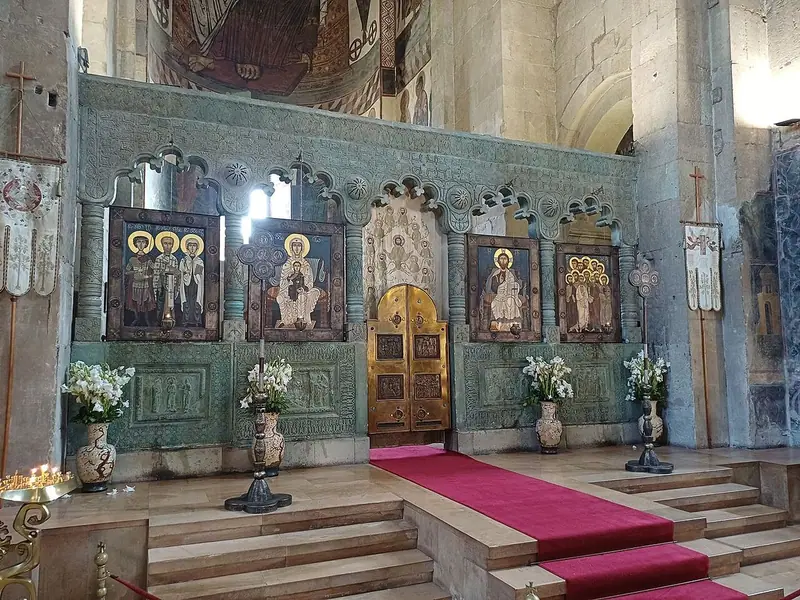 Georgian8 stops · 4th–19th century
Mtskheta audio guide
Start at Jvari Monastery on its hilltop, then cross to the cathedral and the Life-Giving Pillar in the Holy City where Georgia became Christian.
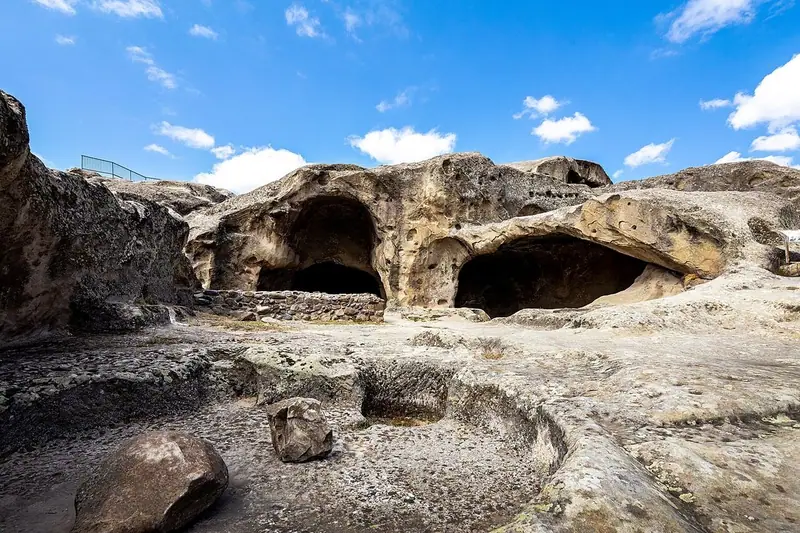 Kartli (Iberia)7 stops · c. 1000 BCE – 14th century
Uplistsikhe audio guide
Climb the ancient main street of a town cut into a sandstone ridge above the Mtkvari, past the theatre and Tamar’s Hall to the Prince’s Church.
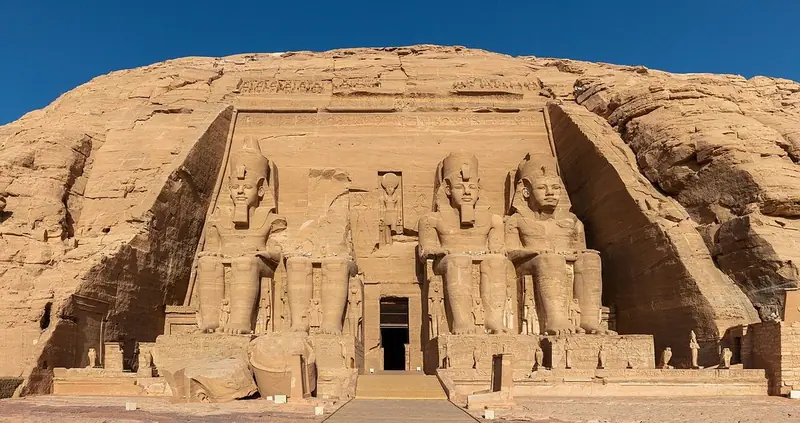 Ancient Egyptian8 stops · 13th century BCE
Abu Simbel audio guide
Ramesses II’s colossal temple façade, the Temple of Nefertari, and how both were rescued from the waters of Lake Nasser.
Every guide, in every country
Old Tbilisi and every other guide we publish, including future ones. One payment, no subscription.