Before you start
Ta Prohm lies about a kilometre east of Angkor Thom, within the Angkor Archaeological Park, a UNESCO World Heritage Site since 1992, and is usually included on the so-called Small Circuit of temples from Siem Reap. You need an Angkor Pass, bought from the official ticket centre or online, and it is checked on entry. Today you can enter only through the western and eastern gates, and many drivers drop visitors at one gate and wait at the other, so agree this first. Inside, the temple is a maze of collapsed galleries, narrow passages and wooden walkways, which can be crowded and slippery after rain. This guide leads from the western gate through the forest to the central sanctuary, explores the courtyards with their famous trees and carvings, and leaves through the Hall of Dancers to the eastern gate.
Use it as a self-guided tour of Ta Prohm: 6 stops in visit order, each played when you’re ready, at your own pace.
 Free preview · Stop 1
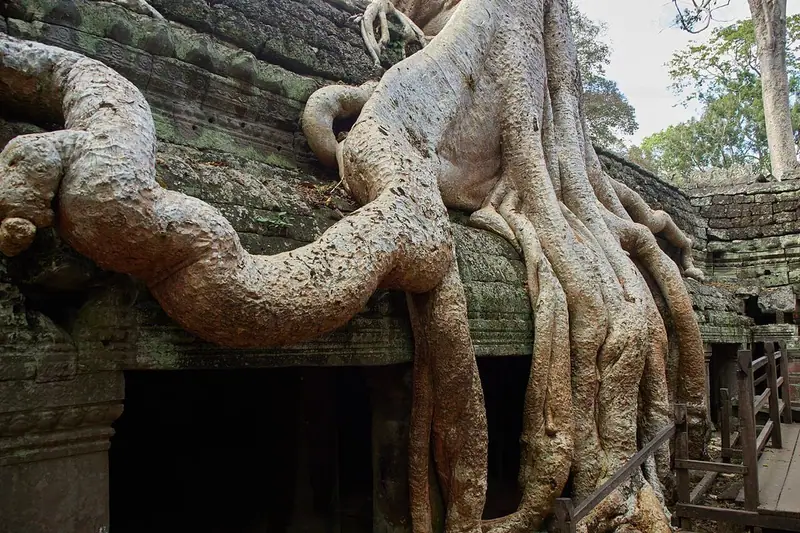
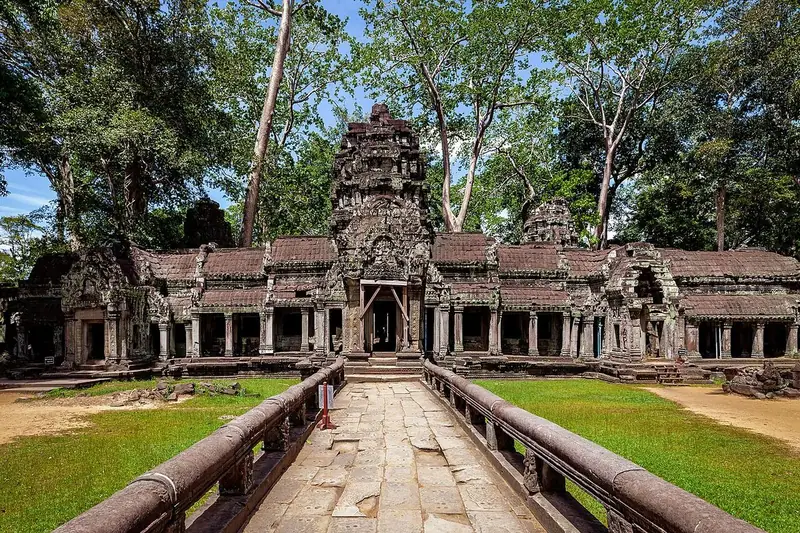
The Western Gate
Begin at the western gate, a gateway in the temple’s outer wall, which measures about a kilometre by 650 metres and once enclosed a substantial town of wooden houses, now covered by forest. Look up at the tower above the gateway, carved with great serene faces like those of the Bayon, gazing out in the four directions; these face towers were added to the gates in the thirteenth century. Then walk along the path through the forest towards the temple, listening for the birds and insects. The towering trees around you give a sense of how the jungle has reclaimed this area since the temple was abandoned. Like most Khmer temples, Ta Prohm faces east, so you are approaching from the back. Ahead, the walls of the inner enclosures appear through the trees, with roots and branches spreading across the stones.
Photo: Supanut Arunoprayote · CC BY 4.0 · Wikimedia Commons
What to see at Ta Prohm: 6 stops, in visit order
- 01
 The Western GateA face tower in the forestFree preview
- 02
 Trees and StonesNature takes holdIn the guide
- 03
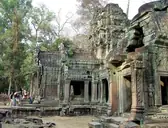 The Central SanctuaryThe shrine of wisdomIn the guide
- 04
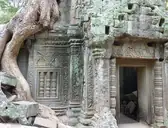 The Tomb Raider TreeRoots over a doorwayIn the guide
- 05
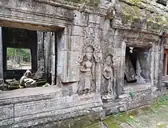 Carvings and DevatasGraceful figures in stoneIn the guide
- 06
 Hall of DancersTowards the eastern gateIn the guide
Site map of Ta Prohm
History of Ta Prohm
Ta Prohm was built by the Khmer, whose empire was founded in the early ninth century, when Jayavarman II declared himself universal monarch in 802, and which dominated much of mainland South-East Asia from its capital at Angkor for the next six centuries. King Jayavarman VII, the great Buddhist ruler who built Angkor Thom and the Bayon, founded Ta Prohm in 1186 as a Buddhist monastery and centre of learning called Rajavihara, the royal monastery, dedicated to his mother. Additions continued until the end of the thirteenth century. After the empire declined in the fifteenth century, the temple was abandoned and the forest took over. In the early twentieth century, French archaeologists decided to leave it largely as they found it, and today Indian and Cambodian teams work to keep it stable and safe.
Ta Prohm guide: questions
How many stops does the Ta Prohm guide have?
6 stops, in visit order: 1. The Western Gate; 2. Trees and Stones; 3. The Central Sanctuary; 4. The Tomb Raider Tree; 5. Carvings and Devatas; 6. Hall of Dancers.
Can I do a self-guided tour of Ta Prohm with this guide?
Yes. The guide is made for a self-guided tour: 6 stops in visit order, each with a photo, a story and a voice, so you can explore Ta Prohm at your own pace, without joining a group. Download it before you go and it works offline.
How long is each guide?
The 6 stops add up to about 4 minutes of listening in total. You play each stop when you’re ready, so you can go at your own pace.
Does the guide work offline?
Yes, once it’s downloaded. The guide is a single self-contained web page (about 7.1 MB) with the photos, text and audio built in. Download it to your phone before you go (Wi-Fi is best); after that it opens in any modern browser on iPhone or Android, with no app, account or mobile signal needed.
Does it use GPS or need my location?
No. The guide doesn’t use GPS and doesn’t know where you are: you play each stop when you reach it. It works on iPhone and Android in any modern browser, and it’s in English.
What’s included?
One self-contained HTML guide: 6 stops in visit order, each with a photo, text and a voice, plus the story of who built the site.
Who built Ta Prohm?
Ta Prohm was built by the Khmer, whose empire was founded in the early ninth century, when Jayavarman II declared himself universal monarch in 802, and which dominated much of mainland South-East Asia from its capital at Angkor for the next six centuries. King Jayavarman VII, the great Buddhist ruler who built Angkor Thom and the Bayon, founded Ta Prohm in 1186 as a Buddhist monastery and centre of learning called Rajavihara, the royal monastery, dedicated to his mother.
Where is Ta Prohm?
Ta Prohm lies about a kilometre east of Angkor Thom, within the Angkor Archaeological Park, a UNESCO World Heritage Site since 1992, and is usually included on the so-called Small Circuit of temples from Siem Reap.
Is there a free audio guide to Ta Prohm?
The first stop, The Western Gate, is free to read and hear on this page, so you can try the Ta Prohm audio tour before you buy. The full guide, with all 6 stops, is a one-off purchase: download it once and it’s yours to keep, working offline.
Is the Ta Prohm guide worth it?
If you’d like to know what you’re looking at, yes. For $10 you get 6 stops in visit order, each with a photo, a short history and a voice you play when you’re ready, plus a site map of the stops, and about 4 minutes of listening in all. It’s short on purpose, so you spend your time looking, not listening. It’s yours to keep, works offline and needs no app. The first stop is free on this page, so you can try it before you buy. If you’d like hours of detail, a guided tour will go deeper.
Audio guide or guided tour?
It depends how you like to visit. This guide lets you explore Ta Prohm at your own pace, at any time, for a one-off price. A guided tour gives you a live expert you can ask questions, but at fixed times and usually for a higher price. Many people use both: a tour for the big picture, and the guide to read beforehand or to revisit the stops in their own time.
Is this the official Ta Prohm guide?
No. It’s an independent guide by The Historian Guide, not affiliated with or endorsed by the operator of Ta Prohm. For tickets and opening hours, check the official site operator before you go.
Does the guide include entry tickets or opening hours?
No. The guide is a digital companion only. Admission to Ta Prohm is separate, so check the official site operator for current tickets and opening hours before you go.
- Stop 1 · The Western Gate: This Photo was taken by Supanut Arunoprayote. Feel free… · CC BY 4.0 · Wikimedia Commons · resized
- Stop 2 · Trees and Stones (also the cover): lumoplank · CC0 · Wikimedia Commons · resized
- Stop 3 · The Central Sanctuary: Michael Gunther · CC BY-SA 4.0 · Wikimedia Commons · resized
- Stop 4 · The Tomb Raider Tree: Anandajoti · CC BY-SA 3.0 · Wikimedia Commons · resized
- Stop 5 · Carvings and Devatas: Radosław Botev · CC BY 3.0 pl · Wikimedia Commons · resized
- Stop 6 · Hall of Dancers: Greg Willis from Denver, CO, usa · CC BY-SA 2.0 · Wikimedia Commons · resized


All photographs from Wikimedia Commons under the licences shown.
More guides in Cambodia
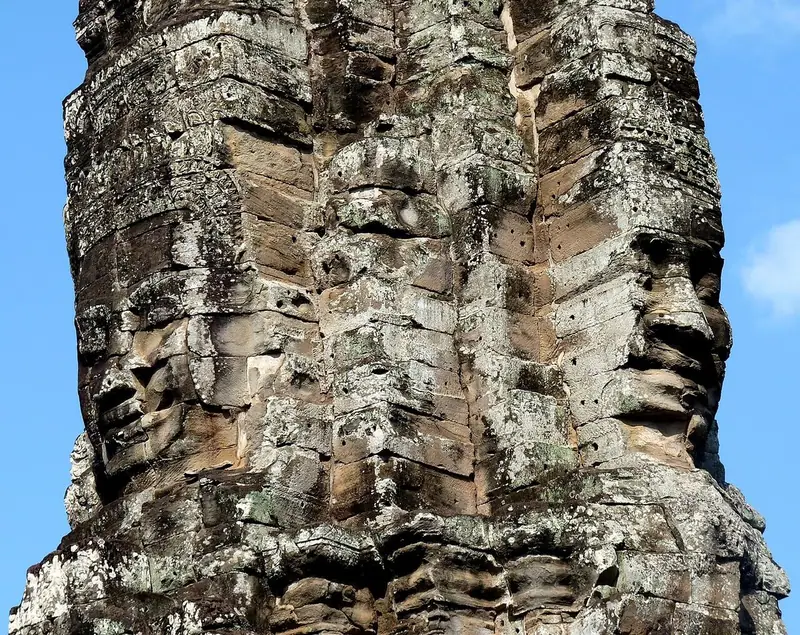 Khmer7 stops · 11th–13th century CE
Angkor Thom and the Bayon audio guide
Pass through the South Gate into the royal city of Jayavarman VII, where serene stone faces gaze from every tower of the Bayon.
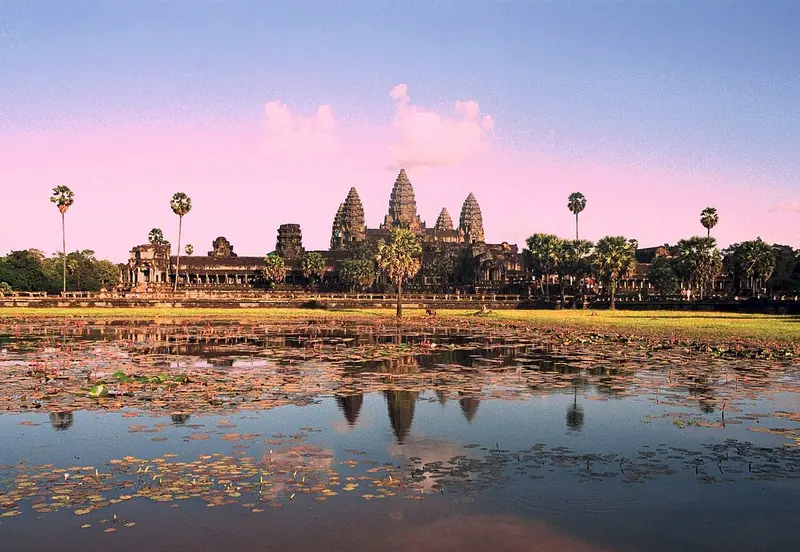 Khmer8 stops · 12th century CE
Angkor Wat audio guide
Cross the western causeway into Angkor Wat, past galleries of reliefs of battles, gods and the Churning of the Sea.
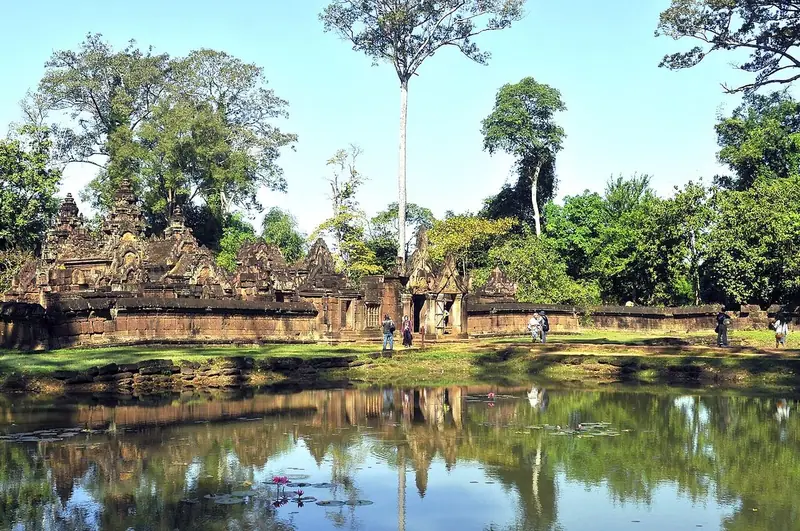 Khmer7 stops · 967 CE
Banteay Srei audio guide
A small, exquisitely carved temple, with Shiva the Dancer over its doors, that was unusually not built by a king.
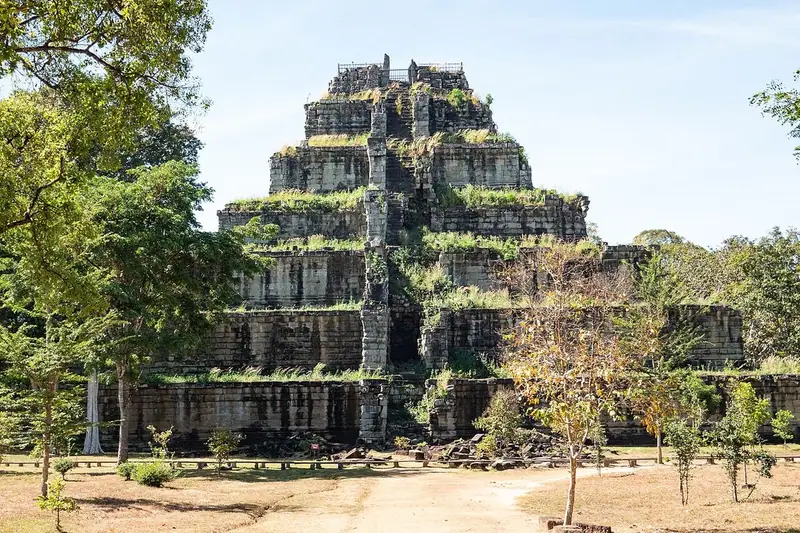 Khmer7 stops · 10th – early 13th century CE
Koh Ker audio guide
The forest capital of the Khmer king Jayavarman IV: brick towers in the roots, linga shrines carved from bedrock, the red tower of Prasat Krahom and the seven-tiered pyramid of the Prang.
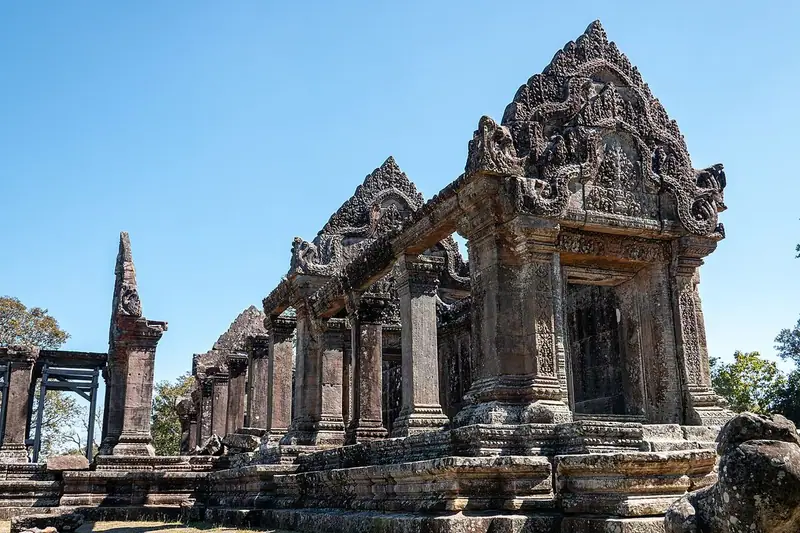 Khmer10 stops · 9th – 12th century CE
Preah Vihear audio guide
A Khmer temple to Shiva strung along a clifftop above the Cambodian plain: five gateways, carved pediments and a sanctuary on the brink, damaged in the border fighting of 2025.
Every guide, in every country
Ta Prohm and every other guide we publish, including future ones. One payment, no subscription.