Before you start
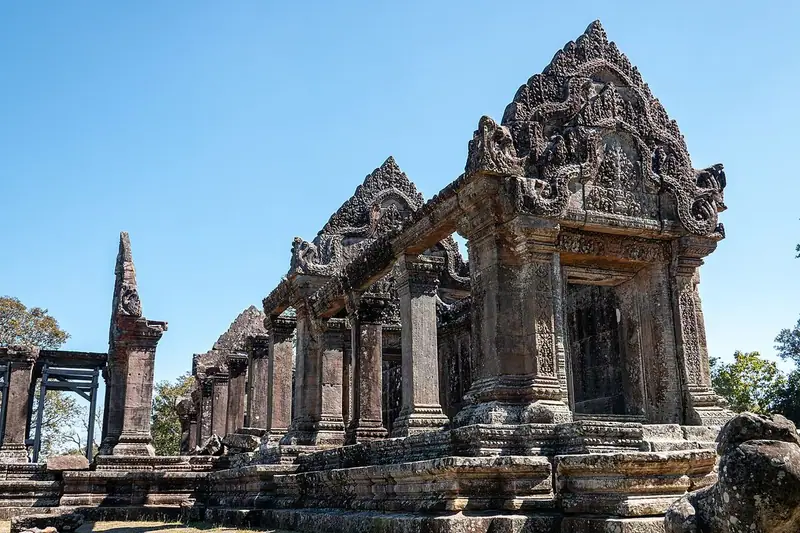
The Temple of Preah Vihear stands on the edge of a cliff in the Dângrêk Mountains, on Cambodia’s northern border with Thailand, more than five hundred metres above the Cambodian plain. Dedicated to the Hindu god Shiva, it is a chain of sanctuaries linked by stairways and causeways along an axis some eight hundred metres long, and UNESCO inscribed it as a World Heritage Site in 2008, calling it an outstanding masterpiece of Khmer architecture. The temple has long been at the centre of a border dispute. During fighting between Cambodia and Thailand in July and December 2025 it was hit by shelling, and a UNESCO and ICOMOS mission in March 2026 found extensive damage and unexploded ordnance on the site. As of autumn 2026 the temple is closed to visitors, with no date set for reopening. This guide says plainly what has been damaged, and what stands today. Check your government’s current travel advice before you plan a visit.
Use it as a self-guided tour of Preah Vihear: 10 stops in visit order, each played when you’re ready, at your own pace.
 Free preview · Stop 1
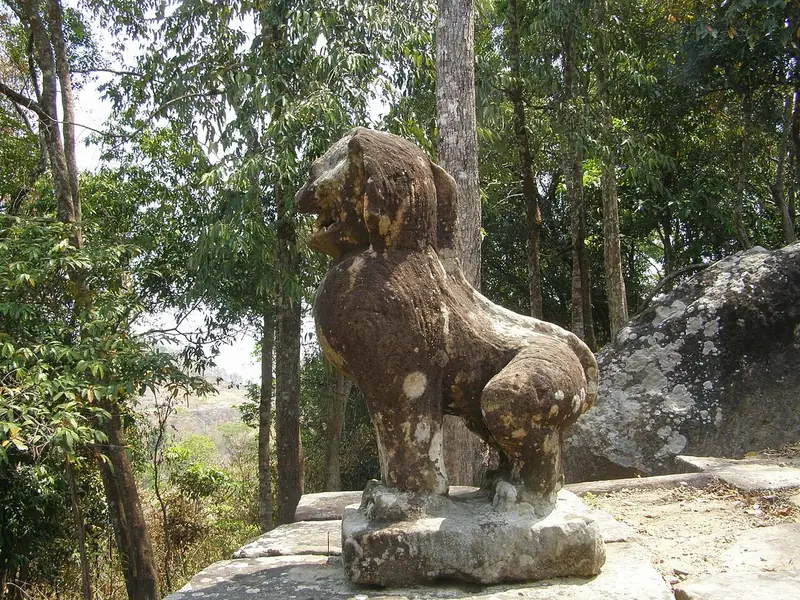
The Great Stairway
The temple was built to be approached from the north, from the plain that is now in Thailand, so the pilgrim’s route begins at the foot of the great stairway. It has a hundred and sixty-three steps of large stone slabs, many cut directly into the rock, about eight metres wide and seventy-eight metres long. Near the top it narrows to four metres, between seven small terraces on each side. Stone lions once lined the whole way; only a few remain, close to the bottom. The difficulty of the climb is often said to express the hard path of faith towards the world of the gods. From 2018 until July 2025, a restoration of this northern staircase was carried out with funding from the United States; it was suspended by the fighting, and restored sections were damaged again. This photograph was taken in 2008.
Photo: Chamrat Charoenkhet · CC BY 3.0 · Wikimedia Commons. Taken in 2008
What to see at Preah Vihear: 10 stops, in visit order
- 01
 The Great StairwayLions on the way upFree preview
- 02
 Gopura VThe first gatewayIn the guide
- 03
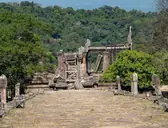 The CausewayA processional wayIn the guide
- 04
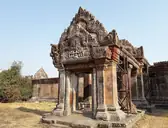 Gopura IVThe churning of the oceanIn the guide
- 05
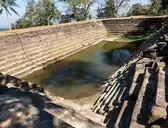 The Lion Head ReservoirA pool for the godIn the guide
- 06
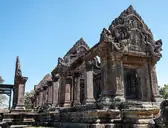 Gopura III and the PalacesThe largest gatewayIn the guide
- 07
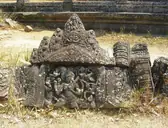 Fallen StonesCarvings on the groundIn the guide
- 08
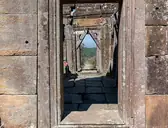 The GalleriesTowards the sanctuaryIn the guide
- 09
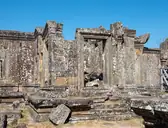 The SanctuaryThe house of ShivaIn the guide
- 10
 The Cliff EdgeThe edge of the plateauIn the guide
Site map of Preah Vihear
History of Preah Vihear
The Khmer Empire, which ruled much of mainland South-East Asia from its capital at Angkor, built the first temple here in the early ninth century, on the site of a hermitage, for Shiva as lord of the mountain peak. The oldest surviving parts date from the early tenth century, when the capital was at Koh Ker, but most of the temple was built under the kings Suryavarman I, who reigned from 1006 to 1050, and Suryavarman II, the builder of Angkor Wat, in the early twelfth century. An inscription tells how the royal priest Divakarapandita gave the temple a golden statue of the dancing Shiva and had its towers and courts redecorated every year. After Hinduism declined in the region the temple was used by Buddhists, and it is still a place of offering today.
Preah Vihear guide: questions
How many stops does the Preah Vihear guide have?
10 stops, in visit order: 1. The Great Stairway; 2. Gopura V; 3. The Causeway; 4. Gopura IV; 5. The Lion Head Reservoir; 6. Gopura III and the Palaces; 7. Fallen Stones; 8. The Galleries; 9. The Sanctuary; 10. The Cliff Edge.
Can I do a self-guided tour of Preah Vihear with this guide?
Yes. The guide is made for a self-guided tour: 10 stops in visit order, each with a photo, a story and a voice, so you can explore Preah Vihear at your own pace, without joining a group. Download it before you go and it works offline.
How long do you need at Preah Vihear?
We suggest allowing half a day (when reopened). The 10 stops add up to about 8 minutes of listening, and you play each one when you’re ready, so you can linger wherever you like.
How long is each guide?
The 10 stops add up to about 8 minutes of listening in total. You play each stop when you’re ready, so you can go at your own pace.
Does the guide work offline?
Yes, once it’s downloaded. The guide is a single self-contained web page (about 10.2 MB) with the photos, text and audio built in. Download it to your phone before you go (Wi-Fi is best); after that it opens in any modern browser on iPhone or Android, with no app, account or mobile signal needed.
Does it use GPS or need my location?
No. The guide doesn’t use GPS and doesn’t know where you are: you play each stop when you reach it. It works on iPhone and Android in any modern browser, and it’s in English.
What’s included?
One self-contained HTML guide: 10 stops in visit order, each with a photo, text and a voice, plus the story of who built the site.
Who built Preah Vihear?
The Khmer Empire, which ruled much of mainland South-East Asia from its capital at Angkor, built the first temple here in the early ninth century, on the site of a hermitage, for Shiva as lord of the mountain peak. The oldest surviving parts date from the early tenth century, when the capital was at Koh Ker, but most of the temple was built under the kings Suryavarman I, who reigned from 1006 to 1050, and Suryavarman II, the builder of Angkor Wat, in the early twelfth century.
Where is Preah Vihear?
The Temple of Preah Vihear stands on the edge of a cliff in the Dângrêk Mountains, on Cambodia’s northern border with Thailand, more than five hundred metres above the Cambodian plain.
Is there a free audio guide to Preah Vihear?
The first stop, The Great Stairway, is free to read and hear on this page, so you can try the Preah Vihear audio tour before you buy. The full guide, with all 10 stops, is a one-off purchase: download it once and it’s yours to keep, working offline.
Is the Preah Vihear guide worth it?
If you’d like to know what you’re looking at, yes. For $10 you get 10 stops in visit order, each with a photo, a short history and a voice you play when you’re ready, plus a site map of the stops, and about 8 minutes of listening in all. It’s short on purpose, so you spend your time looking, not listening. It’s yours to keep, works offline and needs no app. The first stop is free on this page, so you can try it before you buy. If you’d like hours of detail, a guided tour will go deeper.
Audio guide or guided tour?
It depends how you like to visit. This guide lets you explore Preah Vihear at your own pace, at any time, for a one-off price. A guided tour gives you a live expert you can ask questions, but at fixed times and usually for a higher price. Many people use both: a tour for the big picture, and the guide to read beforehand or to revisit the stops in their own time.
Is this the official Preah Vihear guide?
No. It’s an independent guide by The Historian Guide, not affiliated with or endorsed by the operator of Preah Vihear. For tickets and opening hours, check the official site operator before you go.
Does the guide include entry tickets or opening hours?
No. The guide is a digital companion only. Admission to Preah Vihear is separate, so check the official site operator for current tickets and opening hours before you go.
- Stop 1 · The Great Stairway: CHAMRAT CHAROENKHET · CC BY 3.0 · Wikimedia Commons · resized
- Stop 2 · Gopura V: PsamatheM · CC BY-SA 4.0 · Wikimedia Commons · resized
- Stop 3 · The Causeway: PsamatheM · CC BY-SA 4.0 · Wikimedia Commons · resized
- Stop 4 · Gopura IV: GRANDE PUFFO VCO · CC0 · Wikimedia Commons · resized
- Stop 5 · The Lion Head Reservoir: PsamatheM · CC BY-SA 4.0 · Wikimedia Commons · resized
- Stop 6 · Gopura III and the Palaces (also the cover): PsamatheM · CC BY-SA 4.0 · Wikimedia Commons · resized
- Stop 7 · Fallen Stones: CHAMRAT CHAROENKHET · CC BY 3.0 · Wikimedia Commons · resized
- Stop 8 · The Galleries: PsamatheM · CC BY-SA 4.0 · Wikimedia Commons · resized
- Stop 9 · The Sanctuary: PsamatheM · CC BY-SA 4.0 · Wikimedia Commons · resized
- Stop 10 · The Cliff Edge: PsamatheM · CC BY-SA 4.0 · Wikimedia Commons · resized


All photographs from Wikimedia Commons under the licences shown.
More guides in Cambodia
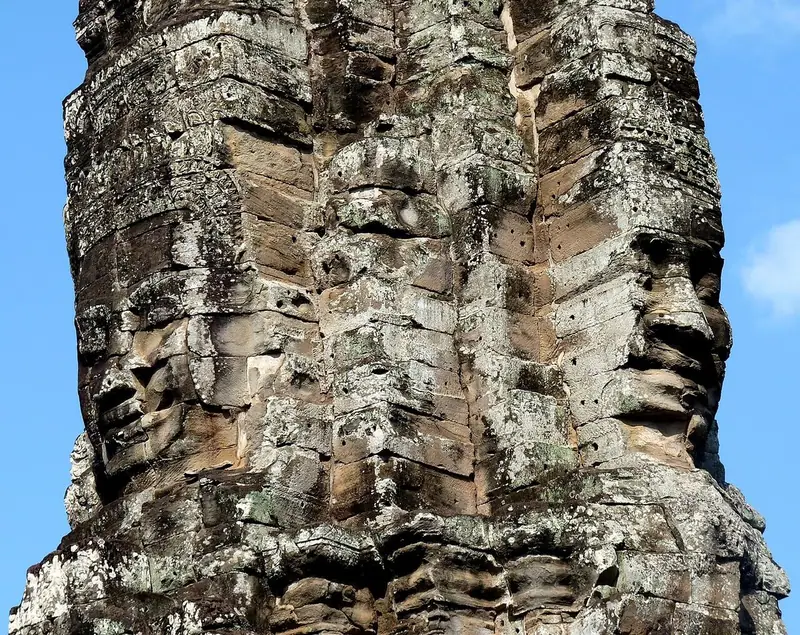 Khmer7 stops · 11th–13th century CE
Angkor Thom and the Bayon audio guide
Pass through the South Gate into the royal city of Jayavarman VII, where serene stone faces gaze from every tower of the Bayon.
 Khmer8 stops · 12th century CE
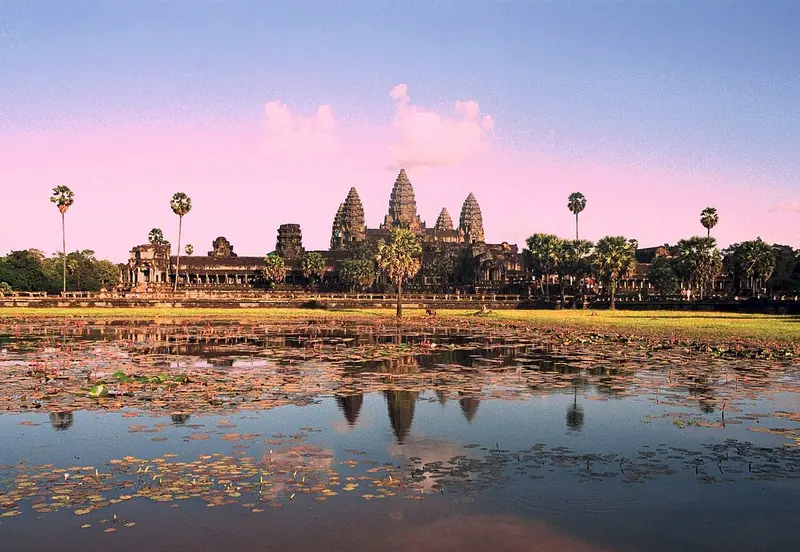
Angkor Wat audio guide
Cross the western causeway into Angkor Wat, past galleries of reliefs of battles, gods and the Churning of the Sea.
 Khmer7 stops · 967 CE
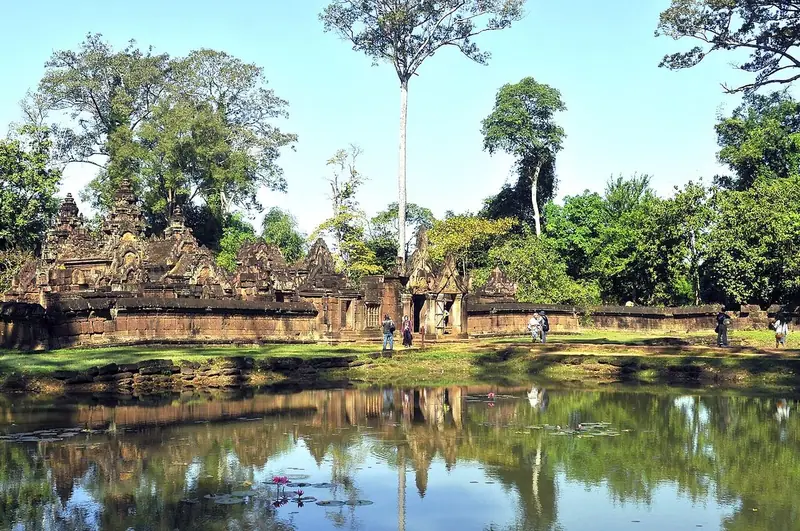
Banteay Srei audio guide
A small, exquisitely carved temple, with Shiva the Dancer over its doors, that was unusually not built by a king.
 Khmer7 stops · 10th – early 13th century CE
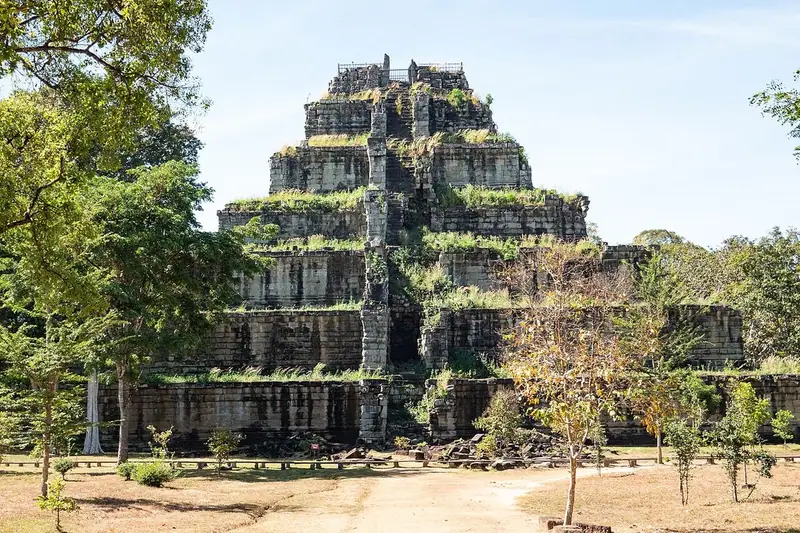
Koh Ker audio guide
The forest capital of the Khmer king Jayavarman IV: brick towers in the roots, linga shrines carved from bedrock, the red tower of Prasat Krahom and the seven-tiered pyramid of the Prang.
 Khmer6 stops · from 1186 CE
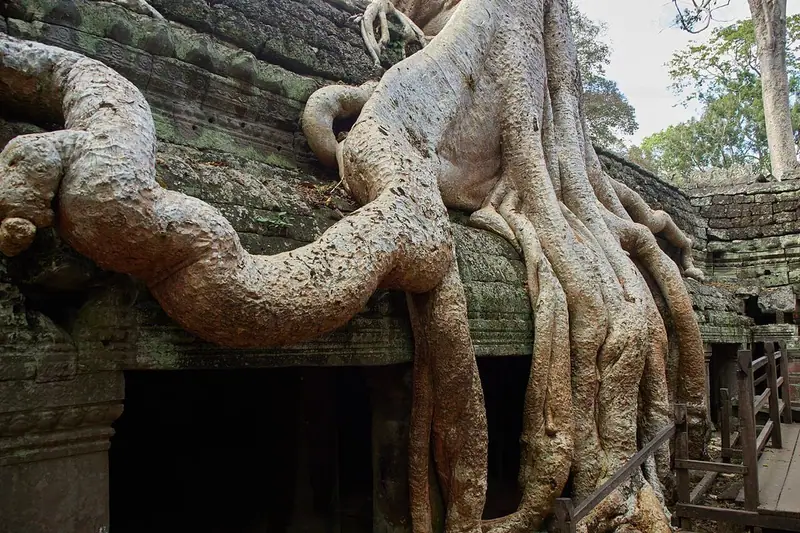
Ta Prohm audio guide
A temple held in the grip of giant trees, its towers and carved devatas half swallowed by the forest.
Every guide, in every country
Preah Vihear and every other guide we publish, including future ones. One payment, no subscription.