
Before you start
Garni and Geghard, in the hills east of Yerevan, are two of Armenia’s most famous historic sites, usually visited together on a day trip from the capital. Garni holds a classical temple on the edge of a dramatic gorge, the only standing Greco-Roman colonnaded building in Armenia, while Geghard, a few kilometres further up the valley, is a medieval monastery partly carved out of the living rock, inscribed as a UNESCO World Heritage Site in 2000 together with the upper Azat valley. The two sites are about ten kilometres apart, so you will need a car, a taxi or a tour to travel between them. This guide explores Garni first, with its fortress, temple, bathhouse and church ruins, then drives up to Geghard to visit its main church and rock-cut chambers.
Use it as a self-guided tour of Garni and Geghard: 8 stops in visit order, each played when you’re ready, at your own pace.
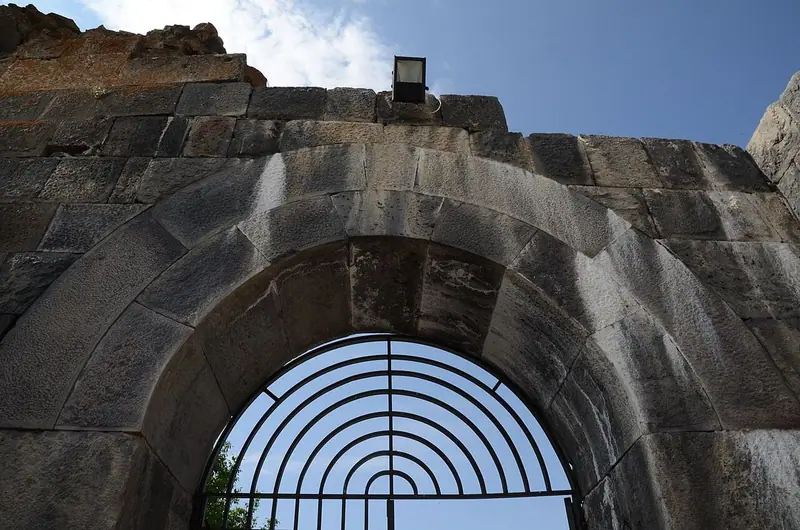 Free preview · Stop 1
Garni Fortress
Begin at the entrance to Garni, where you pass through the line of the ancient fortress walls. The fortress stood on a triangular promontory, protected on two sides by the sheer cliffs of the Azat gorge, so walls were needed only on the side facing the plateau. Look at the massive blocks of basalt, laid without mortar and joined by iron clamps sealed with lead, and the remains of towers along the walls. For centuries this was a royal stronghold of the kings of Armenia, and a Greek inscription found here names King Tiridates as a builder. Walk through the site towards the edge of the cliff, where the temple stands. Notice the wide views across the valley to the mountains beyond, which made this such a strong defensive position, and the scattered stones of the buildings that once filled the fortress.
Photo: Jona Lendering · CC0 · Wikimedia Commons
What to see at Garni and Geghard: 8 stops, in visit order
- 01
 Garni FortressWalls above the gorgeFree preview
- 02
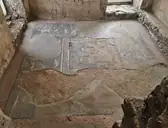 Royal BathhouseA mosaic floorIn the guide
- 03
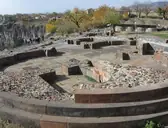 Church RuinsEarly Christian GarniIn the guide
- 04
 Temple of GarniA Greco-Roman templeIn the guide
- 05
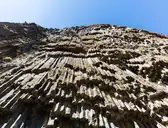 Symphony of StonesBasalt columnsIn the guide
- 06
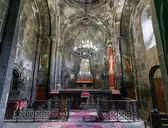 Katoghike ChurchThe main church of GeghardIn the guide
- 07
 Rock-Cut ChurchesCarved from the mountainIn the guide
- 08
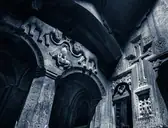 Proshyan TombLions and an eagleIn the guide
Site map of Garni and Geghard
History of Garni and Geghard
Garni was a royal fortress of the kings of Armenia from at least the third century BCE, guarding the routes through the hills. In the first century CE, under King Tiridates I, a temple was built here in the Greco-Roman style. Armenia adopted Christianity as its state religion in the early fourth century, traditionally in 301, and Garni later became a royal summer residence. At Geghard, a monastery grew up around a sacred spring in a cave from the early Christian period, and its main buildings were built in the thirteenth century by the Zakarid and Proshyan princes. Both sites suffered from invasions and earthquakes, and were restored in the twentieth century.
Garni and Geghard guide: questions
How many stops does the Garni and Geghard guide have?
8 stops, in visit order: 1. Garni Fortress; 2. Royal Bathhouse; 3. Church Ruins; 4. Temple of Garni; 5. Symphony of Stones; 6. Katoghike Church; 7. Rock-Cut Churches; 8. Proshyan Tomb.
Can I do a self-guided tour of Garni and Geghard with this guide?
Yes. The guide is made for a self-guided tour: 8 stops in visit order, each with a photo, a story and a voice, so you can explore Garni and Geghard at your own pace, without joining a group. Download it before you go and it works offline.
How long is each guide?
The 8 stops add up to about 6 minutes of listening in total. You play each stop when you’re ready, so you can go at your own pace.
Does the guide work offline?
Yes, once it’s downloaded. The guide is a single self-contained web page (about 7.6 MB) with the photos, text and audio built in. Download it to your phone before you go (Wi-Fi is best); after that it opens in any modern browser on iPhone or Android, with no app, account or mobile signal needed.
Does it use GPS or need my location?
No. The guide doesn’t use GPS and doesn’t know where you are: you play each stop when you reach it. It works on iPhone and Android in any modern browser, and it’s in English.
What’s included?
One self-contained HTML guide: 8 stops in visit order, each with a photo, text and a voice, plus the story of who built the site.
Who built Garni and Geghard?
Garni was a royal fortress of the kings of Armenia from at least the third century BCE, guarding the routes through the hills. In the first century CE, under King Tiridates I, a temple was built here in the Greco-Roman style.
Where is Garni and Geghard?
Garni and Geghard, in the hills east of Yerevan, are two of Armenia’s most famous historic sites, usually visited together on a day trip from the capital.
Is there a free audio guide to Garni and Geghard?
The first stop, Garni Fortress, is free to read and hear on this page, so you can try the Garni and Geghard audio tour before you buy. The full guide, with all 8 stops, is a one-off purchase: download it once and it’s yours to keep, working offline.
Is the Garni and Geghard guide worth it?
If you’d like to know what you’re looking at, yes. For $10 you get 8 stops in visit order, each with a photo, a short history and a voice you play when you’re ready, plus a site map of the stops, and about 6 minutes of listening in all. It’s short on purpose, so you spend your time looking, not listening. It’s yours to keep, works offline and needs no app. The first stop is free on this page, so you can try it before you buy. If you’d like hours of detail, a guided tour will go deeper.
Audio guide or guided tour?
It depends how you like to visit. This guide lets you explore Garni and Geghard at your own pace, at any time, for a one-off price. A guided tour gives you a live expert you can ask questions, but at fixed times and usually for a higher price. Many people use both: a tour for the big picture, and the guide to read beforehand or to revisit the stops in their own time.
Is this the official Garni and Geghard guide?
No. It’s an independent guide by The Historian Guide, not affiliated with or endorsed by the operator of Garni and Geghard. For tickets and opening hours, check the official site operator before you go.
Does the guide include entry tickets or opening hours?
No. The guide is a digital companion only. Admission to Garni and Geghard is separate, so check the official site operator for current tickets and opening hours before you go.
- Stop 1 · Garni Fortress: Jona Lendering · CC0 · Wikimedia Commons · resized
- Stop 2 · Royal Bathhouse: Lubekar · CC BY-SA 4.0 · Wikimedia Commons · resized
- Stop 3 · Church Ruins: Armen Manukov · CC BY-SA 3.0 · Wikimedia Commons · resized
- Stop 4 · Temple of Garni (also the cover): Diego Delso · CC BY-SA 4.0 · Wikimedia Commons · resized
- Stop 5 · Symphony of Stones: Diego Delso · CC BY-SA 4.0 · Wikimedia Commons · resized
- Stop 6 · Katoghike Church: Anton Skrobotov · CC BY-SA 2.0 · Wikimedia Commons · resized
- Stop 7 · Rock-Cut Churches: xiquinhosilva · CC BY 4.0 · Wikimedia Commons · resized
- Stop 8 · Proshyan Tomb: Hove Hayk · CC BY-SA 4.0 · Wikimedia Commons · resized


All photographs from Wikimedia Commons under the licences shown.
More guides in Armenia
 Armenian7 stops · 301–7th century
Etchmiadzin and Zvartnots audio guide
Visit the mother cathedral of the Armenian Apostolic Church beneath Mount Ararat, the churches of Saint Gayane and Saint Hripsime, and Zvartnots.
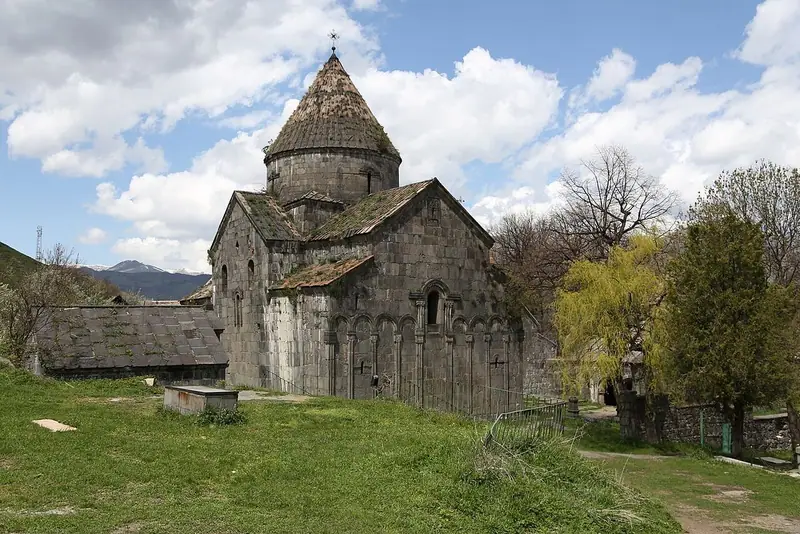 Armenian8 stops · 928–1273
Haghpat and Sanahin audio guide
Visit two medieval monasteries facing each other above the Debed gorge, with their churches, narthexes, library and bell tower.
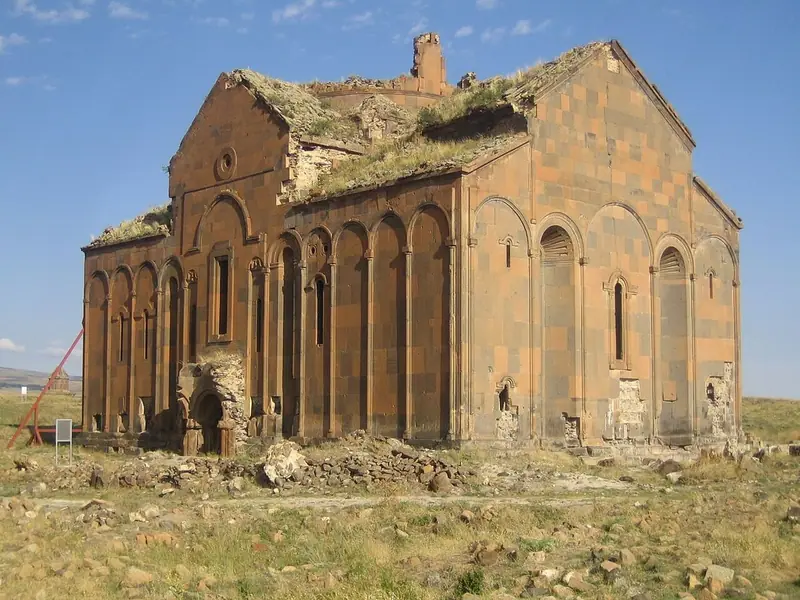 Armenian8 stops · 10th – 14th century CE
Ani audio guide
The ruined capital of medieval Armenia above a border gorge: Trdat’s cathedral, the frescoed church of Tigran Honents, the half-fallen Holy Redeemer and the minaret of Manuchihr.
Every guide, in every country
Garni and Geghard and every other guide we publish, including future ones. One payment, no subscription.