Before you start
Shibam stands on a low rise in the bed of Wadi Hadhramaut, in eastern Yemen, a walled town of about five hundred tower houses built of sun-dried mud brick, many of them five to eight storeys high. It has been called the Manhattan of the desert. UNESCO inscribed the Old Walled City of Shibam as a World Heritage Site in 1982, as one of the oldest and finest examples of urban planning based on building upwards. A great flood in October 2008 weakened the foundations of a number of houses, some of which later collapsed. In 2009 a suicide bombing here killed four South Korean tourists and their Yemeni guide. Yemen has been at war since 2015, the year UNESCO placed Shibam on the List of World Heritage in Danger, and very few foreign visitors have come since. This guide says plainly what has been damaged, and what stands today. Check your government’s current travel advice before you plan a visit.
Use it as a self-guided tour of Shibam: 10 stops in visit order, each played when you’re ready, at your own pace.
 Free preview · Stop 1
The View from the Southern Slope
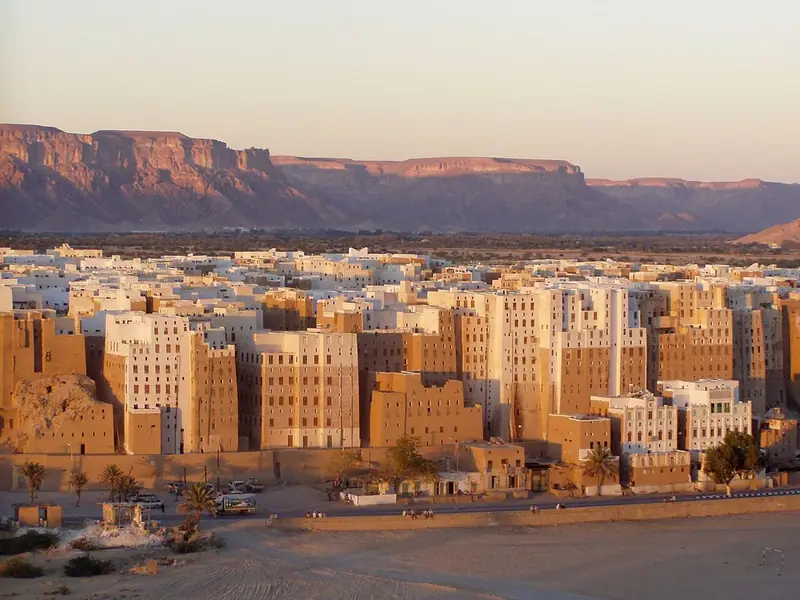
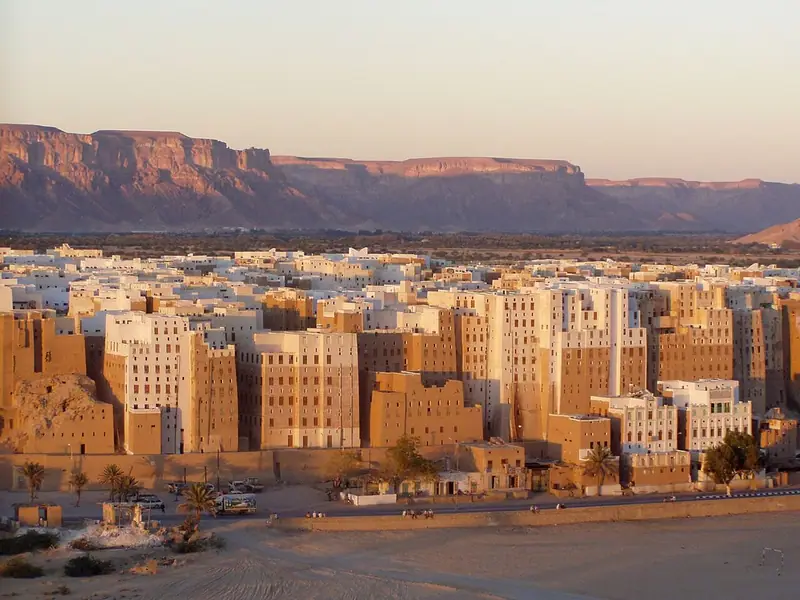
Begin on the slope south of the wadi, near the suburb of Sahil Shibam, for the view that made the town famous. Across the dry riverbed rises a solid block of towers, packed inside a wall about three hundred and twenty metres long and two hundred and forty metres wide, covering some seven hectares. Behind them stand the flat-topped cliffs of the wadi. The houses are built close together, with almost no courtyards, and the upper floors are often whitewashed, so that the skyline turns from brown to white as it climbs. The comparison with Manhattan is a modern one; local people simply call it Shibam. Wealthy townspeople laid out gardens and built houses on this slope from the late nineteenth century, and since the 1950s a new town has spread out along it. Late afternoon is the classic time for this view.
Photo: Dan from Brussels · CC BY-SA 2.0 · Wikimedia Commons. Taken in 2008
What to see at Shibam: 10 stops, in visit order
- 01
 The View from the Southern SlopeThe Manhattan of the desertFree preview
- 02
 The Wadi and Its FloodsA town built against the waterIn the guide
- 03
 The Fields of the WadiPalms, dams and spate waterIn the guide
- 04
 The City WallsA rampart of mud brickIn the guide
- 05
 The City GateThe only way in from the southIn the guide
- 06
 The Main SquareMerchants, sultans and caravansIn the guide
- 07
 The Mosques of ShibamSix mosques within the wallsIn the guide
- 08
 The Tower HousesLiving upwardsIn the guide
- 09
 Doors and WindowsThe craft of the carpentersIn the guide
- 10
 The RooftopsLime, mud and constant careIn the guide
Site map of Shibam
History of Shibam
An inscription found near the town shows that a place called Shibam existed by the third century CE, and it became the capital of the kingdom of Hadhramaut after the destruction of the older capital, Shabwa, around 300 CE. Its wealth came from its position on the incense route across southern Arabia, and later from Hadhrami merchants who traded around the Indian Ocean, from East Africa to India and South-East Asia. Great floods struck the town in the thirteenth century and again in 1532 and 1533, and most of what you see was rebuilt after the second. The Kathiri sultans ruled from here from the fifteenth century; the rival Qu’ayti dynasty took the town in 1858. Money sent home by emigrants renewed many houses in the late nineteenth and early twentieth centuries. After 1967 the town was part of South Yemen, and since 1990 of the unified Republic of Yemen.
Shibam guide: questions
How many stops does the Shibam guide have?
10 stops, in visit order: 1. The View from the Southern Slope; 2. The Wadi and Its Floods; 3. The Fields of the Wadi; 4. The City Walls; 5. The City Gate; 6. The Main Square; 7. The Mosques of Shibam; 8. The Tower Houses; 9. Doors and Windows; 10. The Rooftops.
Can I do a self-guided tour of Shibam with this guide?
Yes. The guide is made for a self-guided tour: 10 stops in visit order, each with a photo, a story and a voice, so you can explore Shibam at your own pace, without joining a group. Download it before you go and it works offline.
How long do you need at Shibam?
We suggest allowing half a day. The 10 stops add up to about 8 minutes of listening, and you play each one when you’re ready, so you can linger wherever you like.
How long is each guide?
The 10 stops add up to about 8 minutes of listening in total. You play each stop when you’re ready, so you can go at your own pace.
Does the guide work offline?
Yes, once it’s downloaded. The guide is a single self-contained web page (about 8.6 MB) with the photos, text and audio built in. Download it to your phone before you go (Wi-Fi is best); after that it opens in any modern browser on iPhone or Android, with no app, account or mobile signal needed.
Does it use GPS or need my location?
No. The guide doesn’t use GPS and doesn’t know where you are: you play each stop when you reach it. It works on iPhone and Android in any modern browser, and it’s in English.
What’s included?
One self-contained HTML guide: 10 stops in visit order, each with a photo, text and a voice, plus the story of who built the site.
Who built Shibam?
An inscription found near the town shows that a place called Shibam existed by the third century CE, and it became the capital of the kingdom of Hadhramaut after the destruction of the older capital, Shabwa, around 300 CE. Its wealth came from its position on the incense route across southern Arabia, and later from Hadhrami merchants who traded around the Indian Ocean, from East Africa to India and South-East Asia.
Where is Shibam?
Shibam stands on a low rise in the bed of Wadi Hadhramaut, in eastern Yemen, a walled town of about five hundred tower houses built of sun-dried mud brick, many of them five to eight storeys high.
Is there a free audio guide to Shibam?
The first stop, The View from the Southern Slope, is free to read and hear on this page, so you can try the Shibam audio tour before you buy. The full guide, with all 10 stops, is a one-off purchase: download it once and it’s yours to keep, working offline.
Is the Shibam guide worth it?
If you’d like to know what you’re looking at, yes. For $10 you get 10 stops in visit order, each with a photo, a short history and a voice you play when you’re ready, plus a site map of the stops, and about 8 minutes of listening in all. It’s short on purpose, so you spend your time looking, not listening. It’s yours to keep, works offline and needs no app. The first stop is free on this page, so you can try it before you buy. If you’d like hours of detail, a guided tour will go deeper.
Audio guide or guided tour?
It depends how you like to visit. This guide lets you explore Shibam at your own pace, at any time, for a one-off price. A guided tour gives you a live expert you can ask questions, but at fixed times and usually for a higher price. Many people use both: a tour for the big picture, and the guide to read beforehand or to revisit the stops in their own time.
Is this the official Shibam guide?
No. It’s an independent guide by The Historian Guide, not affiliated with or endorsed by the operator of Shibam. For tickets and opening hours, check the official site operator before you go.
Does the guide include entry tickets or opening hours?
No. The guide is a digital companion only. Admission to Shibam is separate, so check the official site operator for current tickets and opening hours before you go.
- Stop 1 · The View from the Southern Slope (also the cover): Dan from Brussels, Europe · CC BY-SA 2.0 · Wikimedia Commons · resized
- Stop 2 · The Wadi and Its Floods: Bkar6190 · CC BY-SA 4.0 · Wikimedia Commons · resized
- Stop 3 · The Fields of the Wadi: Mohammed faisal batheeb · CC BY-SA 4.0 · Wikimedia Commons · resized
- Stop 4 · The City Walls: Dan from Brussels, Europe · CC BY-SA 2.0 · Wikimedia Commons · resized
- Stop 5 · The City Gate: Aiman titi · CC BY-SA 3.0 · Wikimedia Commons · resized
- Stop 6 · The Main Square: Ljuba brank · CC BY-SA 3.0 · Wikimedia Commons · resized
- Stop 7 · The Mosques of Shibam: Mohammed faisal batheeb · CC BY-SA 4.0 · Wikimedia Commons · resized
- Stop 8 · The Tower Houses: Maria Gropa · CC BY-SA 3.0 igo · Wikimedia Commons · resized
- Stop 9 · Doors and Windows: Dan from Brussels, Europe · CC BY-SA 2.0 · Wikimedia Commons · resized
- Stop 10 · The Rooftops: Hasso Hohmann · CC BY 4.0 · Wikimedia Commons · resized


All photographs from Wikimedia Commons under the licences shown.
More guides
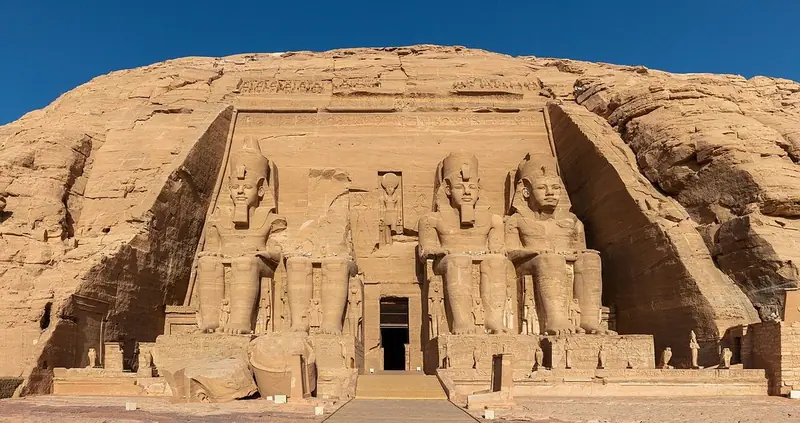 Ancient Egyptian8 stops · 13th century BCE
Abu Simbel audio guide
Ramesses II’s colossal temple façade, the Temple of Nefertari, and how both were rescued from the waters of Lake Nasser.
 Ga7 stops · 1649–1957
Old Accra audio guide
From the old forts and lighthouse of Jamestown, through the Ga fishing quarter, to the monuments of Ghana’s independence and Osu Castle.
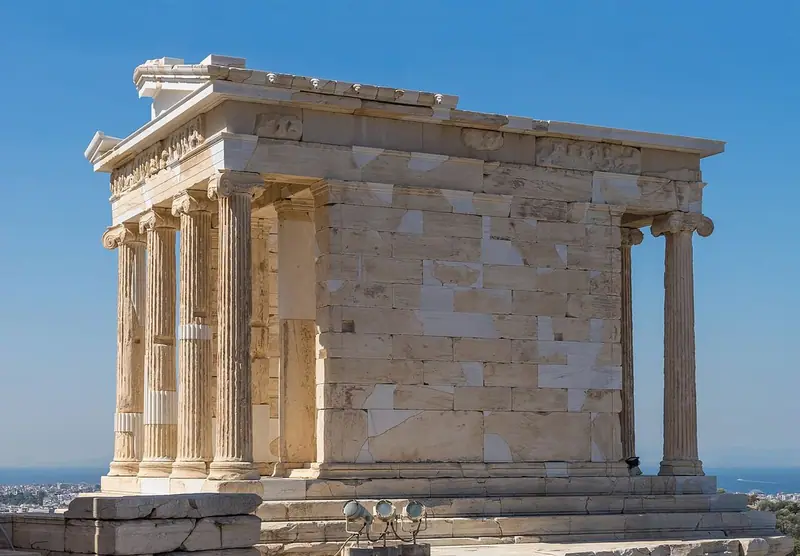 Greek7 stops · 5th century BCE
Acropolis of Athens audio guide
Climb through the Propylaia to the Parthenon and the Erechtheion, on the rock that has crowned Athens for three thousand years.
Every guide, in every country
Shibam and every other guide we publish, including future ones. One payment, no subscription.