Before you start
Wat Arun, the Temple of Dawn, stands on the west bank of the Chao Phraya River, in the Thonburi side of Bangkok, opposite Wat Pho and the Grand Palace. The simplest way to arrive is by the cross-river ferry from Tha Tien pier, next to Wat Pho, which lands beside the temple; river boats along the Chao Phraya also stop here. The temple is named after Aruna, the Hindu god of the dawn, often personified as the rays of the rising sun. It is a working temple: dress modestly, with shoulders and knees covered, take off your shoes before entering the ordination hall, and behave quietly. The steps of the great tower are very steep, and only the lower terraces are normally open. This route looks at the temple from the river, passes the guardian giants into the ordination hall, then circles and climbs the great prang.
Use it as a self-guided tour of Wat Arun: 6 stops in visit order, each played when you’re ready, at your own pace.
 Free preview · Stop 1
From the River
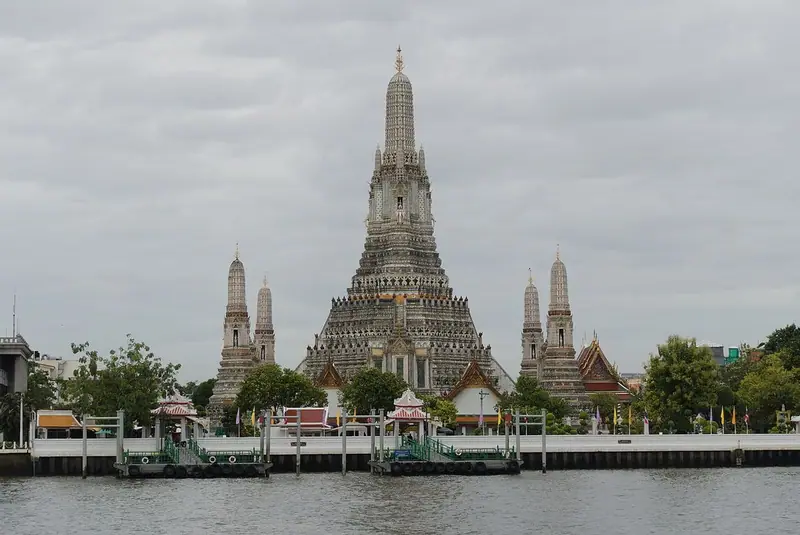
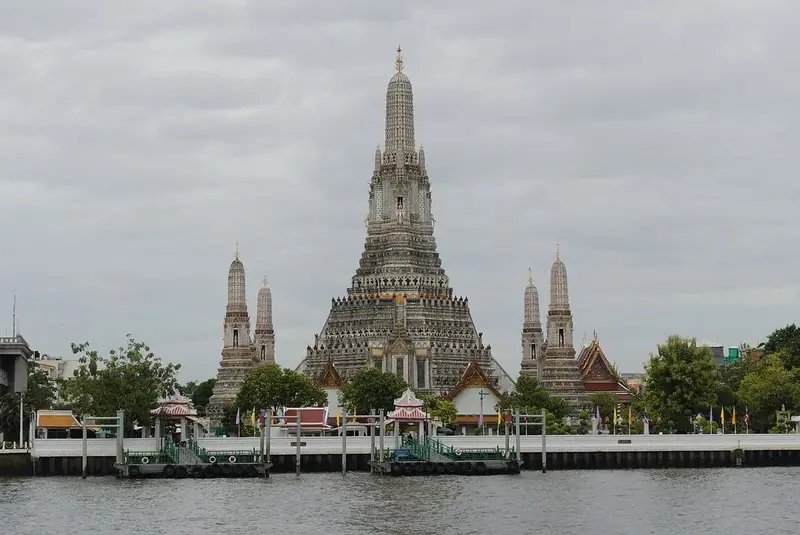
Begin on the river, or on the bank opposite, and look at the temple across the water. The great central tower, the prang, rises above four smaller towers at its corners, all glittering with porcelain. Sources give its height anywhere between about sixty-seven and eighty-six metres. For travellers sailing upstream from the sea, it was the first sign that they had reached the capital. The French explorer Henri Mouhot, who visited Siam in the late 1850s, called Wat Chaeng, as it was then known, the most beautiful temple in Bangkok, with a spire over two hundred feet high. According to tradition, King Taksin vowed to restore the temple after passing it at dawn, a story often linked with its name, the Temple of Dawn. Look along the riverbank for the Chinese-style pavilions, and then land and walk to the ordination hall.
Photo: Paul_012 · CC BY-SA 4.0 · Wikimedia Commons
What to see at Wat Arun: 6 stops, in visit order
- 01
 From the RiverThe first sign of the capitalFree preview
- 02
 Guardian GiantsThotsakan and SahatsadechaIn the guide
- 03
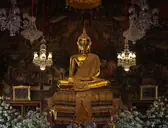 Ordination HallThe Niramit BuddhaIn the guide
- 04
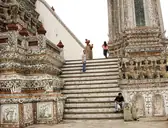 The Central PrangMount Meru in porcelainIn the guide
- 05
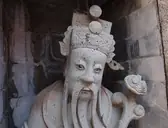 Porcelain and StatuesBallast from ChinaIn the guide
- 06
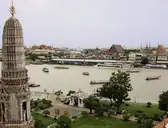 Terraces and SatellitesThe river at your feetIn the guide
Site map of Wat Arun
History of Wat Arun
Wat Arun was rebuilt by the Chakri dynasty, which has reigned over Siam, now Thailand, since 1782, on the site of a much older temple. A temple called Wat Makok stood here in the Ayutthaya period, before the reign of King Narai, who ruled from 1656 to 1688. After Ayutthaya fell in 1767, King Taksin made Thonburi his capital, renamed the temple Wat Chaeng and placed it in the grounds of his palace; it housed the Emerald Buddha until 1785. When King Rama I moved the capital across the river, the temple was left neglected. King Rama II restored it and planned to raise its great tower, and work began under King Rama III. The central prang was completed in 1851, after years of construction.
Wat Arun guide: questions
How many stops does the Wat Arun guide have?
6 stops, in visit order: 1. From the River; 2. Guardian Giants; 3. Ordination Hall; 4. The Central Prang; 5. Porcelain and Statues; 6. Terraces and Satellites.
Can I do a self-guided tour of Wat Arun with this guide?
Yes. The guide is made for a self-guided tour: 6 stops in visit order, each with a photo, a story and a voice, so you can explore Wat Arun at your own pace, without joining a group. Download it before you go and it works offline.
How long is each guide?
The 6 stops add up to about 4 minutes of listening in total. You play each stop when you’re ready, so you can go at your own pace.
Does the guide work offline?
Yes, once it’s downloaded. The guide is a single self-contained web page (about 6.0 MB) with the photos, text and audio built in. Download it to your phone before you go (Wi-Fi is best); after that it opens in any modern browser on iPhone or Android, with no app, account or mobile signal needed.
Does it use GPS or need my location?
No. The guide doesn’t use GPS and doesn’t know where you are: you play each stop when you reach it. It works on iPhone and Android in any modern browser, and it’s in English.
What’s included?
One self-contained HTML guide: 6 stops in visit order, each with a photo, text and a voice, plus the story of who built the site.
Who built Wat Arun?
Wat Arun was rebuilt by the Chakri dynasty, which has reigned over Siam, now Thailand, since 1782, on the site of a much older temple. A temple called Wat Makok stood here in the Ayutthaya period, before the reign of King Narai, who ruled from 1656 to 1688.
Where is Wat Arun?
Wat Arun, the Temple of Dawn, stands on the west bank of the Chao Phraya River, in the Thonburi side of Bangkok, opposite Wat Pho and the Grand Palace.
Is there a free audio guide to Wat Arun?
The first stop, From the River, is free to read and hear on this page, so you can try the Wat Arun audio tour before you buy. The full guide, with all 6 stops, is a one-off purchase: download it once and it’s yours to keep, working offline.
Is the Wat Arun guide worth it?
If you’d like to know what you’re looking at, yes. For $10 you get 6 stops in visit order, each with a photo, a short history and a voice you play when you’re ready, plus a site map of the stops, and about 4 minutes of listening in all. It’s short on purpose, so you spend your time looking, not listening. It’s yours to keep, works offline and needs no app. The first stop is free on this page, so you can try it before you buy. If you’d like hours of detail, a guided tour will go deeper.
Audio guide or guided tour?
It depends how you like to visit. This guide lets you explore Wat Arun at your own pace, at any time, for a one-off price. A guided tour gives you a live expert you can ask questions, but at fixed times and usually for a higher price. Many people use both: a tour for the big picture, and the guide to read beforehand or to revisit the stops in their own time.
Is this the official Wat Arun guide?
No. It’s an independent guide by The Historian Guide, not affiliated with or endorsed by the operator of Wat Arun. For tickets and opening hours, check the official site operator before you go.
Does the guide include entry tickets or opening hours?
No. The guide is a digital companion only. Admission to Wat Arun is separate, so check the official site operator for current tickets and opening hours before you go.
- Stop 1 · From the River (also the cover): Paul_012 · CC BY-SA 4.0 · Wikimedia Commons · resized
- Stop 2 · Guardian Giants: BerryJ · CC BY-SA 4.0 · Wikimedia Commons · resized
- Stop 3 · Ordination Hall: This Photo was taken by Supanut Arunoprayote. Feel free… · CC BY 4.0 · Wikimedia Commons · resized
- Stop 4 · The Central Prang: Jorge Láscar from Australia · CC BY 2.0 · Wikimedia Commons · resized
- Stop 5 · Porcelain and Statues: Photo Dharma from Sadao, Thailand · CC BY 2.0 · Wikimedia Commons · resized
- Stop 6 · Terraces and Satellites: Jorge Láscar from Australia · CC BY 2.0 · Wikimedia Commons · resized


All photographs from Wikimedia Commons under the licences shown.
More guides in Thailand
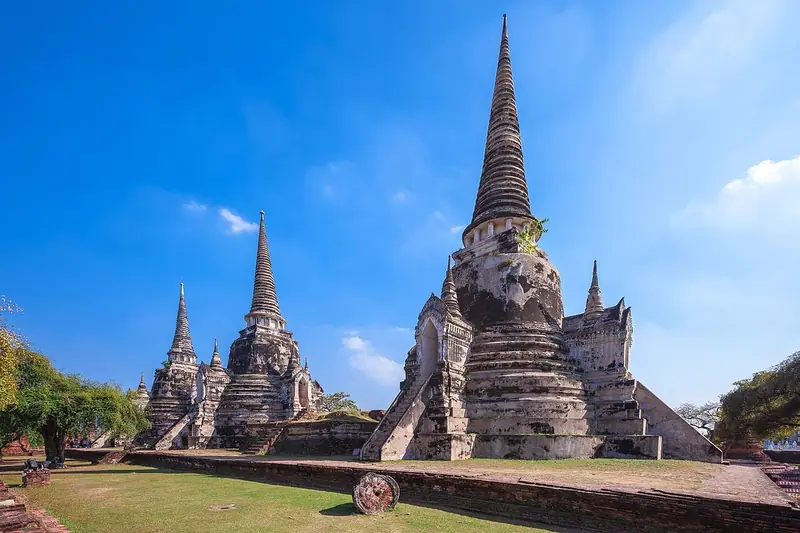 Siamese7 stops · 1351–1767 CE
Ayutthaya Historical Park audio guide
Cycle among the ruined temples of the old royal capital of Siam, from the Buddha head in the tree roots at Wat Mahathat to the towers of Wat Chaiwatthanaram.
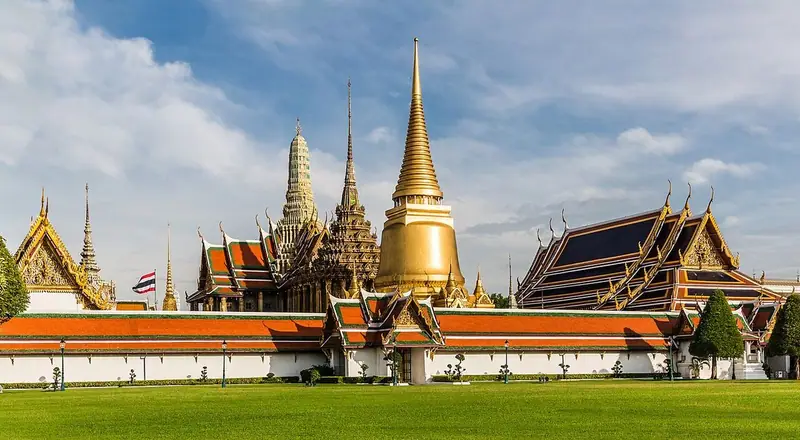 Chakri9 stops · from 1782 CE
Grand Palace audio guide
Pass the yaksha guardians into Bangkok’s royal palace and the Temple of the Emerald Buddha, built from 1782 on the east bank of the Chao Phraya.
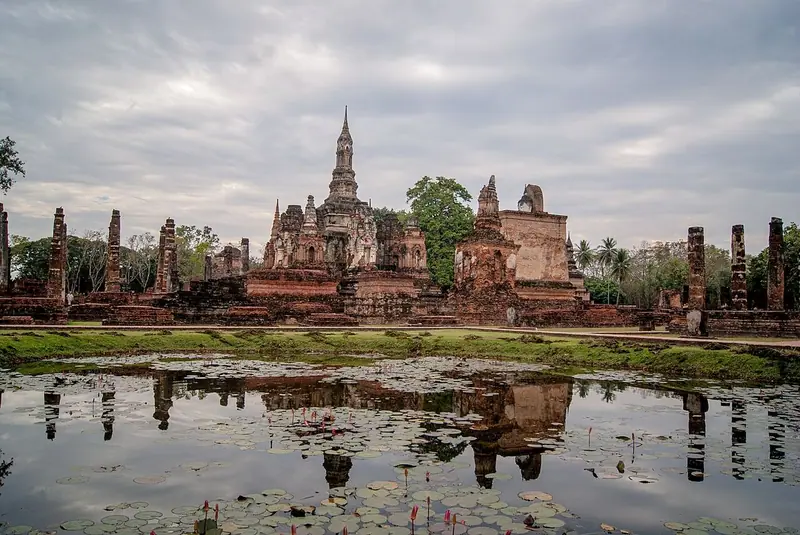 Sukhothai7 stops · c. 1238–1378 CE
Sukhothai Historical Park audio guide
Cycle the walled old city of Sukhothai, from the lotus-bud towers of Wat Mahathat to the great seated Buddha of Wat Si Chum.
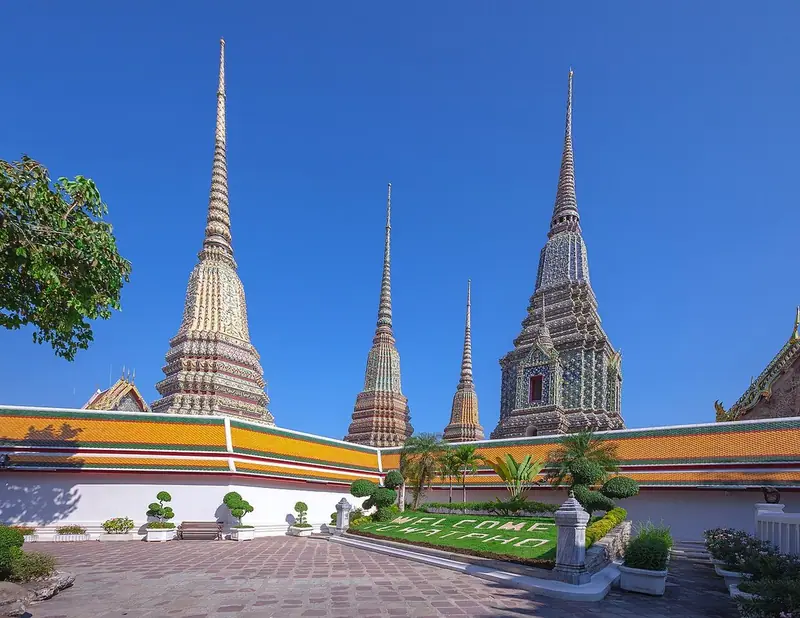 Chakri7 stops · 1788–1848 CE
Wat Pho audio guide
Find the great Reclining Buddha and his inlaid feet, then walk among the four great chedis and stone guardians of Bangkok’s royal temple.
Every guide, in every country
Wat Arun and every other guide we publish, including future ones. One payment, no subscription.