Before you start
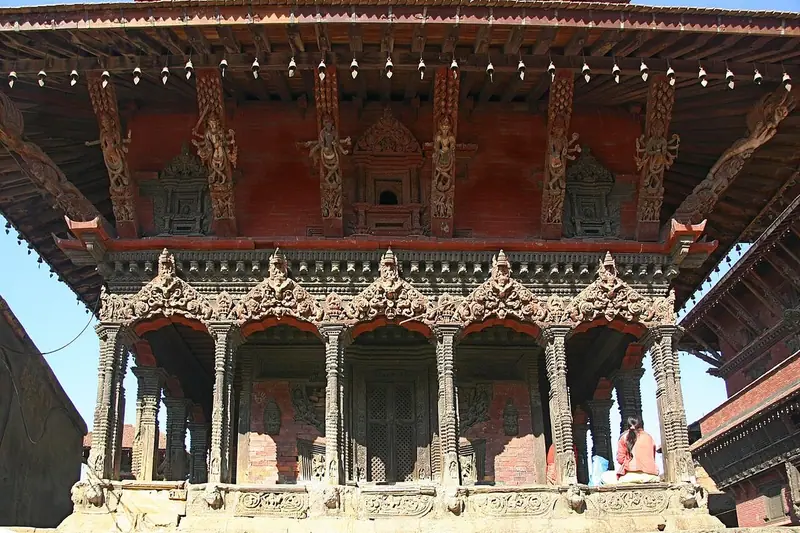
Patan, also called Lalitpur, the city of beauty, lies just south of Kathmandu, across the Bagmati river. At its heart is Durbar Square, the palace square of its Malla kings, crowded with temples of brick, wood and stone, and one of the three royal squares of the Kathmandu Valley that are part of a UNESCO World Heritage Site. This guide begins at the ancient water spout of Manga Hiti, enters the royal palace and its museum, visits the temples of the square, and ends at the Golden Temple, a Buddhist monastery nearby. Many buildings were damaged in the earthquake of 2015, and some are still being restored. These are living places of worship, so walk round shrines clockwise.
Use it as a self-guided tour of Patan Durbar Square: 7 stops in visit order, each played when you’re ready, at your own pace.
 Free preview · Stop 1
Manga Hiti
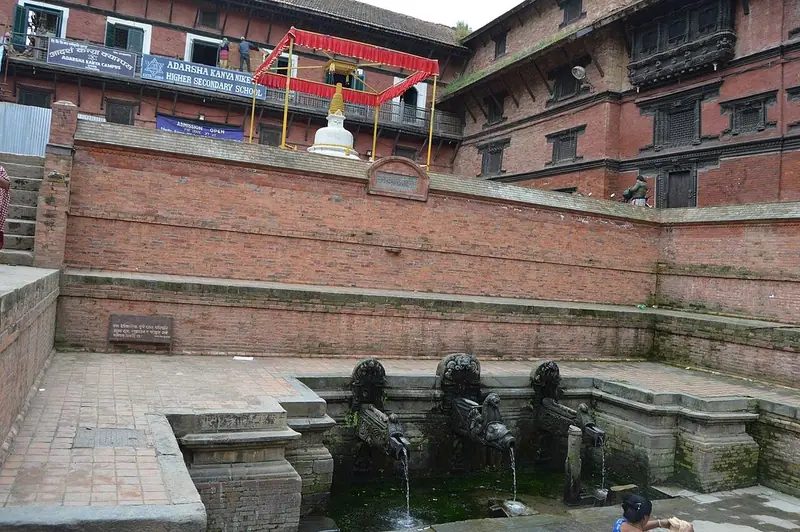
Begin at the north end of the square, at Manga Hiti, a sunken stone water spout. Walk down the steps and look at the stone spouts carved in the shape of mythical creatures, called makaras, with water flowing from their mouths. Spouts like this have supplied the people of the valley with water for well over a thousand years, fed by channels and ponds, and this one is thought to be among the oldest still in use in Patan. People still come here to wash and to fill their pots. Beside it stands a wooden pavilion, the Mani Mandap, built for royal ceremonies. Then look south along the square, at the row of temples on one side, facing the long front of the royal palace on the other. Notice how the temples face east, towards the palace, so that the kings and the gods looked at each other.
Photo: Suraj Belbase · CC BY-SA 4.0 · Wikimedia Commons
What to see at Patan Durbar Square: 7 stops, in visit order
- 01
 Manga HitiWater from the pastFree preview
- 02
 The Patan MuseumBronze and copperIn the guide
- 03
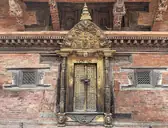 The Royal PalaceTaleju and Mul ChowkIn the guide
- 04
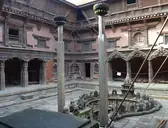 Sundari ChowkThe royal bathIn the guide
- 05
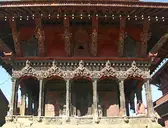 Vishwanath and GarudaElephants and a birdIn the guide
- 06
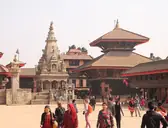 Krishna MandirA temple of stoneIn the guide
- 07
 The Golden TempleA Buddhist monasteryIn the guide
Site map of Patan Durbar Square
History of Patan Durbar Square
Patan is one of the oldest cities in the valley, and an important centre of both Hinduism and Buddhism, with inscriptions on the palace site going back to the sixth and seventh centuries. Its people are the Newars, the traditional inhabitants of the Kathmandu Valley, famous for their skill in building, wood carving and metalwork. From the fifteenth century, the valley was divided into rival kingdoms, ruled by branches of the Malla dynasty, and Patan was one of them. Most of the square was built in the seventeenth and eighteenth centuries. In 1768 the valley was conquered by Prithvi Narayan Shah of Gorkha, and the Malla kingdoms came to an end.
Patan Durbar Square guide: questions
How many stops does the Patan Durbar Square guide have?
7 stops, in visit order: 1. Manga Hiti; 2. The Patan Museum; 3. The Royal Palace; 4. Sundari Chowk; 5. Vishwanath and Garuda; 6. Krishna Mandir; 7. The Golden Temple.
Can I do a self-guided tour of Patan Durbar Square with this guide?
Yes. The guide is made for a self-guided tour: 7 stops in visit order, each with a photo, a story and a voice, so you can explore Patan Durbar Square at your own pace, without joining a group. Download it before you go and it works offline.
How long is each guide?
The 7 stops add up to about 5 minutes of listening in total. You play each stop when you’re ready, so you can go at your own pace.
Does the guide work offline?
Yes, once it’s downloaded. The guide is a single self-contained web page (about 6.8 MB) with the photos, text and audio built in. Download it to your phone before you go (Wi-Fi is best); after that it opens in any modern browser on iPhone or Android, with no app, account or mobile signal needed.
Does it use GPS or need my location?
No. The guide doesn’t use GPS and doesn’t know where you are: you play each stop when you reach it. It works on iPhone and Android in any modern browser, and it’s in English.
What’s included?
One self-contained HTML guide: 7 stops in visit order, each with a photo, text and a voice, plus the story of who built the site.
Who built Patan Durbar Square?
Patan is one of the oldest cities in the valley, and an important centre of both Hinduism and Buddhism, with inscriptions on the palace site going back to the sixth and seventh centuries. Its people are the Newars, the traditional inhabitants of the Kathmandu Valley, famous for their skill in building, wood carving and metalwork.
Is there a free audio guide to Patan Durbar Square?
The first stop, Manga Hiti, is free to read and hear on this page, so you can try the Patan Durbar Square audio tour before you buy. The full guide, with all 7 stops, is a one-off purchase: download it once and it’s yours to keep, working offline.
Is the Patan Durbar Square guide worth it?
If you’d like to know what you’re looking at, yes. For $10 you get 7 stops in visit order, each with a photo, a short history and a voice you play when you’re ready, plus a site map of the stops, and about 5 minutes of listening in all. It’s short on purpose, so you spend your time looking, not listening. It’s yours to keep, works offline and needs no app. The first stop is free on this page, so you can try it before you buy. If you’d like hours of detail, a guided tour will go deeper.
Audio guide or guided tour?
It depends how you like to visit. This guide lets you explore Patan Durbar Square at your own pace, at any time, for a one-off price. A guided tour gives you a live expert you can ask questions, but at fixed times and usually for a higher price. Many people use both: a tour for the big picture, and the guide to read beforehand or to revisit the stops in their own time.
Is this the official Patan Durbar Square guide?
No. It’s an independent guide by The Historian Guide, not affiliated with or endorsed by the operator of Patan Durbar Square. For tickets and opening hours, check the official site operator before you go.
Does the guide include entry tickets or opening hours?
No. The guide is a digital companion only. Admission to Patan Durbar Square is separate, so check the official site operator for current tickets and opening hours before you go.
- Stop 1 · Manga Hiti: Suraj Belbase · CC BY-SA 4.0 · Wikimedia Commons · resized
- Stop 2 · The Patan Museum: Dolon Prova · CC BY-SA 4.0 · Wikimedia Commons · resized
- Stop 3 · The Royal Palace: Chainwit. · CC BY 4.0 · Wikimedia Commons · resized
- Stop 4 · Sundari Chowk: Suraj Belbase · CC BY-SA 4.0 · Wikimedia Commons · resized
- Stop 5 · Vishwanath and Garuda (also the cover): Gerd Eichmann · CC BY-SA 4.0 · Wikimedia Commons · resized
- Stop 6 · Krishna Mandir: Abhishake Appy · CC BY-SA 4.0 · Wikimedia Commons · resized
- Stop 7 · The Golden Temple: Megh shakya · CC BY-SA 4.0 · Wikimedia Commons · resized


All photographs from Wikimedia Commons under the licences shown.
More guides in Nepal
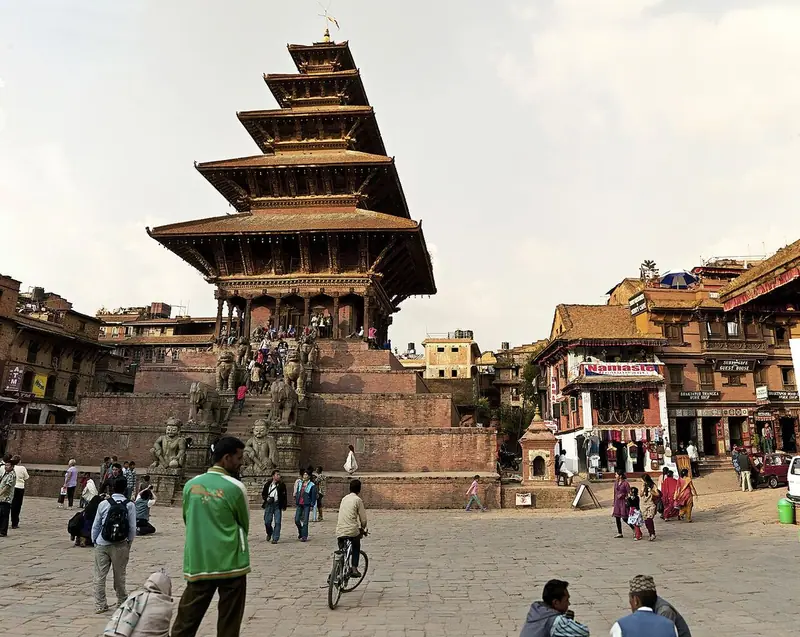 Newar8 stops · 12th–18th century
Bhaktapur audio guide
Brick lanes and temple squares in the best preserved of the Kathmandu Valley’s royal cities, from Durbar Square to the Nyatapola Temple.
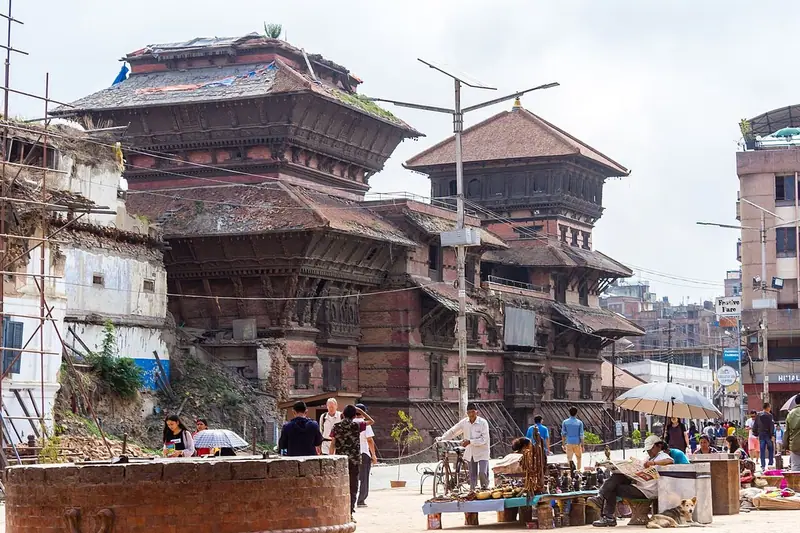 Newar8 stops · c. 7th–18th century
Kathmandu Durbar Square audio guide
Explore the tiered temples and palace courtyards of Kathmandu’s old royal heart, from the Kasthamandap to the house of the living goddess Kumari.
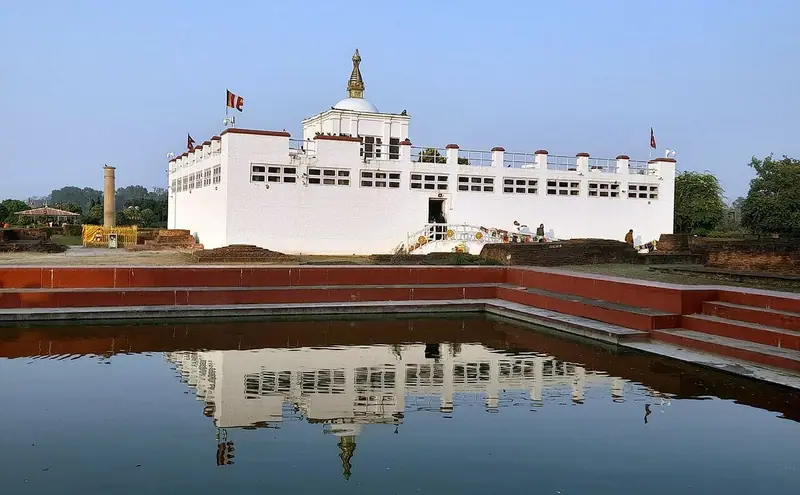 Maurya8 stops · c. 6th century BCE – 15th century CE
Lumbini audio guide
Stand at the birthplace of the Buddha, beside the Maya Devi Temple, Ashoka’s inscribed pillar and the sacred pool, then follow the canal past monasteries of many nations to the World Peace Pagoda.
Every guide, in every country
Patan Durbar Square and every other guide we publish, including future ones. One payment, no subscription.