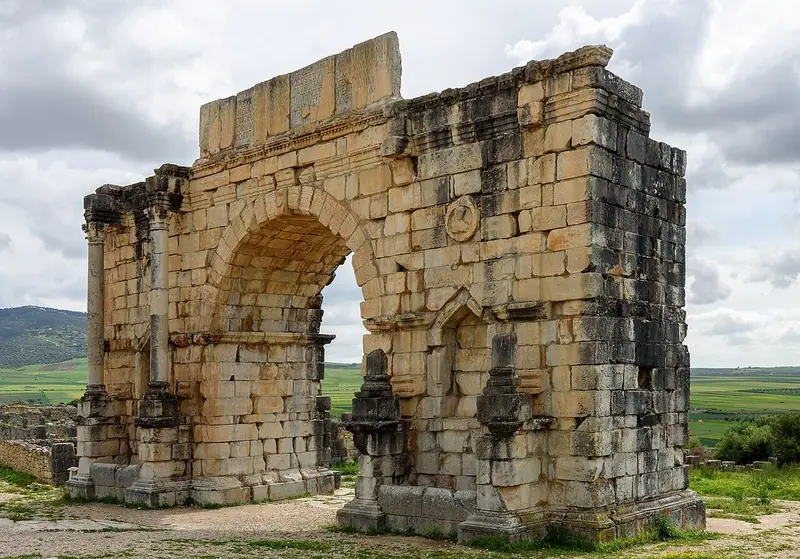
Before you start
Volubilis lies on a ridge below the Zerhoun mountain, overlooking a fertile plain north of Meknes a few kilometres from the hill town of Moulay Idriss Zerhoun. Most visitors come by car or grand taxi from Meknes, or on a day trip from Fez. UNESCO inscribed it as a World Heritage Site in 1997, describing it as an exceptionally well-preserved Roman colonial town on the fringes of the Empire. Only about half of the city has been excavated, and many of its finest mosaics are still in place in the houses where they were laid. There is almost no shade among the ruins, so bring a hat, sun cream and plenty of water, and wear sturdy shoes for the uneven stones. Stay on the paths and do not walk on the mosaics. The route climbs from the entrance through the southern houses to the forum, then follows the main street north-east to the Tingis Gate.
Use it as a self-guided tour of Volubilis: 8 stops in visit order, each played when you’re ready, at your own pace.
 Free preview · Stop 1
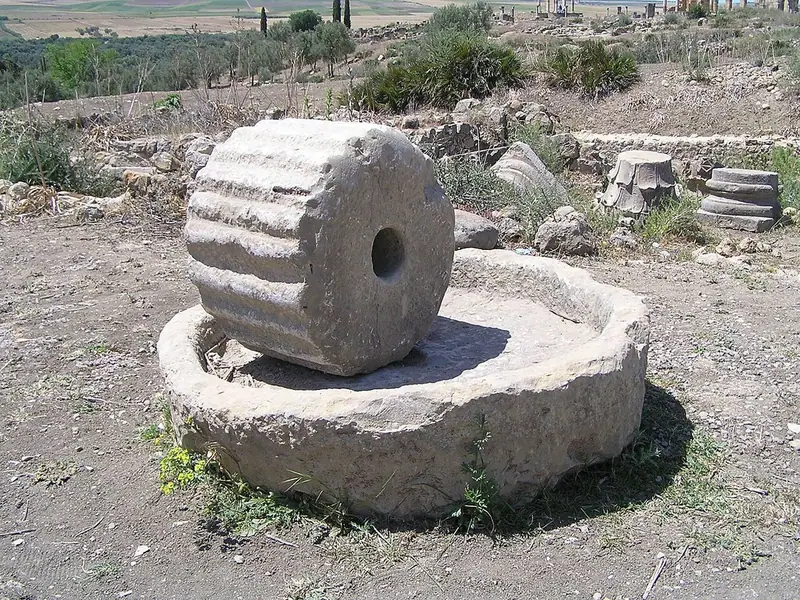
Olive Presses
From the entrance, follow the path up into the southern part of the city and look for the remains of olive presses and mills. Olive oil was the source of the city’s wealth: it was food, but also fuel for lamps, a cleanser at the baths and an ingredient in medicines, while the crushed olives fed animals and heated the bathhouses. Archaeologists have found fifty-eight oil-pressing complexes here, and even some of the grandest mansions had their own. Look for the round stone mills, where olives were crushed into a paste. The paste was packed into woven baskets and squeezed beneath a heavy wooden beam, and the oil ran into a basin where water was added so that the lighter oil floated to the top to be skimmed off and stored in jars. One workshop has been restored with a full-size replica of a Roman press.
Photo: rosier · CC BY-SA 3.0 · Wikimedia Commons
What to see at Volubilis: 8 stops, in visit order
- 01
 Olive PressesThe source of the city’s wealthFree preview
- 02
 House of OrpheusA poet charms the animalsIn the guide
- 03
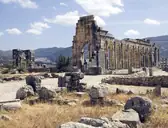 Forum and BasilicaThe heart of the cityIn the guide
- 04
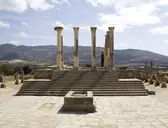 Capitoline TempleJupiter, Juno and MinervaIn the guide
- 05
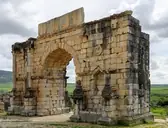 Arch of CaracallaAn arch for an emperorIn the guide
- 06
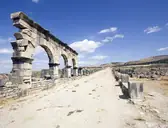 Decumanus MaximusThe street of mansionsIn the guide
- 07
 House of VenusMosaics of myth and sportIn the guide
- 08
 Tingis GateThe road to TangierIn the guide
Site map of Volubilis
History of Volubilis
Volubilis was built by the Romans and the Romanised Berbers of the province of Mauretania Tingitana. Roman civilisation, which grew from the city of Rome, traditionally founded in 753 BCE, lasted in the West until the fall of the Western Roman Empire in 476 CE. A settlement existed here by the third century BCE, with Carthaginian influence, and it became an important town of the Berber kingdom of Mauretania. In 25 BCE the emperor Augustus placed Juba II, a Berber prince educated in Rome, on the Mauretanian throne, and he favoured Roman art and architecture. After the emperor Claudius annexed the kingdom in 44 CE, Volubilis grew rich on olive oil and grain, and at its peak in the late second century it had around twenty thousand inhabitants. Roman control ended around 285, but people lived here for centuries afterwards.
The full history continues in the guide.
Volubilis guide: questions
How many stops does the Volubilis guide have?
8 stops, in visit order: 1. Olive Presses; 2. House of Orpheus; 3. Forum and Basilica; 4. Capitoline Temple; 5. Arch of Caracalla; 6. Decumanus Maximus; 7. House of Venus; 8. Tingis Gate.
Can I do a self-guided tour of Volubilis with this guide?
Yes. The guide is made for a self-guided tour: 8 stops in visit order, each with a photo, a story and a voice, so you can explore Volubilis at your own pace, without joining a group. Download it before you go and it works offline.
How long is each guide?
The 8 stops add up to about 6 minutes of listening in total. You play each stop when you’re ready, so you can go at your own pace.
Does the guide work offline?
Yes, once it’s downloaded. The guide is a single self-contained web page (about 8.2 MB) with the photos, text and audio built in. Download it to your phone before you go (Wi-Fi is best); after that it opens in any modern browser on iPhone or Android, with no app, account or mobile signal needed.
Does it use GPS or need my location?
No. The guide doesn’t use GPS and doesn’t know where you are: you play each stop when you reach it. It works on iPhone and Android in any modern browser, and it’s in English.
What’s included?
One self-contained HTML guide: 8 stops in visit order, each with a photo, text and a voice, plus the story of who built the site.
Who built Volubilis?
Volubilis was built by the Romans and the Romanised Berbers of the province of Mauretania Tingitana. Roman civilisation, which grew from the city of Rome, traditionally founded in 753 BCE, lasted in the West until the fall of the Western Roman Empire in 476 CE.
Where is Volubilis?
Volubilis lies on a ridge below the Zerhoun mountain, overlooking a fertile plain north of Meknes a few kilometres from the hill town of Moulay Idriss Zerhoun.
Is there a free audio guide to Volubilis?
The first stop, Olive Presses, is free to read and hear on this page, so you can try the Volubilis audio tour before you buy. The full guide, with all 8 stops, is a one-off purchase: download it once and it’s yours to keep, working offline.
Is the Volubilis guide worth it?
If you’d like to know what you’re looking at, yes. For $10 you get 8 stops in visit order, each with a photo, a short history and a voice you play when you’re ready, plus a site map of the stops, and about 6 minutes of listening in all. It’s short on purpose, so you spend your time looking, not listening. It’s yours to keep, works offline and needs no app. The first stop is free on this page, so you can try it before you buy. If you’d like hours of detail, a guided tour will go deeper.
Audio guide or guided tour?
It depends how you like to visit. This guide lets you explore Volubilis at your own pace, at any time, for a one-off price. A guided tour gives you a live expert you can ask questions, but at fixed times and usually for a higher price. Many people use both: a tour for the big picture, and the guide to read beforehand or to revisit the stops in their own time.
Is this the official Volubilis guide?
No. It’s an independent guide by The Historian Guide, not affiliated with or endorsed by the operator of Volubilis. For tickets and opening hours, check the official site operator before you go.
Does the guide include entry tickets or opening hours?
No. The guide is a digital companion only. Admission to Volubilis is separate, so check the official site operator for current tickets and opening hours before you go.
- Stop 1 · Olive Presses: rosier · CC BY-SA 3.0 · Wikimedia Commons · resized
- Stop 2 · House of Orpheus: Hiroki Ogawa · CC BY 3.0 · Wikimedia Commons · resized
- Stop 3 · Forum and Basilica: Prioryman · CC BY-SA 3.0 · Wikimedia Commons · resized
- Stop 4 · Capitoline Temple: Prioryman · CC BY-SA 3.0 · Wikimedia Commons · resized
- Stop 5 · Arch of Caracalla (also the cover): Mustang Joe · CC0 · Wikimedia Commons · resized
- Stop 6 · Decumanus Maximus: Prioryman · CC BY-SA 4.0 · Wikimedia Commons · resized
- Stop 7 · House of Venus: Flamejoke · CC0 · Wikimedia Commons · resized
- Stop 8 · Tingis Gate: Prioryman · CC BY-SA 4.0 · Wikimedia Commons · resized


All photographs from Wikimedia Commons under the licences shown.
More guides in Morocco
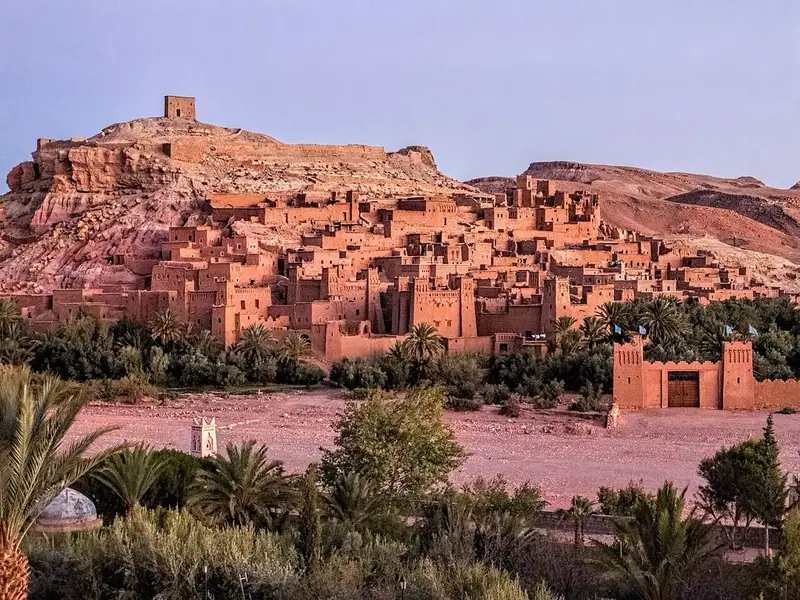 Amazigh6 stops · 17th–20th century
Aït Benhaddou audio guide
An earthen village of tower houses climbing a hill above the Ounila River, once a stop on the caravan road across the Atlas.
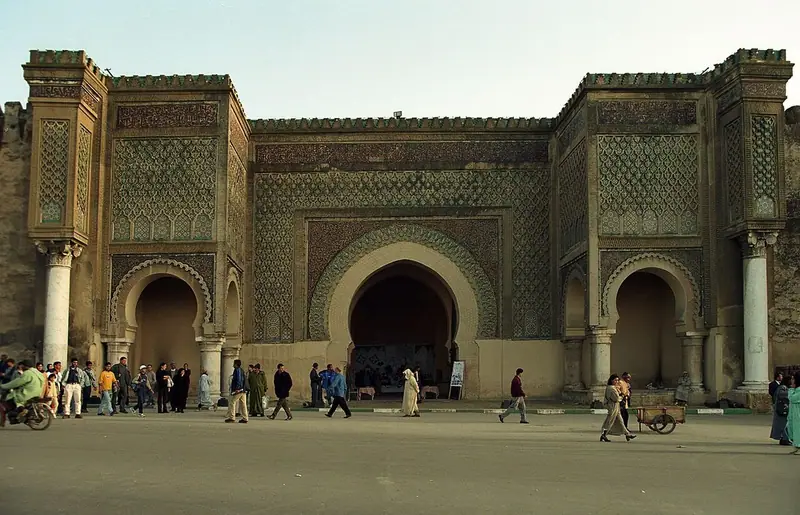 Alaouite8 stops · 1672–1727
Historic Meknes audio guide
Moulay Ismail’s imperial capital, from the great gate of Bab Mansour to his mausoleum, the vast granaries and the Agdal basin.
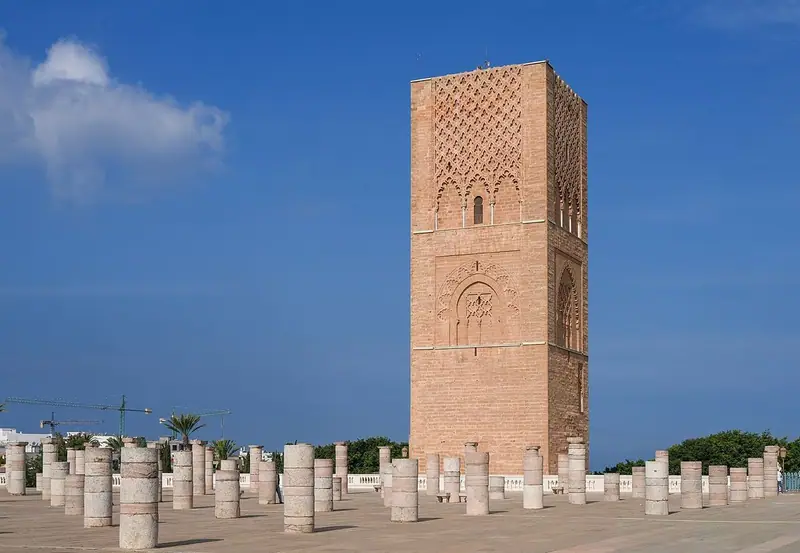 Almohad6 stops · c. 1150–1199
Historic Rabat audio guide
The unfinished Hassan Tower, the Mausoleum of Mohammed V, and through the Bab Oudaya to the Andalusian Garden.
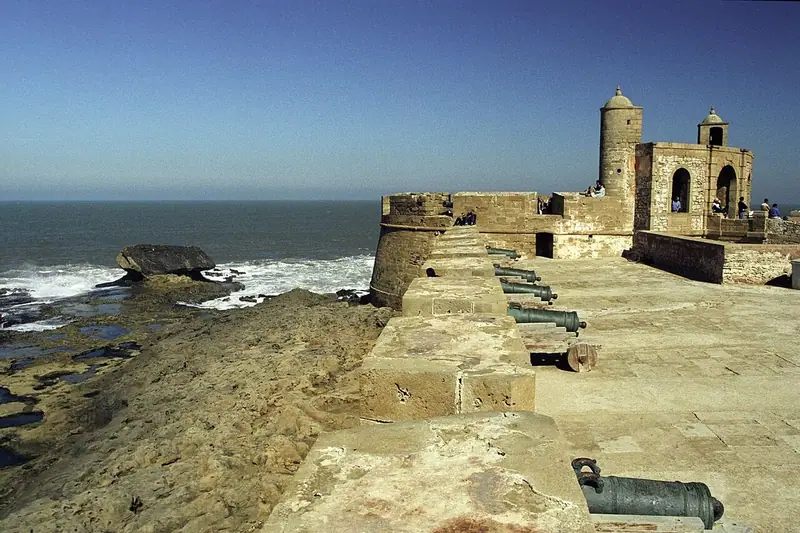 Alaouite8 stops · 1760s–19th century
Medina of Essaouira audio guide
Old Mogador on the Atlantic: blue boats in the harbour, cannons on the sea ramparts, the kasbah of the consuls and the old Jewish quarter.
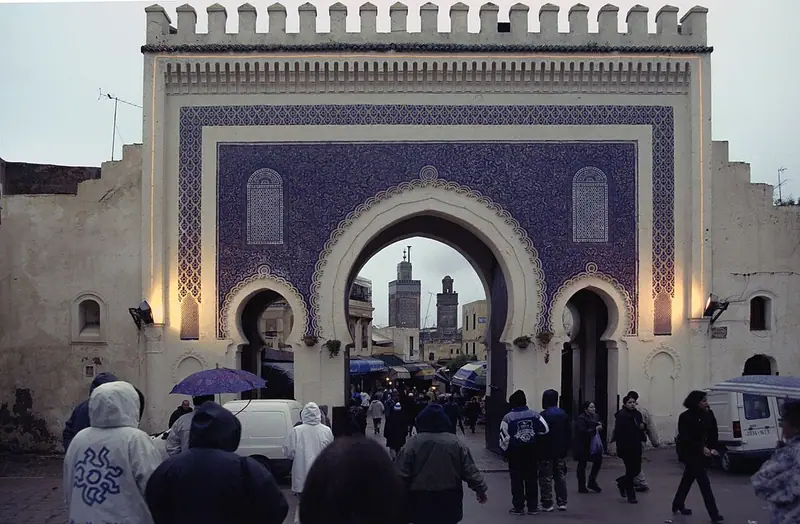 Marinid8 stops · 789–14th century
Medina of Fez audio guide
Through Bab Bou Jeloud into the lanes of Fes el-Bali, past jewel-box madrasas to the Chouara tannery.
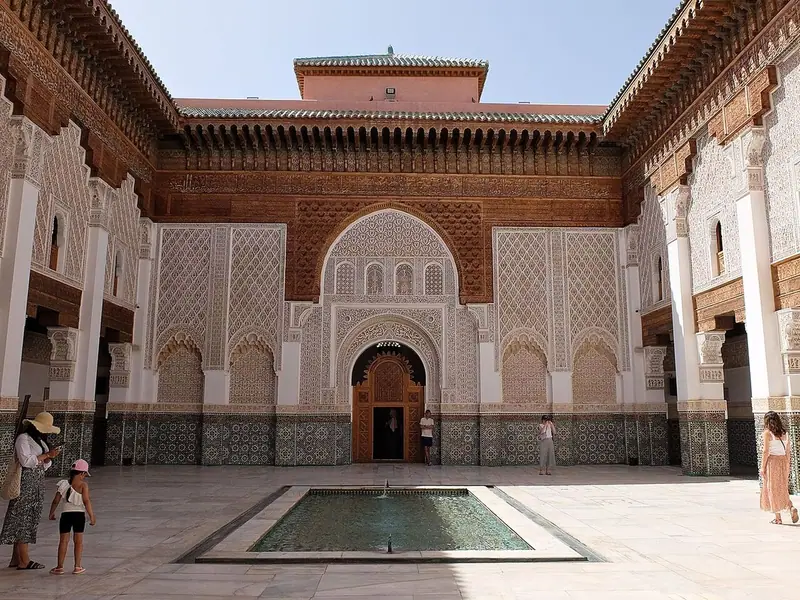 Almoravid & Almohad7 stops · c. 1070–16th century
Medina of Marrakech audio guide
From the Koutoubia minaret to Jemaa el-Fnaa, then into the souks and the courtyard of the Ben Youssef Madrasa.
Every guide, in every country
Volubilis and every other guide we publish, including future ones. One payment, no subscription.