Before you start
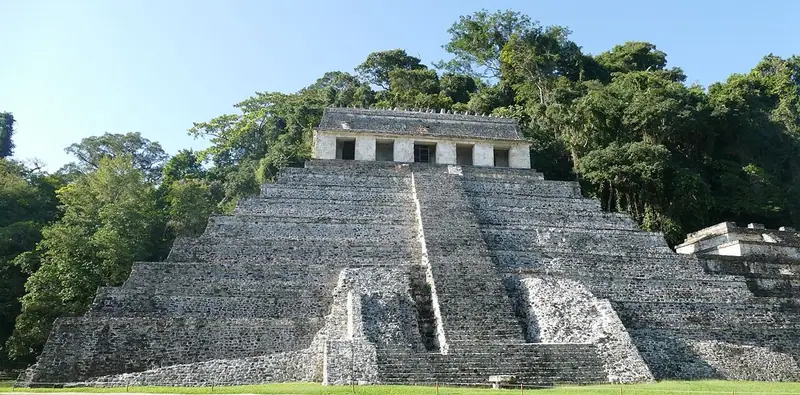
Palenque lies in the foothills of northern Chiapas, at the edge of the rainforest, about eight kilometres from the modern town of the same name. The Pre-Hispanic City and National Park of Palenque has been a UNESCO World Heritage Site since 1987 and is managed by INAH, Mexico’s National Institute of Anthropology and History. This guide follows the usual route from the main entrance: past the Temple of the Red Queen to the Temple of the Inscriptions, through the Palace, across the stream to the Cross Group, back past the ballcourt to the North Group, and finally down the forest path beside the waterfalls to the site museum.
Use it as a self-guided tour of Palenque: 7 stops in visit order, each played when you’re ready, at your own pace.
 Free preview · Stop 1
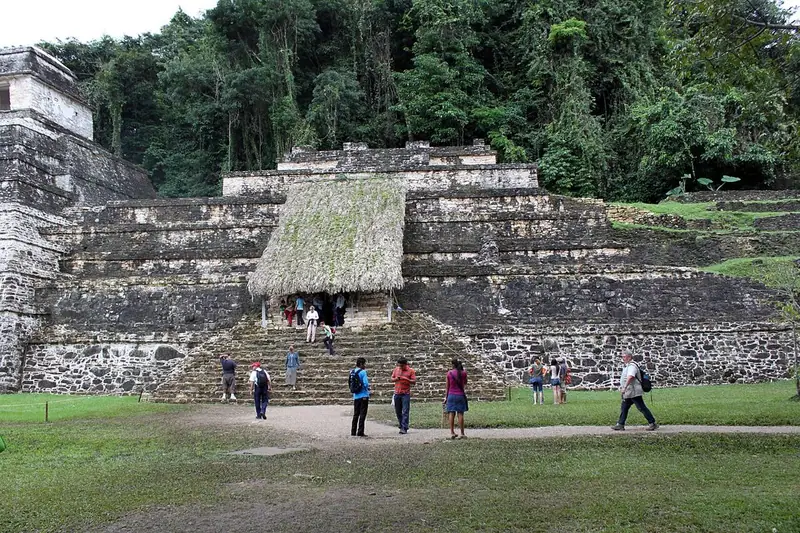
Temple of the Red Queen
Just inside the entrance, on your right, is a row of temples. The middle one, Temple XIII, holds one of Palenque’s most remarkable discoveries. In 1994 the archaeologist Fanny López Jiménez found a sealed chamber inside it containing a stone sarcophagus. Within lay the skeleton of a woman, covered in bright red cinnabar, a mercury mineral, and adorned with a jade and malachite mask, jade jewellery and pearls. She became known as the Red Queen. Her identity is not certain, but many researchers believe she was Ix Tz’akbu Ajaw, the wife of the great king Pakal, whose own tomb lies next door. Two other people had been sacrificed to accompany her. Look into the corridor if it is open. A reconstruction of the burial is displayed in the site museum, which you will reach at the end of this walk.
Photo: Anagoria · CC BY 3.0 · Wikimedia Commons
What to see at Palenque: 7 stops, in visit order
- 01
 Temple of the Red QueenTemplo XIIIFree preview
- 02
 Temple of the InscriptionsTemplo de las InscripcionesIn the guide
- 03
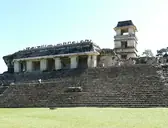 The PalaceEl PalacioIn the guide
- 04
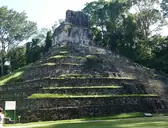 The Cross GroupGrupo de las CrucesIn the guide
- 05
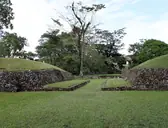 BallcourtJuego de PelotaIn the guide
- 06
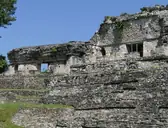 North GroupGrupo NorteIn the guide
- 07
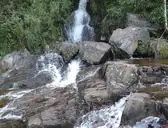 Queen’s Bath and museumBaño de la ReinaIn the guide
Site map of Palenque
History of Palenque
Palenque was built by the Maya, whose civilisation took shape over more than three thousand years: the first farming villages appeared around 2000 BCE, great cities rose in the Preclassic period (to about 250 CE), the lowland kingdoms reached their height in the Classic period (about 250–900 CE), and northern Yucatán flourished on into the Postclassic, until the Spanish conquest, which began in the 1520s and ended only in 1697 with the fall of the last independent Maya kingdom, Nojpetén, in Guatemala. Maya people did not vanish: millions still live in Mexico and Central America, and Ch’ol and Tzeltal Maya communities live around Palenque today. Its builders called the city Lakamha’, ‘big water’, after its streams, and it was the seat of the kingdom of B’aakal. Palenque reached its height in the seventh and early eighth centuries CE under K’inich Janaab Pakal, who ruled from 615 to 683, and his sons.
The full history continues in the guide.
Palenque guide: questions
How many stops does the Palenque guide have?
7 stops, in visit order: 1. Temple of the Red Queen; 2. Temple of the Inscriptions; 3. The Palace; 4. The Cross Group; 5. Ballcourt; 6. North Group; 7. Queen’s Bath and museum.
Can I do a self-guided tour of Palenque with this guide?
Yes. The guide is made for a self-guided tour: 7 stops in visit order, each with a photo, a story and a voice, so you can explore Palenque at your own pace, without joining a group. Download it before you go and it works offline.
How long is each guide?
The 7 stops add up to about 6 minutes of listening in total. You play each stop when you’re ready, so you can go at your own pace.
Does the guide work offline?
Yes, once it’s downloaded. The guide is a single self-contained web page (about 7.8 MB) with the photos, text and audio built in. Download it to your phone before you go (Wi-Fi is best); after that it opens in any modern browser on iPhone or Android, with no app, account or mobile signal needed.
Does it use GPS or need my location?
No. The guide doesn’t use GPS and doesn’t know where you are: you play each stop when you reach it. It works on iPhone and Android in any modern browser, and it’s in English.
What’s included?
One self-contained HTML guide: 7 stops in visit order, each with a photo, text and a voice, plus the story of who built the site.
Who built Palenque?
Palenque was built by the Maya, whose civilisation took shape over more than three thousand years: the first farming villages appeared around 2000 BCE, great cities rose in the Preclassic period (to about 250 CE), the lowland kingdoms reached their height in the Classic period (about 250–900 CE), and northern Yucatán flourished on into the Postclassic, until the Spanish conquest, which began in the 1520s and ended only in 1697 with the fall of the last independent Maya kingdom, Nojpetén, in Guatemala. Maya people did not vanish: millions still live in Mexico and Central America, and Ch’ol and Tzeltal Maya communities live around Palenque today.
Where is Palenque?
Palenque lies in the foothills of northern Chiapas, at the edge of the rainforest, about eight kilometres from the modern town of the same name.
Is there a free audio guide to Palenque?
The first stop, Temple of the Red Queen, is free to read and hear on this page, so you can try the Palenque audio tour before you buy. The full guide, with all 7 stops, is a one-off purchase: download it once and it’s yours to keep, working offline.
Is the Palenque guide worth it?
If you’d like to know what you’re looking at, yes. For $10 you get 7 stops in visit order, each with a photo, a short history and a voice you play when you’re ready, plus a site map of the stops, and about 6 minutes of listening in all. It’s short on purpose, so you spend your time looking, not listening. It’s yours to keep, works offline and needs no app. The first stop is free on this page, so you can try it before you buy. If you’d like hours of detail, a guided tour will go deeper.
Audio guide or guided tour?
It depends how you like to visit. This guide lets you explore Palenque at your own pace, at any time, for a one-off price. A guided tour gives you a live expert you can ask questions, but at fixed times and usually for a higher price. Many people use both: a tour for the big picture, and the guide to read beforehand or to revisit the stops in their own time.
Is this the official Palenque guide?
No. It’s an independent guide by The Historian Guide, not affiliated with or endorsed by the operator of Palenque. For tickets and opening hours, check the official site operator before you go.
Does the guide include entry tickets or opening hours?
No. The guide is a digital companion only. Admission to Palenque is separate, so check the official site operator for current tickets and opening hours before you go.
- Stop 1 · Temple of the Red Queen: Anagoria · CC BY 3.0 · Wikimedia Commons · resized
- Stop 2 · Temple of the Inscriptions (also the cover): Bernard DUPONT · CC BY-SA 2.0 · Wikimedia Commons · resized
- Stop 3 · The Palace: Bernard DUPONT · CC BY-SA 2.0 · Wikimedia Commons · resized
- Stop 4 · The Cross Group: Bernard DUPONT · CC BY-SA 2.0 · Wikimedia Commons · resized
- Stop 5 · Ballcourt: Anagoria · CC BY 3.0 · Wikimedia Commons · resized
- Stop 6 · North Group: Bernard DUPONT · CC BY-SA 2.0 · Wikimedia Commons · resized
- Stop 7 · Queen’s Bath and museum: D.Medin · CC BY-SA 4.0 · Wikimedia Commons · resized


All photographs from Wikimedia Commons under the licences shown.
More guides in Mexico
 New Spain and Mexico8 stops · Colonial and modern Mexico
The Basilica of Guadalupe audio guide
Cross the great plaza of the world’s most visited Catholic shrine to see the image of Our Lady of Guadalupe, then climb the hill of Tepeyac.
 Maya6 stops · c. 600–800 CE
Bonampak audio guide
Three small rooms in the Lacandon forest painted with vivid Maya murals: a royal court, a battle and a celebration.
 Maya6 stops · c. 250–900 CE
Calakmul audio guide
Capital of the Snake Kingdom, rising out of the Campeche rainforest.
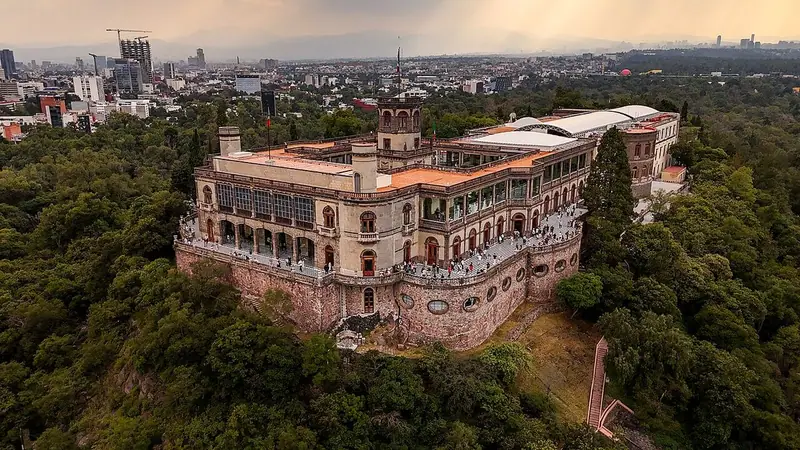 New Spain and Mexico8 stops · Second Mexican Empire
Chapultepec Castle audio guide
Climb the hill of Chapultepec to the castle of a viceroy, an emperor and presidents, now the National Museum of History.
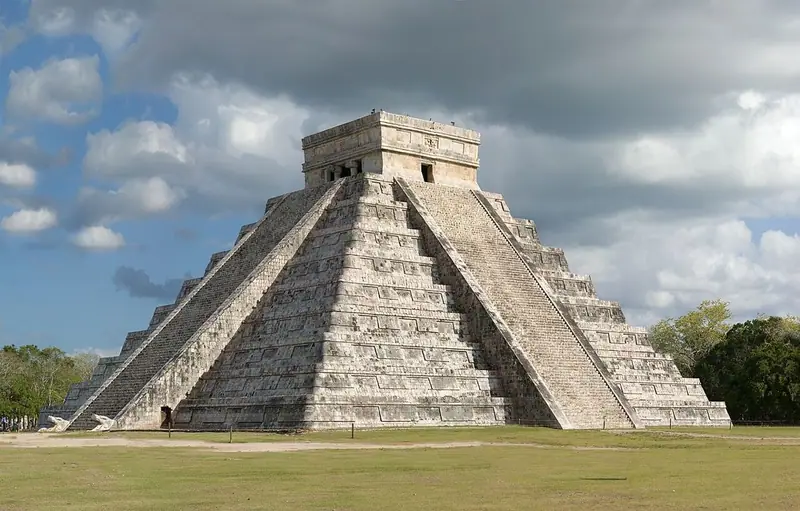 Maya8 stops · c. 600–1200 CE
Chichén Itzá audio guide
El Castillo and its serpent of light, the greatest ballcourt in Mesoamerica and the Sacred Cenote.
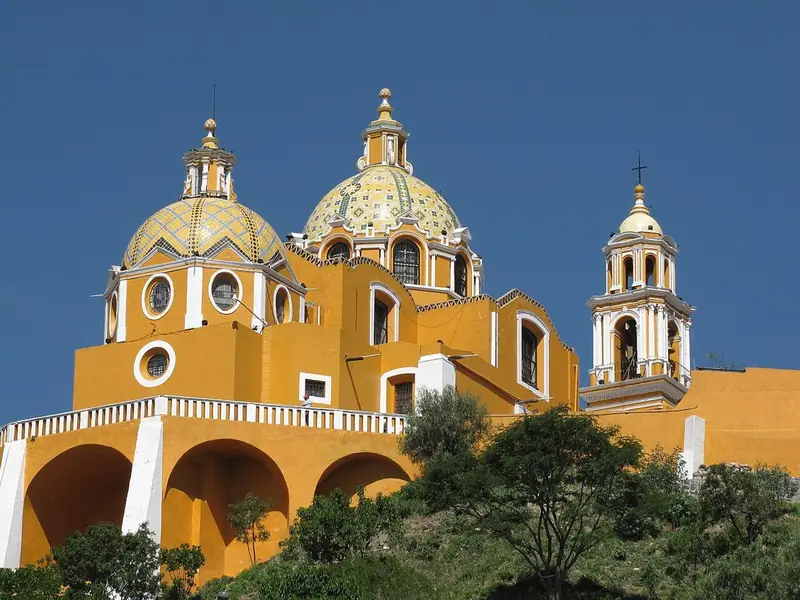 Mesoamerican6 stops · c. 300 BCE – 900 CE (pyramid)
Cholula audio guide
Tunnel into the Great Pyramid, then climb to the church on its summit and the view of the volcanoes.
Every guide, in every country
Palenque and every other guide we publish, including future ones. One payment, no subscription.