Before you start
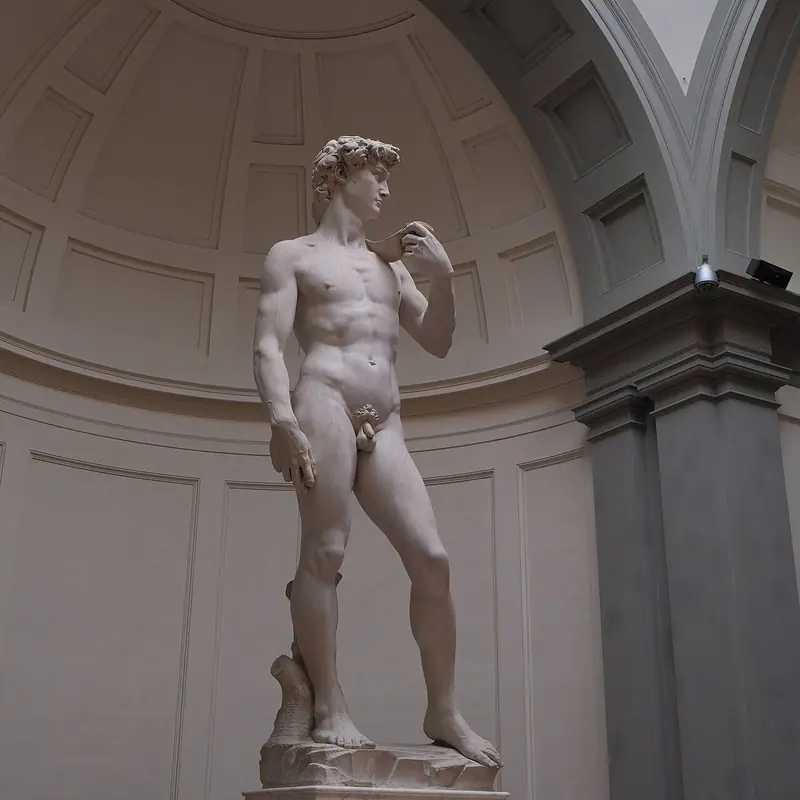
The Galleria dell’Accademia, in Florence, is the home of Michelangelo’s David, perhaps the most famous statue in the world. Around it are Michelangelo’s unfinished Prisoners, which show how he carved, a hall of nineteenth century plaster models, galleries of Florentine painting, and a museum of musical instruments from the court of the Medici. The gallery is compact, and this walk follows the usual route, from the Hall of the Colossus, along the Hall of the Prisoners to David, and then upstairs. Allow about two hours.
Use it as a self-guided tour of the Galleria dell’Accademia: 8 stops in visit order, each played when you’re ready, at your own pace.
 Free preview · Stop 1
The Hall of the Colossus
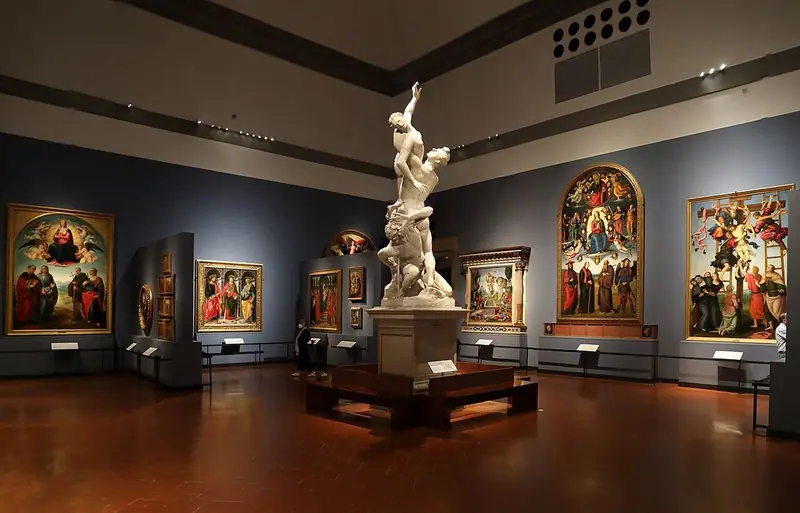
Begin in the first large room, the Hall of the Colossus. In the centre stands a tall group of three twisting figures, made of plaster, not marble. This is the full-size model made by the sculptor Giambologna for his Rape of the Sabine Women, which stands carved in marble in the Loggia dei Lanzi, on the Piazza della Signoria. The story comes from the legend of early Rome, when the Romans are said to have seized women from their neighbours, the Sabines. Walk round the group, and see how it is designed to be seen from every side, with no single front. On the walls hang Florentine paintings of the late fifteenth and early sixteenth centuries; the works on display may change. Then walk into the long hall beyond.
Photo: Francesco Bini · CC BY-SA 4.0 · Wikimedia Commons
What to see at the Galleria dell’Accademia: 8 stops, in visit order
- 01
 The Hall of the ColossusGiambologna’s full-size modelFree preview
- 02
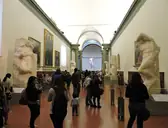 The Hall of the PrisonersFigures emerging from stoneIn the guide
- 03
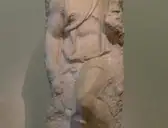 Saint Matthew and the PietàMore unfinished marbleIn the guide
- 04
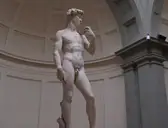 The Tribune of DavidA room built for one statueIn the guide
- 05
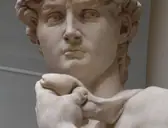 DavidThe giant from the blockIn the guide
- 06
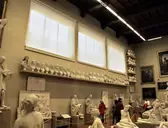 The Gipsoteca BartoliniA workshop of plaster modelsIn the guide
- 07
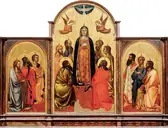 The Florentine Gothic galleriesGold backgrounds and iconsIn the guide
- 08
 The Museum of Musical InstrumentsThe music of the Medici courtIn the guide
History of the Galleria dell’Accademia
The Accademia was founded in 1784 by Pietro Leopoldo, Grand Duke of Tuscany, as a gallery for the students of the city’s academy of fine arts, who learned by copying the old masters. In 1873 Michelangelo’s David, carved between 1501 and 1504, was moved here from the Piazza della Signoria to protect it from the weather. Other works by Michelangelo were added later, and in 2001 a museum of musical instruments opened in the gallery.
Galleria dell’Accademia guide: questions
How many stops does the Galleria dell’Accademia guide have?
8 stops, in visit order: 1. The Hall of the Colossus; 2. The Hall of the Prisoners; 3. Saint Matthew and the Pietà; 4. The Tribune of David; 5. David; 6. The Gipsoteca Bartolini; 7. The Florentine Gothic galleries; 8. The Museum of Musical Instruments.
Can I do a self-guided tour of the Galleria dell’Accademia with this guide?
Yes. The guide is made for a self-guided tour: 8 stops in visit order, each with a photo, a story and a voice, so you can explore the Galleria dell’Accademia at your own pace, without joining a group. Download it before you go and it works offline.
How long is each guide?
The 8 stops add up to about 5 minutes of listening in total. You play each stop when you’re ready, so you can go at your own pace.
Does the guide work offline?
Yes, once it’s downloaded. The guide is a single self-contained web page (about 6.5 MB) with the photos, text and audio built in. Download it to your phone before you go (Wi-Fi is best); after that it opens in any modern browser on iPhone or Android, with no app, account or mobile signal needed.
Does it use GPS or need my location?
No. The guide doesn’t use GPS and doesn’t know where you are: you play each stop when you reach it. It works on iPhone and Android in any modern browser, and it’s in English.
What’s included?
One self-contained HTML guide: 8 stops in visit order, each with a photo, text and a voice, plus the story of who built the site.
Who built the Galleria dell’Accademia?
The Accademia was founded in 1784 by Pietro Leopoldo, Grand Duke of Tuscany, as a gallery for the students of the city’s academy of fine arts, who learned by copying the old masters. In 1873 Michelangelo’s David, carved between 1501 and 1504, was moved here from the Piazza della Signoria to protect it from the weather.
Where is the Galleria dell’Accademia?
The Galleria dell’Accademia, in Florence, is the home of Michelangelo’s David, perhaps the most famous statue in the world.
Is there a free audio guide to the Galleria dell’Accademia?
The first stop, The Hall of the Colossus, is free to read and hear on this page, so you can try the Galleria dell’Accademia audio tour before you buy. The full guide, with all 8 stops, is a one-off purchase: download it once and it’s yours to keep, working offline.
Is the Galleria dell’Accademia guide worth it?
If you’d like to know what you’re looking at, yes. For $10 you get 8 stops in visit order, each with a photo, a short history and a voice you play when you’re ready, about 5 minutes of listening in all. It’s short on purpose, so you spend your time looking, not listening. It’s yours to keep, works offline and needs no app. The first stop is free on this page, so you can try it before you buy. If you’d like hours of detail, a guided tour will go deeper.
Audio guide or guided tour?
It depends how you like to visit. This guide lets you explore the Galleria dell’Accademia at your own pace, at any time, for a one-off price. A guided tour gives you a live expert you can ask questions, but at fixed times and usually for a higher price. Many people use both: a tour for the big picture, and the guide to read beforehand or to revisit the stops in their own time.
Is this the official Galleria dell’Accademia guide?
No. It’s an independent guide by The Historian Guide, not affiliated with or endorsed by the operator of the Galleria dell’Accademia. For tickets and opening hours, check the official site operator before you go.
Does the guide include entry tickets or opening hours?
No. The guide is a digital companion only. Admission to the Galleria dell’Accademia is separate, so check the official site operator for current tickets and opening hours before you go.
- Stop 1 · The Hall of the Colossus: Francesco Bini · CC BY-SA 4.0 · Wikimedia Commons · resized
- Stop 2 · The Hall of the Prisoners: Dimitris Kamaras from Athens, Greece · CC BY 2.0 · Wikimedia Commons · resized
- Stop 3 · Saint Matthew and the Pietà: Jörg Bittner Unna · CC BY-SA 3.0 · Wikimedia Commons · resized
- Stop 4 · The Tribune of David (also the cover): Jörg Bittner Unna [email protected] · CC BY 4.0 · Wikimedia Commons · resized
- Stop 5 · David: George M. Groutas · CC BY 2.0 · Wikimedia Commons · resized
- Stop 6 · The Gipsoteca Bartolini: Francesco Bini · CC BY-SA 4.0 · Wikimedia Commons · resized
- Stop 7 · The Florentine Gothic galleries: Orcagna · Public domain · Wikimedia Commons · resized
- Stop 8 · The Museum of Musical Instruments: Sailko · CC BY 3.0 · Wikimedia Commons · resized


All photographs from Wikimedia Commons under the licences shown.
More guides in Italy
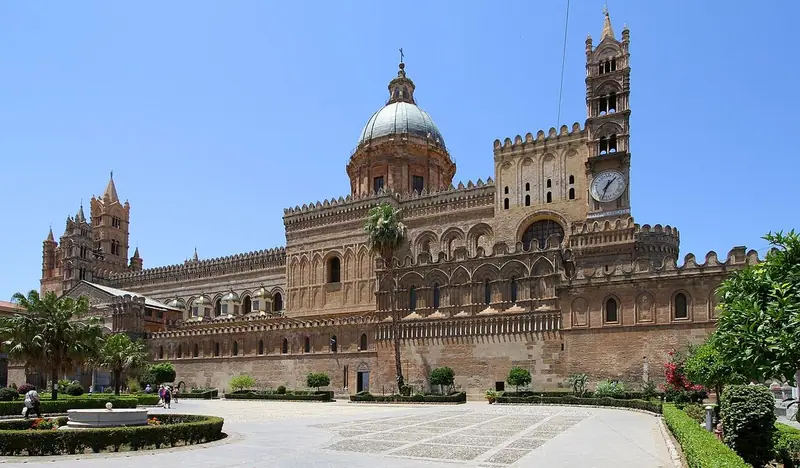 Arab-Norman11 stops · 1130 – 1194 (Norman kings of Sicily)
Arab-Norman Palermo, Monreale and Cefalù audio guide
Norman kings, Byzantine mosaicists and Arab craftsmen together: the Palatine Chapel, red-domed churches, the Zisa palace and the golden cathedrals of Monreale and Cefalù.
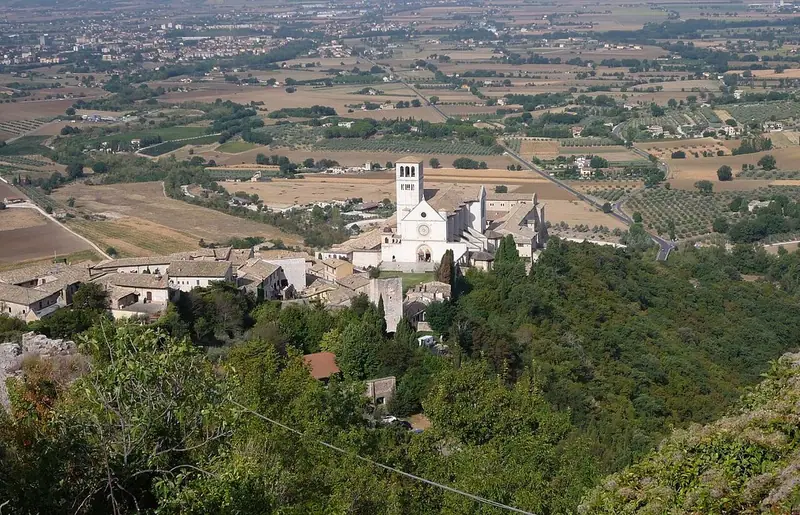 Franciscan10 stops · 1182 – 1253 (lives of Francis and Clare; basilica begun 1228)
Assisi audio guide
The hill town of Saint Francis: the double basilica with Giotto’s frescoes, his tomb, Santa Chiara, San Damiano and a Roman temple on the main square.
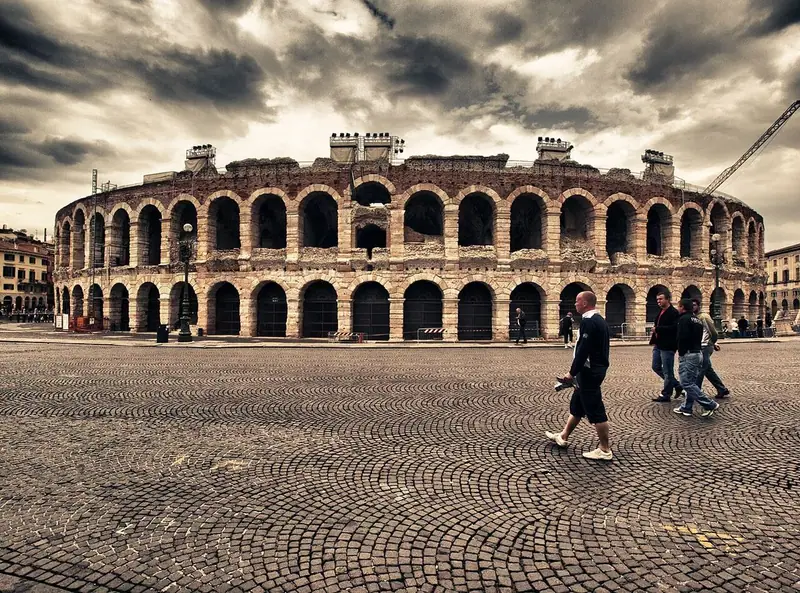 Roman11 stops · 1st c. BCE – 1797 (Roman colony to the end of Venetian rule)
City of Verona audio guide
A Roman arena still used for opera, the towers and tombs of the della Scala lords, and the Romanesque splendour of San Zeno, in a bend of the Adige.
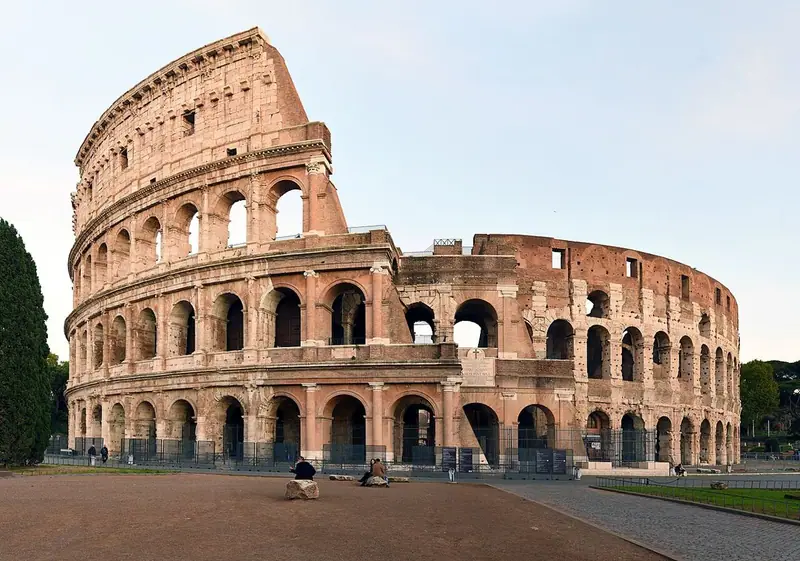 Roman7 stops · 70–80 CE
Colosseum audio guide
From the outer façade into the corridors and seating, then down to the arena floor and the hypogeum beneath it.
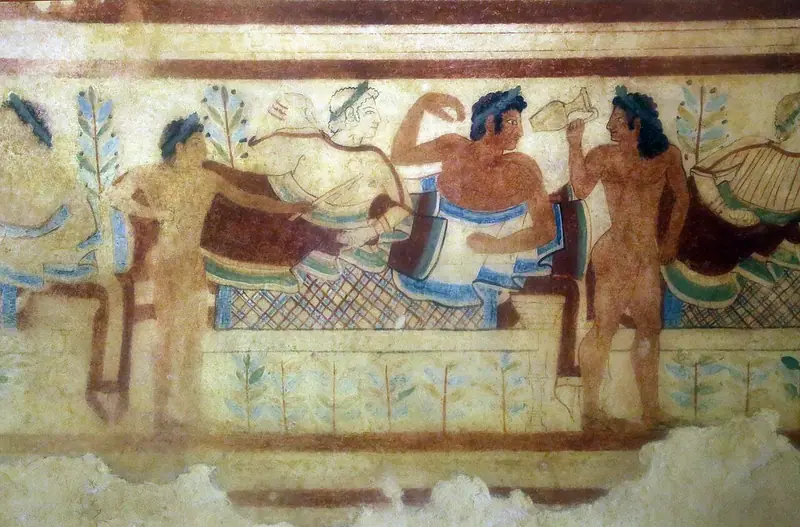 Etruscan9 stops · 9th – 3rd century BCE
Etruscan Necropolises of Cerveteri and Tarquinia audio guide
The Etruscan cities of the dead: the tumuli and tomb streets of the Banditaccia at Cerveteri, the Tomb of the Reliefs, and the painted tombs of Tarquinia’s Monterozzi necropolis.
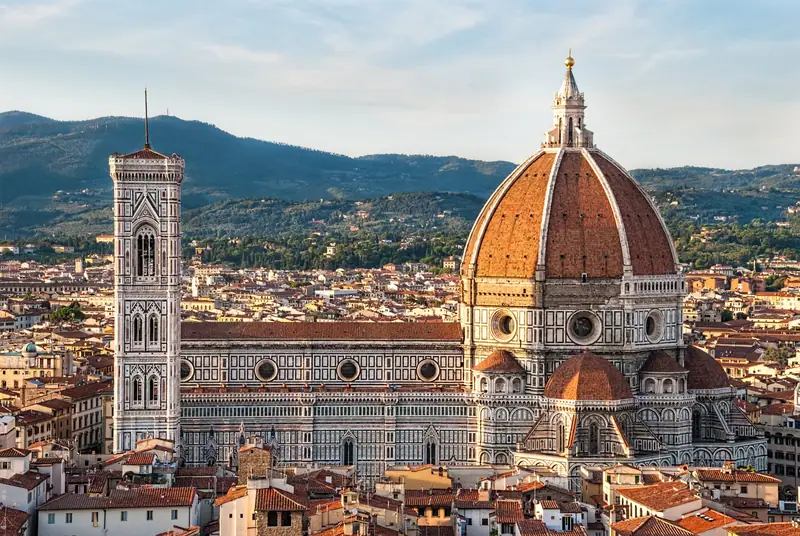 Renaissance7 stops · 1296–1436
Florence Duomo audio guide
The Gates of Paradise, Giotto’s Campanile and Brunelleschi’s dome, the great monument of Renaissance Florence.
Every guide, in every country
Galleria dell’Accademia and every other guide we publish, including future ones. One payment, no subscription.