Before you start
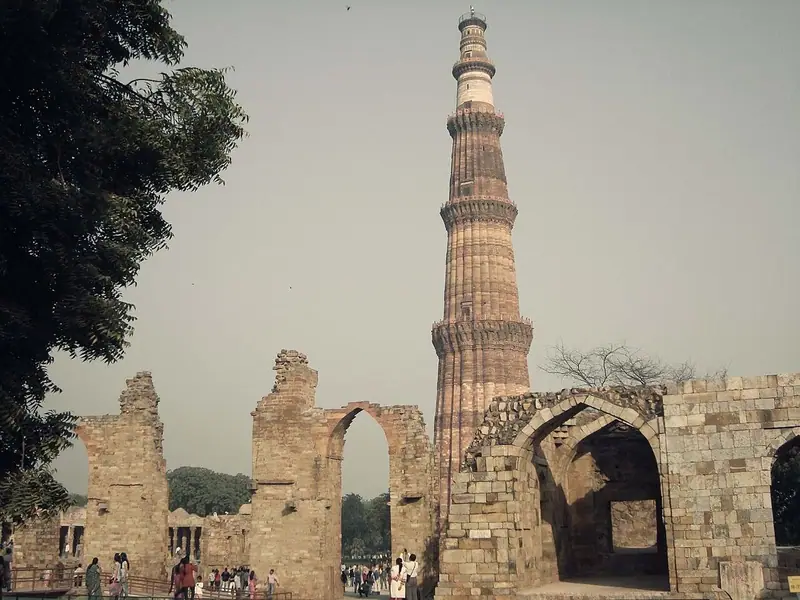
The Qutb Minar complex lies in Mehrauli, on the southern edge of Delhi, about fifteen kilometres from Connaught Place. Its fluted tower, 72.5 metres high, is the tallest masonry tower in India, and around it stand the ruins of the first great mosque built in Delhi, an ancient iron pillar, a royal tomb and a magnificent gateway. The complex has been a UNESCO World Heritage Site since 1993 and is cared for by the Archaeological Survey of India. The site sits in a landscaped park, and the main monuments are close together, so it is easy to explore on foot. This guide follows a natural visiting order: from the domed southern gateway to the foot of the minar, through the mosque to the iron pillar and the great arched screen, then on to the tomb of Iltutmish and the unfinished tower to the north.
Use it as a self-guided tour of the Qutb Minar: 7 stops in visit order, each played when you’re ready, at your own pace.
 Free preview · Stop 1
Alai Darwaza
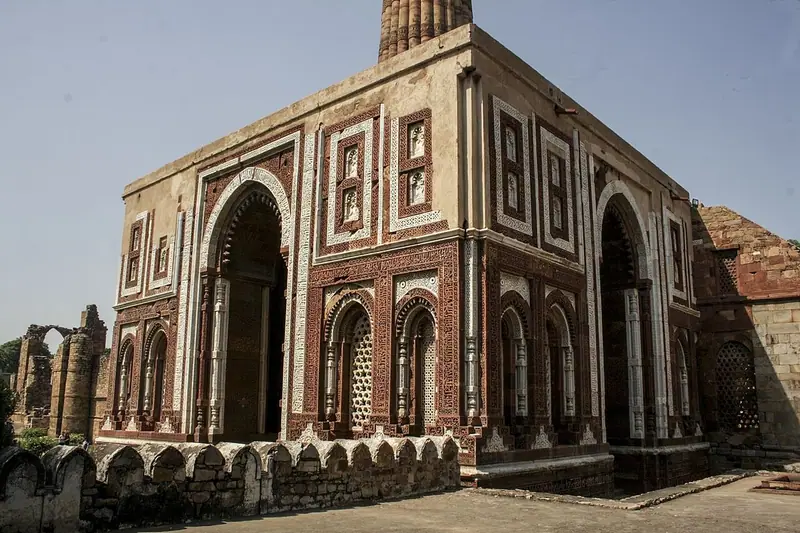
Begin at the square domed gatehouse just south of the minar, the Alai Darwaza, built by Sultan Alauddin Khalji in 1311 as the southern entrance to his enlarged mosque. It is a gem of early Indo-Islamic architecture. Look at the way red sandstone is set off by bands and panels of white marble, a contrast that would become a hallmark of buildings in India for centuries. The pointed horseshoe arches are fringed with spearhead shapes, possibly lotus buds, and the windows are filled with delicate stone lattice screens. Inside, look up at the dome. The gate is often described as the first building in India with a true dome and true arches, built with properly shaped stones rather than layers of overlapping stones. Alauddin planned three more gateways, but he died in 1316 before they were built.
Photo: Indrajit Das · CC BY-SA 4.0 · Wikimedia Commons
What to see at the Qutb Minar: 7 stops, in visit order
- 01
 Alai DarwazaThe southern gatewayFree preview
- 02
 Qutb MinarThe towerIn the guide
- 03
 Quwwat-ul-Islam MosqueThe first mosque of DelhiIn the guide
- 04
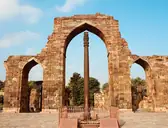 Iron PillarA Gupta-era marvelIn the guide
- 05
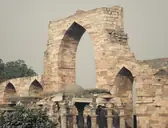 The Great ScreenArched facade of the prayer hallIn the guide
- 06
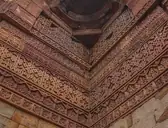 Tomb of IltutmishThe first royal tombIn the guide
- 07
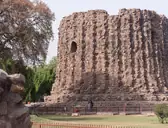 Alai MinarThe unfinished towerIn the guide
Site map of the Qutb Minar
History of the Qutb Minar
The Qutb complex was built by the rulers of the Delhi Sultanate, a succession of Muslim dynasties of Turkic and Afghan origin that ruled much of northern India from Delhi. It began in the 1190s, when the armies of Muhammad of Ghor captured Delhi; his general Qutb ud-din Aibak stayed on as governor and in 1206 became the first sultan. Five dynasties followed one another, the Mamluks, Khaljis, Tughlaqs, Sayyids and Lodis, and the Sultanate lasted until 1526, when the last Lodi sultan was defeated by Babur, founder of the Mughal Empire. Aibak began the mosque and the minar around 1199; his successor Iltutmish added storeys to the tower, Alauddin Khalji enlarged the complex between 1296 and 1311, and later sultans repaired the minar, the last time in 1503. The iron pillar is much older: it was made in the Gupta Empire, which flourished in northern India from about 320 to 550 CE.
Qutb Minar guide: questions
How many stops does the Qutb Minar guide have?
7 stops, in visit order: 1. Alai Darwaza; 2. Qutb Minar; 3. Quwwat-ul-Islam Mosque; 4. Iron Pillar; 5. The Great Screen; 6. Tomb of Iltutmish; 7. Alai Minar.
Can I do a self-guided tour of the Qutb Minar with this guide?
Yes. The guide is made for a self-guided tour: 7 stops in visit order, each with a photo, a story and a voice, so you can explore the Qutb Minar at your own pace, without joining a group. Download it before you go and it works offline.
How long is each guide?
The 7 stops add up to about 7 minutes of listening in total. You play each stop when you’re ready, so you can go at your own pace.
Does the guide work offline?
Yes, once it’s downloaded. The guide is a single self-contained web page (about 7.9 MB) with the photos, text and audio built in. Download it to your phone before you go (Wi-Fi is best); after that it opens in any modern browser on iPhone or Android, with no app, account or mobile signal needed.
Does it use GPS or need my location?
No. The guide doesn’t use GPS and doesn’t know where you are: you play each stop when you reach it. It works on iPhone and Android in any modern browser, and it’s in English.
What’s included?
One self-contained HTML guide: 7 stops in visit order, each with a photo, text and a voice, plus the story of who built the site.
Who built the Qutb Minar?
The Qutb complex was built by the rulers of the Delhi Sultanate, a succession of Muslim dynasties of Turkic and Afghan origin that ruled much of northern India from Delhi. It began in the 1190s, when the armies of Muhammad of Ghor captured Delhi; his general Qutb ud-din Aibak stayed on as governor and in 1206 became the first sultan.
Where is the Qutb Minar?
The Qutb Minar complex lies in Mehrauli, on the southern edge of Delhi, about fifteen kilometres from Connaught Place.
Is there a free audio guide to the Qutb Minar?
The first stop, Alai Darwaza, is free to read and hear on this page, so you can try the Qutb Minar audio tour before you buy. The full guide, with all 7 stops, is a one-off purchase: download it once and it’s yours to keep, working offline.
Is the Qutb Minar guide worth it?
If you’d like to know what you’re looking at, yes. For $10 you get 7 stops in visit order, each with a photo, a short history and a voice you play when you’re ready, plus a site map of the stops, and about 7 minutes of listening in all. It’s short on purpose, so you spend your time looking, not listening. It’s yours to keep, works offline and needs no app. The first stop is free on this page, so you can try it before you buy. If you’d like hours of detail, a guided tour will go deeper.
Audio guide or guided tour?
It depends how you like to visit. This guide lets you explore the Qutb Minar at your own pace, at any time, for a one-off price. A guided tour gives you a live expert you can ask questions, but at fixed times and usually for a higher price. Many people use both: a tour for the big picture, and the guide to read beforehand or to revisit the stops in their own time.
Is this the official Qutb Minar guide?
No. It’s an independent guide by The Historian Guide, not affiliated with or endorsed by the operator of the Qutb Minar. For tickets and opening hours, check the official site operator before you go.
Does the guide include entry tickets or opening hours?
No. The guide is a digital companion only. Admission to the Qutb Minar is separate, so check the official site operator for current tickets and opening hours before you go.
- Stop 1 · Alai Darwaza: Indrajit Das · CC BY-SA 4.0 · Wikimedia Commons · resized
- Stop 2 · Qutb Minar (also the cover): Anupamg · CC BY-SA 4.0 · Wikimedia Commons · resized
- Stop 3 · Quwwat-ul-Islam Mosque: Saarthak Gupta · CC BY-SA 4.0 · Wikimedia Commons · resized
- Stop 4 · Iron Pillar: Hridya08 · CC BY-SA 4.0 · Wikimedia Commons · resized
- Stop 5 · The Great Screen: Anupamg · CC BY-SA 4.0 · Wikimedia Commons · resized
- Stop 6 · Tomb of Iltutmish: Syed Sajidul Islam · CC BY-SA 4.0 · Wikimedia Commons · resized
- Stop 7 · Alai Minar: Wasir kasab · CC BY 4.0 · Wikimedia Commons · resized


All photographs from Wikimedia Commons under the licences shown.
More guides in India
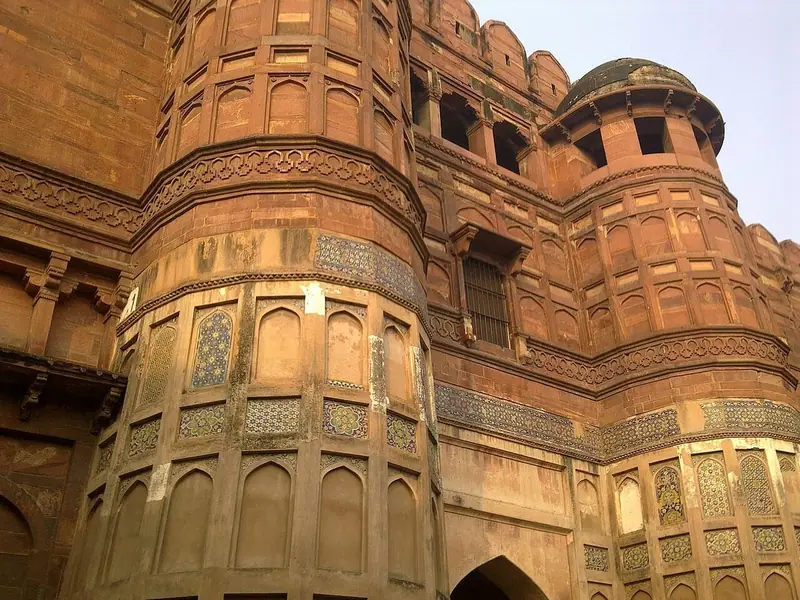 Mughal7 stops · 1565–1640s
Agra Fort audio guide
Red sandstone ramparts and marble palaces, with the Taj Mahal in view from the riverside terraces.
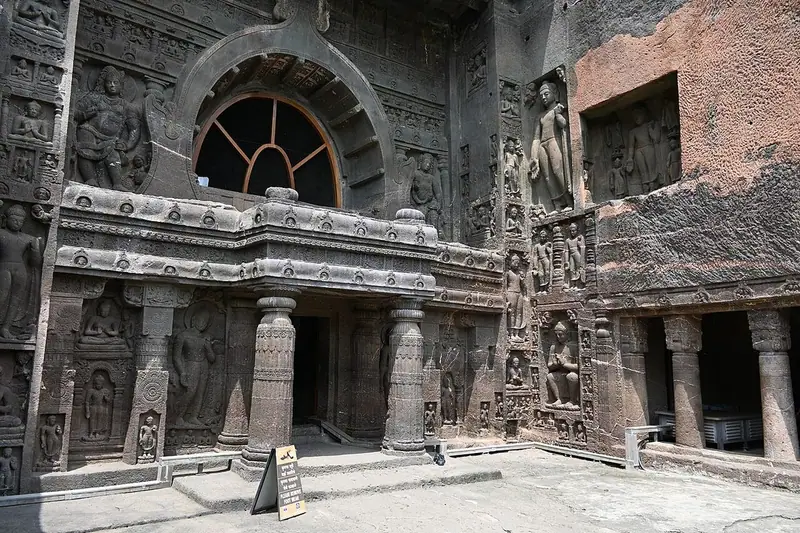 Deccan8 stops · 2nd century BCE – 5th century CE
Ajanta Caves audio guide
Thirty caves cut into a curving cliff above the Waghora river, their prayer halls and monasteries painted and carved by Buddhist monks and their patrons.
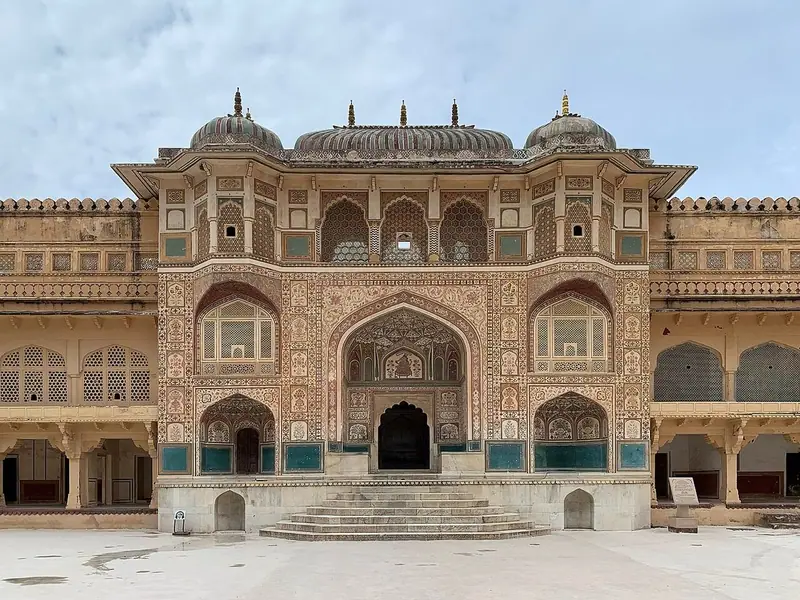 Rajput8 stops · 1592–18th century
Amber Fort audio guide
Up from Maota Lake through the great gates and courtyards to the Sheesh Mahal, palace of the Kachhwaha Rajputs.
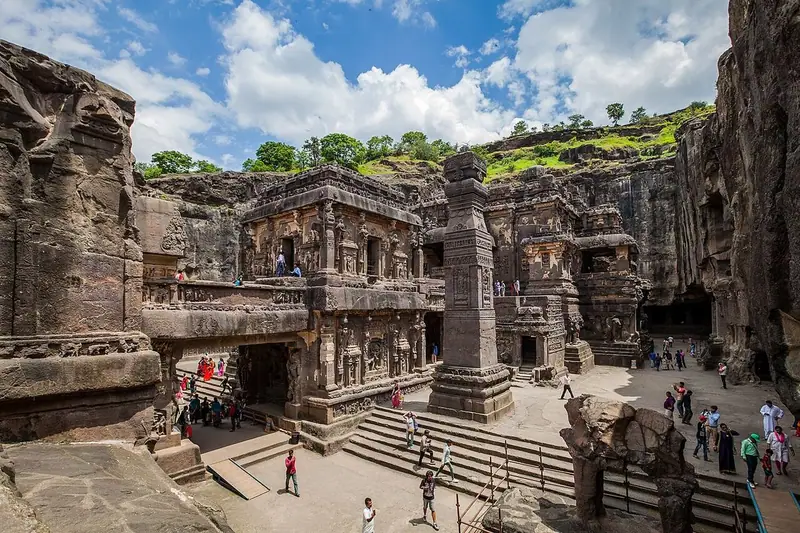 Deccan8 stops · c. 600–1000 CE
Ellora Caves audio guide
Thirty-four Buddhist, Hindu and Jain caves cut into a basalt escarpment, crowned by the Kailasa Temple.
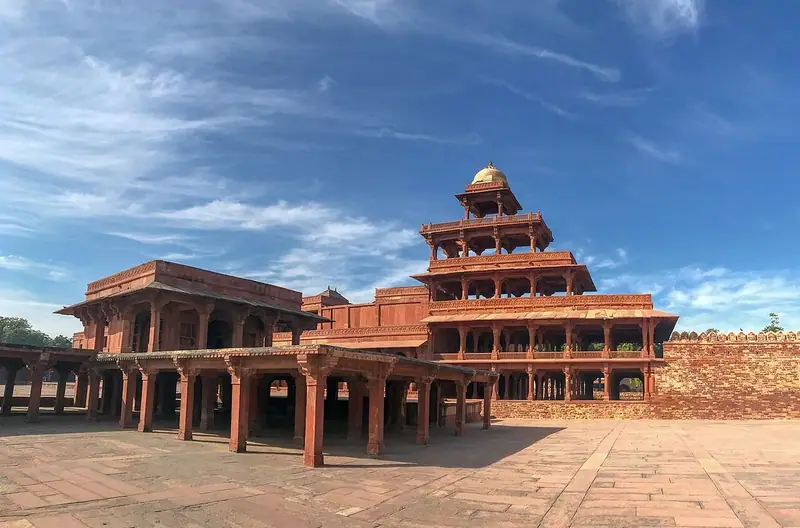 Mughal8 stops · 1571–1585
Fatehpur Sikri audio guide
Akbar’s short-lived red sandstone capital: the Panch Mahal, the Diwan-i-Khas and the tomb of Salim Chishti.
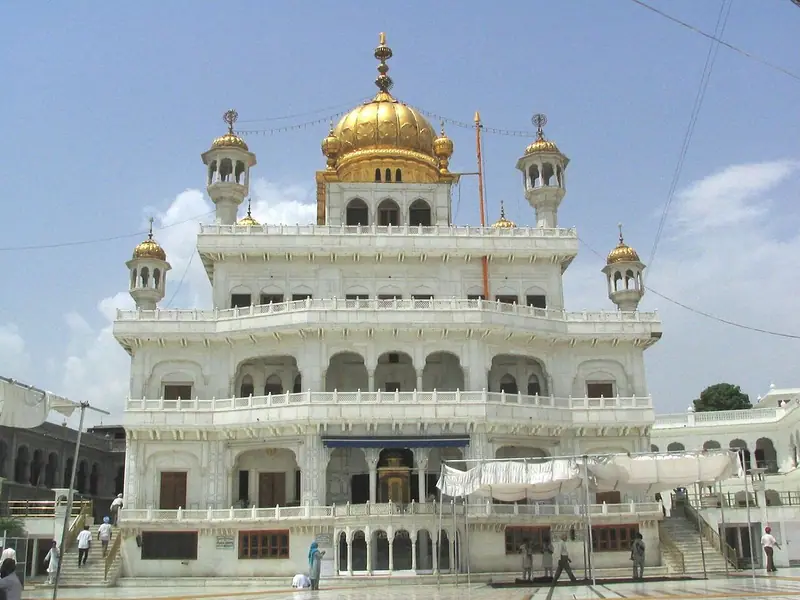 Sikh9 stops · Sikh Gurus and Sikh Empire
The Golden Temple audio guide
Follow the marble path around the sacred pool, cross the causeway to the gilded Harmandir Sahib, and share a meal at the Guru ka Langar.
Every guide, in every country
Qutb Minar and every other guide we publish, including future ones. One payment, no subscription.