Before you start
The Dohány Street Synagogue, also called the Great Synagogue, stands in the old Jewish quarter of Pest, in the seventh district of Budapest. It is the largest synagogue in Europe, with seats for nearly three thousand worshippers, and the centre of Neolog Judaism, a Hungarian tradition of reformed Judaism. It is a place of worship and of remembrance, for its courtyards hold the graves of people who died in the Budapest Ghetto, and a memorial to the hundreds of thousands of Hungarian Jews murdered in the Holocaust. This guide leads from the façade into the synagogue, then out to the Jewish Museum, the Heroes’ Temple, the cemetery and the memorial garden. Please dress modestly; men are asked to cover their heads, and visitors pass through a security check.
Use it as a self-guided tour of the Dohány Street Synagogue: 7 stops in visit order, each played when you’re ready, at your own pace.
 Free preview · Stop 1
The Façade
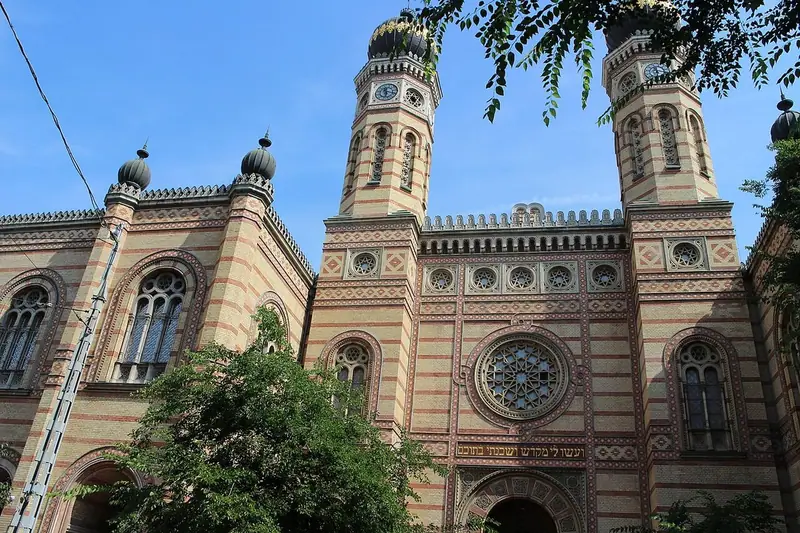
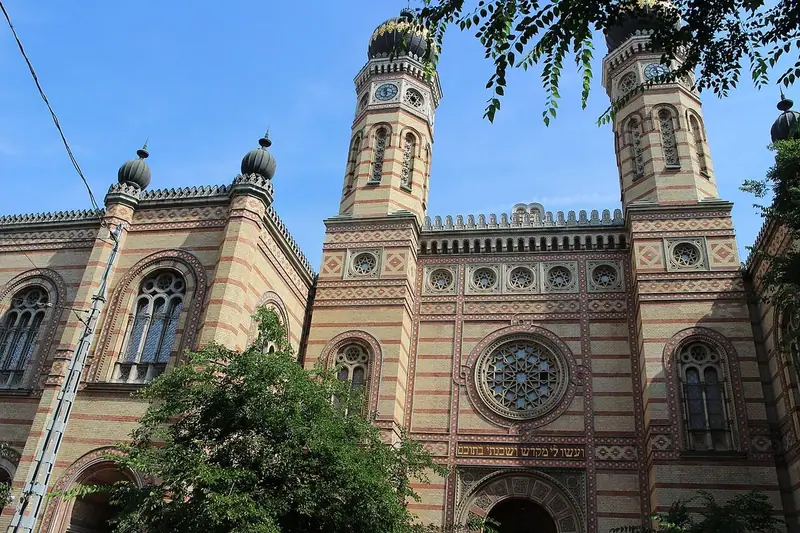
Stand in the small square in front of the synagogue and look at its striking façade. Two tall, eight-sided towers rise on either side, each crowned with an onion dome, about forty-three metres above the street. Between them, notice the great rose window over the entrance, the stone crenellations along the top, and the bands of red and yellow brick, a feature borrowed from Moorish buildings. Look for Jewish symbols in the decoration, such as the tablets of the Law. The synagogue was consecrated in September 1859, the proud work of a community that had grown in size and confidence in the nineteenth century, and wished to show its place in the life of the city. Its style inspired other synagogues, including the Central Synagogue in New York.
Photo: Suicasmo · CC BY-SA 4.0 · Wikimedia Commons
What to see at the Dohány Street Synagogue: 7 stops, in visit order
- 01
 The FaçadeMoorish TowersFree preview
- 02
 The SanctuaryA Great House of PrayerIn the guide
- 03
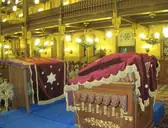 The Ark and the OrganThe Heart of WorshipIn the guide
- 04
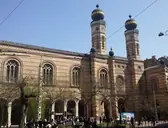 The Jewish MuseumHerzl’s BirthplaceIn the guide
- 05
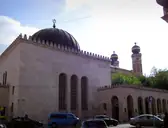 The Heroes’ TempleRemembering the FallenIn the guide
- 06
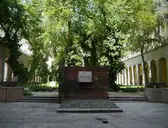 The CemeteryThe Graves of the GhettoIn the guide
- 07
 The Tree of LifeThe Memorial GardenIn the guide
History of the Dohány Street Synagogue
The synagogue was built between 1854 and 1859 by the Jewish community of Pest, to designs by the Viennese architect Ludwig Förster, with interior decoration partly by the Hungarian architect Frigyes Feszl. Förster believed there was no distinctively Jewish style of architecture, and drew on the Moorish buildings of North Africa and medieval Spain. The synagogue was damaged in the Second World War, when Dohány Street formed the edge of the Budapest Ghetto, and it was restored in the 1990s, with help from donors around the world.
Dohány Street Synagogue guide: questions
How many stops does the Dohány Street Synagogue guide have?
7 stops, in visit order: 1. The Façade; 2. The Sanctuary; 3. The Ark and the Organ; 4. The Jewish Museum; 5. The Heroes’ Temple; 6. The Cemetery; 7. The Tree of Life.
Can I do a self-guided tour of the Dohány Street Synagogue with this guide?
Yes. The guide is made for a self-guided tour: 7 stops in visit order, each with a photo, a story and a voice, so you can explore the Dohány Street Synagogue at your own pace, without joining a group. Download it before you go and it works offline.
How long is each guide?
The 7 stops add up to about 5 minutes of listening in total. You play each stop when you’re ready, so you can go at your own pace.
Does the guide work offline?
Yes, once it’s downloaded. The guide is a single self-contained web page (about 6.8 MB) with the photos, text and audio built in. Download it to your phone before you go (Wi-Fi is best); after that it opens in any modern browser on iPhone or Android, with no app, account or mobile signal needed.
Does it use GPS or need my location?
No. The guide doesn’t use GPS and doesn’t know where you are: you play each stop when you reach it. It works on iPhone and Android in any modern browser, and it’s in English.
What’s included?
One self-contained HTML guide: 7 stops in visit order, each with a photo, text and a voice, plus the story of who built the site.
Who built the Dohány Street Synagogue?
The synagogue was built between 1854 and 1859 by the Jewish community of Pest, to designs by the Viennese architect Ludwig Förster, with interior decoration partly by the Hungarian architect Frigyes Feszl. Förster believed there was no distinctively Jewish style of architecture, and drew on the Moorish buildings of North Africa and medieval Spain.
Where is the Dohány Street Synagogue?
The Dohány Street Synagogue, also called the Great Synagogue, stands in the old Jewish quarter of Pest, in the seventh district of Budapest.
Is there a free audio guide to the Dohány Street Synagogue?
The first stop, The Façade, is free to read and hear on this page, so you can try the Dohány Street Synagogue audio tour before you buy. The full guide, with all 7 stops, is a one-off purchase: download it once and it’s yours to keep, working offline.
Is the Dohány Street Synagogue guide worth it?
If you’d like to know what you’re looking at, yes. For $10 you get 7 stops in visit order, each with a photo, a short history and a voice you play when you’re ready, about 5 minutes of listening in all. It’s short on purpose, so you spend your time looking, not listening. It’s yours to keep, works offline and needs no app. The first stop is free on this page, so you can try it before you buy. If you’d like hours of detail, a guided tour will go deeper.
Audio guide or guided tour?
It depends how you like to visit. This guide lets you explore the Dohány Street Synagogue at your own pace, at any time, for a one-off price. A guided tour gives you a live expert you can ask questions, but at fixed times and usually for a higher price. Many people use both: a tour for the big picture, and the guide to read beforehand or to revisit the stops in their own time.
Is this the official Dohány Street Synagogue guide?
No. It’s an independent guide by The Historian Guide, not affiliated with or endorsed by the operator of the Dohány Street Synagogue. For tickets and opening hours, check the official site operator before you go.
Does the guide include entry tickets or opening hours?
No. The guide is a digital companion only. Admission to the Dohány Street Synagogue is separate, so check the official site operator for current tickets and opening hours before you go.
- Stop 1 · The Façade (also the cover): Suicasmo · CC BY-SA 4.0 · Wikimedia Commons · resized
- Stop 2 · The Sanctuary: Suicasmo · CC BY-SA 4.0 · Wikimedia Commons · resized
- Stop 3 · The Ark and the Organ: Bence Damokos · CC BY-SA 3.0 · Wikimedia Commons · resized
- Stop 4 · The Jewish Museum: 2jaipm · CC BY-SA 4.0 · Wikimedia Commons · resized
- Stop 5 · The Heroes’ Temple: Varius · CC BY-SA 3.0 · Wikimedia Commons · resized
- Stop 6 · The Cemetery: Zairon · CC BY-SA 3.0 · Wikimedia Commons · resized
- Stop 7 · The Tree of Life: Zairon · CC BY-SA 3.0 · Wikimedia Commons · resized


All photographs from Wikimedia Commons under the licences shown.
More guides in Hungary
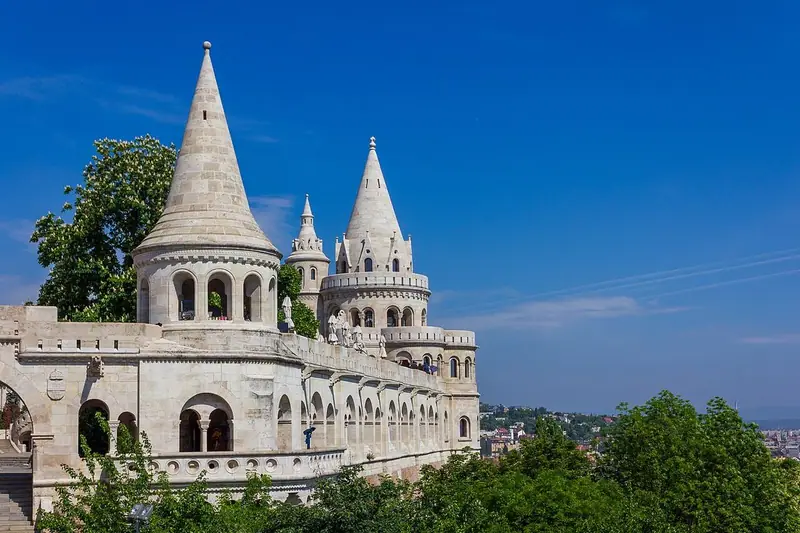 Medieval8 stops · from 1241 CE
Buda Castle Hill audio guide
Ride the funicular up to Buda’s royal ridge above the Danube for the palace of Hungary’s kings, the Matthias Church and the Fisherman’s Bastion.
 Modern Europe8 stops · 1885–1904 CE
Hungarian Parliament audio guide
Climb the grand staircase of Hungary’s Gothic Revival parliament on the Danube to the Dome Hall and the Holy Crown.
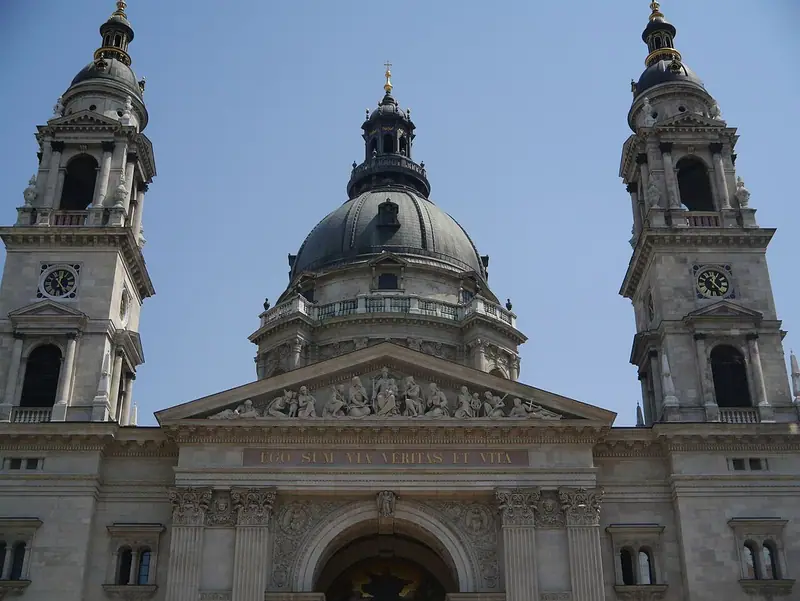 Modern Europe7 stops · 1851–1905 CE
St Stephen’s Basilica audio guide
Step under the great dome of Budapest’s largest church to see the Holy Right, then climb to the dome terrace above Pest.
Every guide, in every country
Dohány Street Synagogue and every other guide we publish, including future ones. One payment, no subscription.