Before you start
Cienfuegos lies on the southern coast of central Cuba, on the shore of a great sheltered bay, about two hundred and fifty kilometres south-east of Havana. Founded in 1819, it is one of the youngest colonial cities in Cuba, and its grid of wide streets, colonnades and pastel façades was named a World Heritage Site in 2005. The guide opens in Parque José Martí, the old parade ground, visits its arch, cathedral, theatre and palaces, follows the Prado, and ends at the Palacio de Valle on the Punta Gorda peninsula. The square is compact, but the Prado and the Malecón make a long walk. Allow half a day, or take a taxi or bicycle taxi for the last stretch.
Use it as a self-guided tour of Historic Cienfuegos: 7 stops in visit order, each played when you’re ready, at your own pace.
 Free preview · Stop 1
Parque José Martí
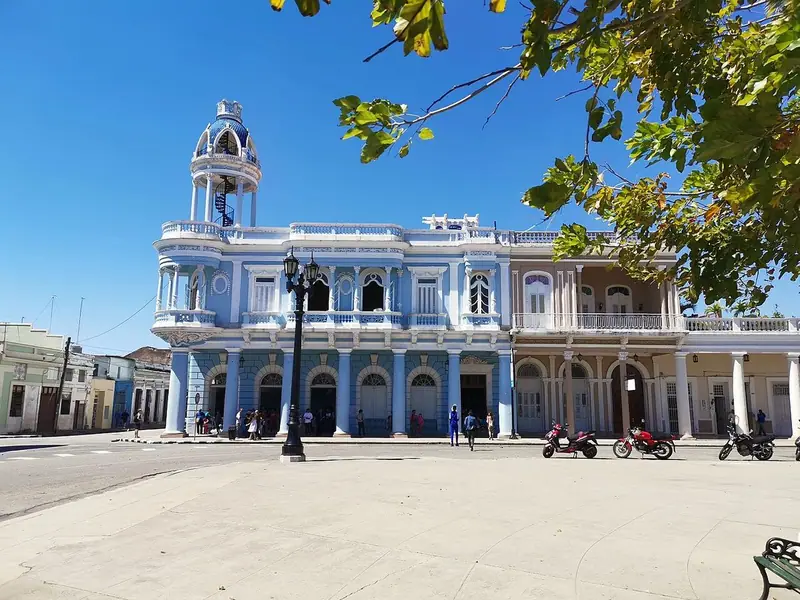
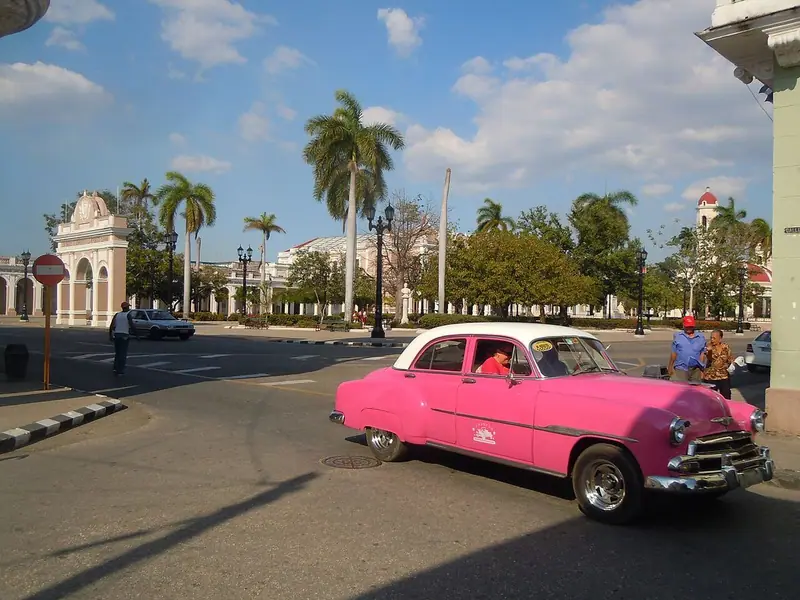
Begin in Parque José Martí, the old Plaza de Armas, where the founding of the town was made official in 1819. The first twenty-five blocks of the town were laid out around it, in a neat grid, which is why the streets of the centre are so straight and regular. Walk slowly round the square and look at the buildings that surround it, among them the cathedral, the Tomás Terry Theatre, the government palace and the Palacio Ferrer, with its domed tower. The square has carried the name of José Martí, the poet and hero of Cuban independence, since 1902. Find his statue, and the stone lions around it, and the bandstand, or glorieta, which dates from the 1920s. Notice the French names of some of the streets nearby, such as D’Clouet and Bouyón, a reminder of the town’s first settlers.
Photo: Patrice78500 · CC BY-SA 4.0 · Wikimedia Commons
What to see at Historic Cienfuegos: 7 stops, in visit order
- 01
 Parque José MartíThe founding squareFree preview
- 02
 The ArchThe workers’ archIn the guide
- 03
 Palacio FerrerThe palace with the domeIn the guide
- 04
 The CathedralThe Purísima ConcepciónIn the guide
- 05
 Tomás Terry TheatreA theatre for the sugar cityIn the guide
- 06
 The Prado and the MalecónAlong the bayIn the guide
- 07
 Palacio de ValleA Moorish fantasyIn the guide
Site map of Historic Cienfuegos
History of Historic Cienfuegos
Before the Spanish arrived, the bay was the home of a Taíno chiefdom, remembered by the name Jagua. The Spanish built a fortress at the mouth of the bay in 1745, to keep pirates out, but no town grew up until much later. On the twenty-second of April 1819, settlers from Bordeaux and Louisiana, led by Louis de Clouet, founded a town named Fernandina de Jagua. In 1829 it was renamed in honour of José Cienfuegos, a former Captain General of Cuba. The town grew rich from sugar, and later from its railway and port, and its merchants filled the centre with theatres, palaces and clubs into the early twentieth century.
Historic Cienfuegos guide: questions
How many stops does the Historic Cienfuegos guide have?
7 stops, in visit order: 1. Parque José Martí; 2. The Arch; 3. Palacio Ferrer; 4. The Cathedral; 5. Tomás Terry Theatre; 6. The Prado and the Malecón; 7. Palacio de Valle.
Can I do a self-guided tour of Historic Cienfuegos with this guide?
Yes. The guide is made for a self-guided tour: 7 stops in visit order, each with a photo, a story and a voice, so you can explore Historic Cienfuegos at your own pace, without joining a group. Download it before you go and it works offline.
How long is each guide?
The 7 stops add up to about 5 minutes of listening in total. You play each stop when you’re ready, so you can go at your own pace.
Does the guide work offline?
Yes, once it’s downloaded. The guide is a single self-contained web page (about 6.6 MB) with the photos, text and audio built in. Download it to your phone before you go (Wi-Fi is best); after that it opens in any modern browser on iPhone or Android, with no app, account or mobile signal needed.
Does it use GPS or need my location?
No. The guide doesn’t use GPS and doesn’t know where you are: you play each stop when you reach it. It works on iPhone and Android in any modern browser, and it’s in English.
What’s included?
One self-contained HTML guide: 7 stops in visit order, each with a photo, text and a voice, plus the story of who built the site.
Who built Historic Cienfuegos?
Before the Spanish arrived, the bay was the home of a Taíno chiefdom, remembered by the name Jagua. The Spanish built a fortress at the mouth of the bay in 1745, to keep pirates out, but no town grew up until much later.
Where is Historic Cienfuegos?
Cienfuegos lies on the southern coast of central Cuba, on the shore of a great sheltered bay, about two hundred and fifty kilometres south-east of Havana.
Is there a free audio guide to Historic Cienfuegos?
The first stop, Parque José Martí, is free to read and hear on this page, so you can try the Historic Cienfuegos audio tour before you buy. The full guide, with all 7 stops, is a one-off purchase: download it once and it’s yours to keep, working offline.
Is the Historic Cienfuegos guide worth it?
If you’d like to know what you’re looking at, yes. For $10 you get 7 stops in visit order, each with a photo, a short history and a voice you play when you’re ready, plus a site map of the stops, and about 5 minutes of listening in all. It’s short on purpose, so you spend your time looking, not listening. It’s yours to keep, works offline and needs no app. The first stop is free on this page, so you can try it before you buy. If you’d like hours of detail, a guided tour will go deeper.
Audio guide or guided tour?
It depends how you like to visit. This guide lets you explore Historic Cienfuegos at your own pace, at any time, for a one-off price. A guided tour gives you a live expert you can ask questions, but at fixed times and usually for a higher price. Many people use both: a tour for the big picture, and the guide to read beforehand or to revisit the stops in their own time.
Is this the official Historic Cienfuegos guide?
No. It’s an independent guide by The Historian Guide, not affiliated with or endorsed by the operator of Historic Cienfuegos. For tickets and opening hours, check the official site operator before you go.
Does the guide include entry tickets or opening hours?
No. The guide is a digital companion only. Admission to Historic Cienfuegos is separate, so check the official site operator for current tickets and opening hours before you go.
- Stop 1 · Parque José Martí: Patrice78500 · CC BY-SA 4.0 · Wikimedia Commons · resized
- Stop 2 · The Arch: nurzumspass · CC BY-SA 3.0 · Wikimedia Commons · resized
- Stop 3 · Palacio Ferrer (also the cover): Afanasovich · CC BY 4.0 · Wikimedia Commons · resized
- Stop 4 · The Cathedral: Toutaitanous · CC BY-SA 3.0 · Wikimedia Commons · resized
- Stop 5 · Tomás Terry Theatre: Burkhard Mücke · CC BY-SA 4.0 · Wikimedia Commons · resized
- Stop 6 · The Prado and the Malecón: Patrice78500 · CC BY-SA 4.0 · Wikimedia Commons · resized
- Stop 7 · Palacio de Valle: Joe Ross from Lansing, Michigan · CC BY-SA 2.0 · Wikimedia Commons · resized


All photographs from Wikimedia Commons under the licences shown.
More guides in Cuba
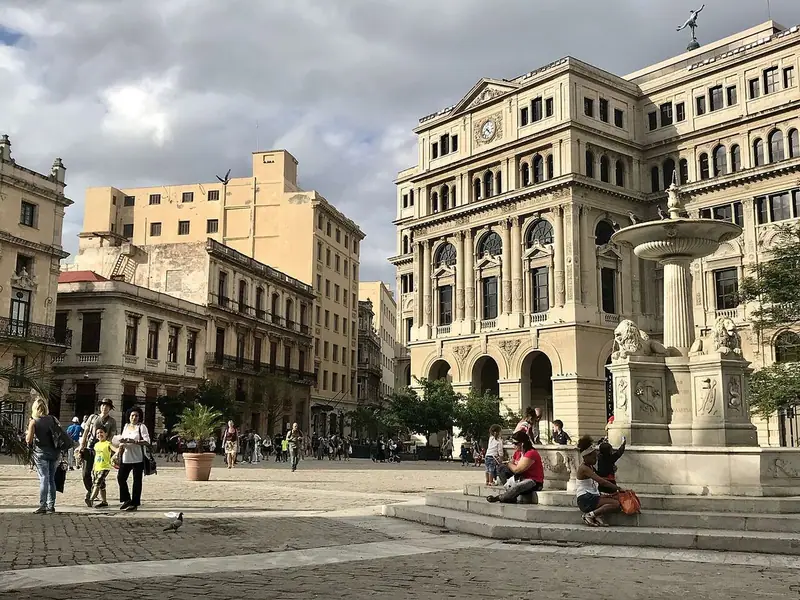 Spanish Colonial8 stops · 1519 – early 20th century
Old Havana audio guide
Link the great squares of Old Havana, from the cathedral and the Plaza de Armas along Calle Obispo to El Capitolio.
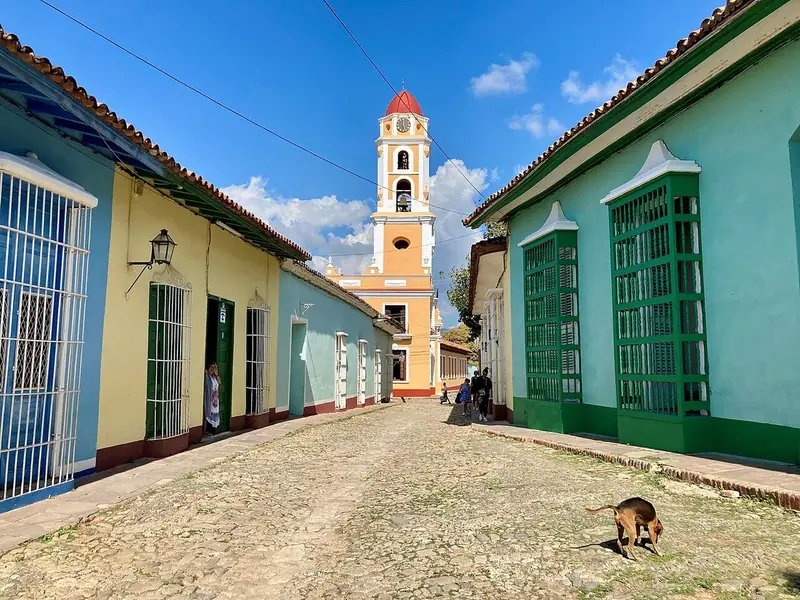 Spanish Colonial7 stops · 1514–1886
Trinidad audio guide
The cobbled streets of one of the Caribbean’s best-preserved colonial towns, from the Plaza Mayor to the mansions of the sugar barons.
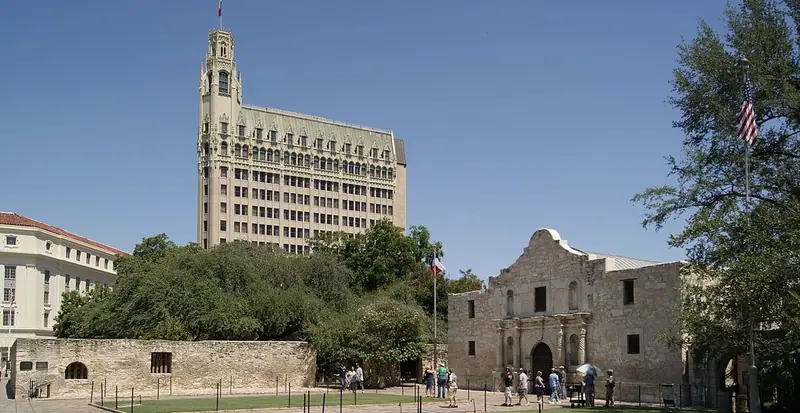 Spanish Colonial7 stops · 1718–1782
Alamo and San Antonio Missions audio guide
From the battle-scarred Alamo to Mission San José and the Espada Aqueduct, the five missions that made San Antonio.
Every guide, in every country
Historic Cienfuegos and every other guide we publish, including future ones. One payment, no subscription.