Before you start
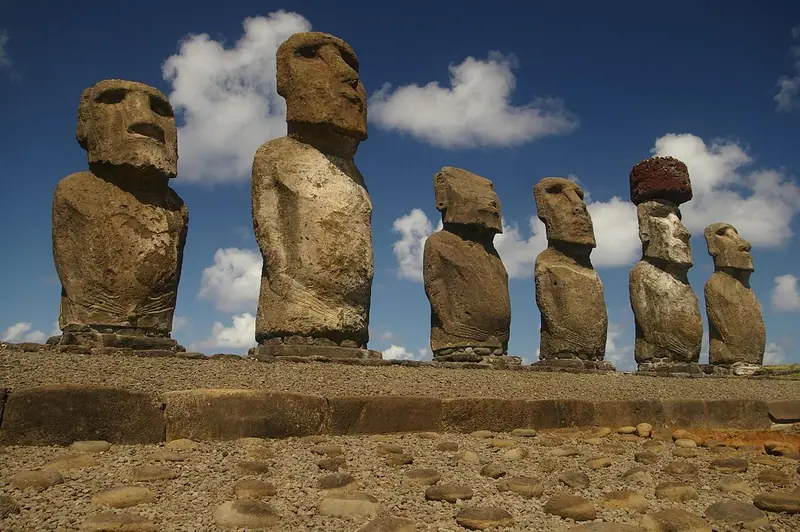
Rano Raraku is the volcanic crater where the people of Rapa Nui carved almost all of their great stone statues, the moai. A short distance away stands Ahu Tongariki, the largest ceremonial platform on the island, with its row of fifteen restored moai. Both lie in Rapa Nui National Park, a UNESCO World Heritage Site, cared for by the Maʻu Henua indigenous community. Visitors must hold a park ticket and be accompanied by an accredited guide, and Rano Raraku may be visited only once on each ticket. Stay on the marked paths, never touch or climb on the moai, and bring water, a hat and sun cream, as there is little shade.
Use it as a self-guided tour of Rano Raraku and Ahu Tongariki: 8 stops in visit order, each played when you’re ready, at your own pace.
 Free preview · Stop 1
Rano Raraku
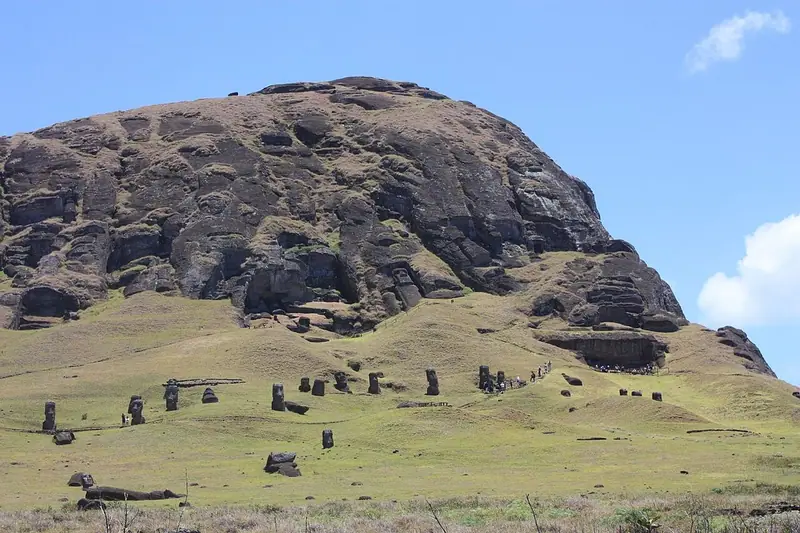
Begin below Rano Raraku, and look up at the volcanic crater, its steep cliffs rising above a grassy slope dotted with dozens of moai. The crater is made of consolidated volcanic ash, called tuff, which was soft enough to carve with stone tools, yet strong enough to last for centuries. About eight hundred and eighty-seven moai remain at Rano Raraku, in every stage of making, from faint outlines on the rock to finished statues standing on the slopes. That is nearly half of all the moai on the island. Notice how the statues seem to emerge from the hillside. In October 2022, a fire swept across this area and blackened many of the moai, a reminder of how fragile this place is. Follow your guide round into the crater first.
Photo: Arian Zwegers · CC BY 2.0 · Wikimedia Commons
What to see at Rano Raraku and Ahu Tongariki: 8 stops, in visit order
- 01
 Rano RarakuThe Mountain of the MoaiFree preview
- 02
 The Crater LakeInside the VolcanoIn the guide
- 03
 The Quarry SlopesThe Moai FactoryIn the guide
- 04
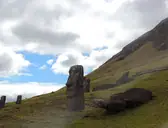 The Buried HeadsFaces in the GroundIn the guide
- 05
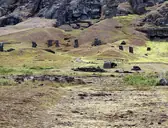 The Unfinished GiantsStill in the RockIn the guide
- 06
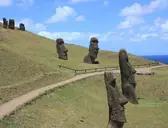 The Paths of the MoaiMoving the StatuesIn the guide
- 07
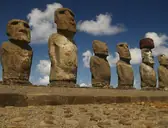 Ahu TongarikiThe Fifteen MoaiIn the guide
- 08
 Destruction and RestorationRaised AgainIn the guide
Site map of Rano Raraku and Ahu Tongariki
History of Rano Raraku and Ahu Tongariki
Polynesian voyagers settled Rapa Nui, one of the most remote inhabited islands in the world, many centuries ago. Over several hundred years, they carved the moai, which are thought to represent deified ancestors, and set many of them on stone platforms called ahu around the coast. Rano Raraku was a quarry for about five hundred years, until the early eighteenth century, and it supplied the stone for about ninety-five per cent of the island’s known moai. By the nineteenth century, all of the moai on the platforms had been toppled, perhaps in conflicts between clans. Many have since been raised again by archaeologists, working with the Rapa Nui community.
Rano Raraku and Ahu Tongariki guide: questions
How many stops does the Rano Raraku and Ahu Tongariki guide have?
8 stops, in visit order: 1. Rano Raraku; 2. The Crater Lake; 3. The Quarry Slopes; 4. The Buried Heads; 5. The Unfinished Giants; 6. The Paths of the Moai; 7. Ahu Tongariki; 8. Destruction and Restoration.
Can I do a self-guided tour of Rano Raraku and Ahu Tongariki with this guide?
Yes. The guide is made for a self-guided tour: 8 stops in visit order, each with a photo, a story and a voice, so you can explore Rano Raraku and Ahu Tongariki at your own pace, without joining a group. Download it before you go and it works offline.
How long is each guide?
The 8 stops add up to about 5 minutes of listening in total. You play each stop when you’re ready, so you can go at your own pace.
Does the guide work offline?
Yes, once it’s downloaded. The guide is a single self-contained web page (about 7.0 MB) with the photos, text and audio built in. Download it to your phone before you go (Wi-Fi is best); after that it opens in any modern browser on iPhone or Android, with no app, account or mobile signal needed.
Does it use GPS or need my location?
No. The guide doesn’t use GPS and doesn’t know where you are: you play each stop when you reach it. It works on iPhone and Android in any modern browser, and it’s in English.
What’s included?
One self-contained HTML guide: 8 stops in visit order, each with a photo, text and a voice, plus the story of who built the site.
Who built Rano Raraku and Ahu Tongariki?
Polynesian voyagers settled Rapa Nui, one of the most remote inhabited islands in the world, many centuries ago. Over several hundred years, they carved the moai, which are thought to represent deified ancestors, and set many of them on stone platforms called ahu around the coast.
Where is Rano Raraku and Ahu Tongariki?
Rano Raraku is the volcanic crater where the people of Rapa Nui carved almost all of their great stone statues, the moai.
Is there a free audio guide to Rano Raraku and Ahu Tongariki?
The first stop, Rano Raraku, is free to read and hear on this page, so you can try the Rano Raraku and Ahu Tongariki audio tour before you buy. The full guide, with all 8 stops, is a one-off purchase: download it once and it’s yours to keep, working offline.
Is the Rano Raraku and Ahu Tongariki guide worth it?
If you’d like to know what you’re looking at, yes. For $10 you get 8 stops in visit order, each with a photo, a short history and a voice you play when you’re ready, plus a site map of the stops, and about 5 minutes of listening in all. It’s short on purpose, so you spend your time looking, not listening. It’s yours to keep, works offline and needs no app. The first stop is free on this page, so you can try it before you buy. If you’d like hours of detail, a guided tour will go deeper.
Audio guide or guided tour?
It depends how you like to visit. This guide lets you explore Rano Raraku and Ahu Tongariki at your own pace, at any time, for a one-off price. A guided tour gives you a live expert you can ask questions, but at fixed times and usually for a higher price. Many people use both: a tour for the big picture, and the guide to read beforehand or to revisit the stops in their own time.
Is this the official Rano Raraku and Ahu Tongariki guide?
No. It’s an independent guide by The Historian Guide, not affiliated with or endorsed by the operator of Rano Raraku and Ahu Tongariki. For tickets and opening hours, check the official site operator before you go.
Does the guide include entry tickets or opening hours?
No. The guide is a digital companion only. Admission to Rano Raraku and Ahu Tongariki is separate, so check the official site operator for current tickets and opening hours before you go.
- Stop 1 · Rano Raraku: Arian Zwegers · CC BY 2.0 · Wikimedia Commons · resized
- Stop 2 · The Crater Lake: TravelingOtter · CC BY 2.0 · Wikimedia Commons · resized
- Stop 3 · The Quarry Slopes: Rivi · CC BY-SA 3.0 · Wikimedia Commons · resized
- Stop 4 · The Buried Heads: Mbmerino · CC BY-SA 3.0 · Wikimedia Commons · resized
- Stop 5 · The Unfinished Giants: LBM1948 · CC BY-SA 4.0 · Wikimedia Commons · resized
- Stop 6 · The Paths of the Moai: Arian Zwegers · CC BY 2.0 · Wikimedia Commons · resized
- Stop 7 · Ahu Tongariki (also the cover): Rivi · CC BY-SA 3.0 · Wikimedia Commons · resized
- Stop 8 · Destruction and Restoration: Claire Provost · CC BY-SA 3.0 · Wikimedia Commons · resized


All photographs from Wikimedia Commons under the licences shown.
More guides in Chile
 Rapa Nui8 stops · from c. 1200 CE
Anakena and the North of Rapa Nui audio guide
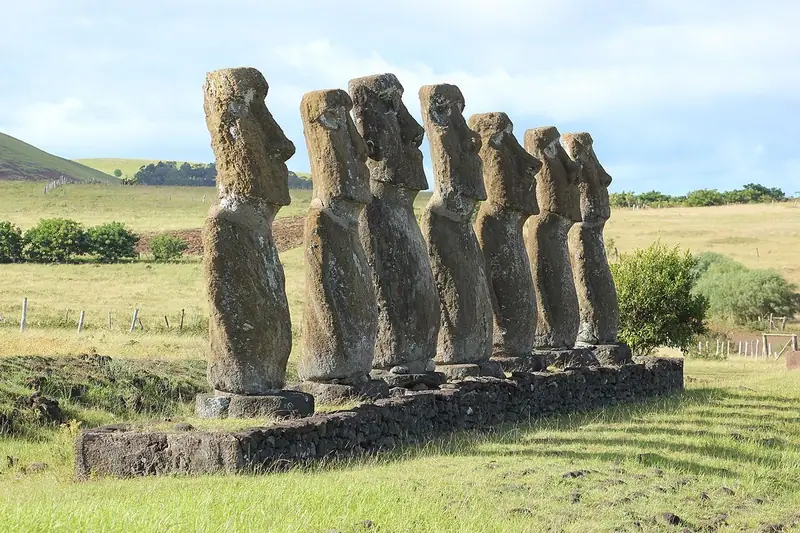
Cross Rapa Nui from the red topknot quarry of Puna Pau and the seven moai of Ahu Akivi to the white sand of Anakena, where tradition says Hotu Matuʻa landed.
 Rapa Nui7 stops · 18th – mid-19th century CE
Orongo and Rano Kau audio guide
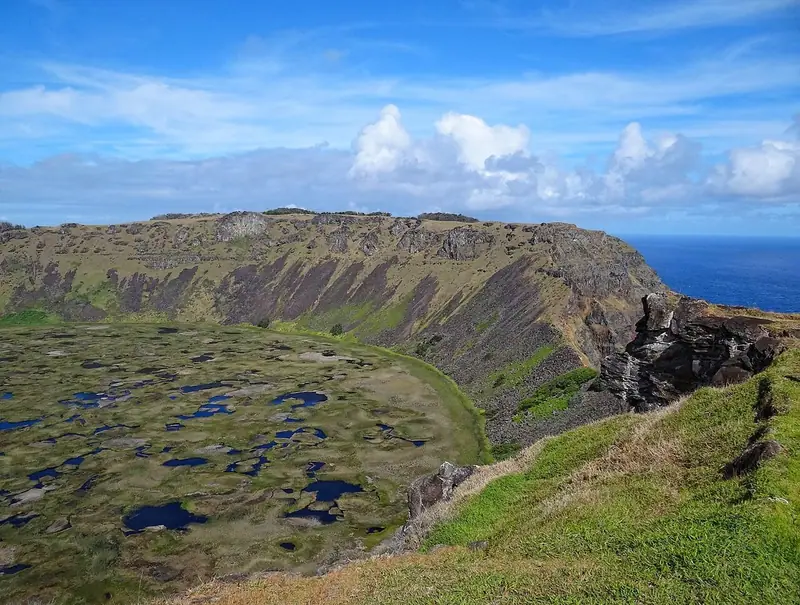
Look into the vast reed-filled crater of Rano Kau, then walk the stone houses of Orongo, centre of the birdman contest for the first sooty tern egg.
 Modern9 stops · late 19th – early 20th century
Valparaíso audio guide
Chile’s historic port, with its civic squares, Prat Pier, funicular lifts and the colourful hillside quarters of Cerro Concepción and Cerro Alegre.
Every guide, in every country
Rano Raraku and Ahu Tongariki and every other guide we publish, including future ones. One payment, no subscription.